During 1915 occasional murmurs of discontent about the Belgian refugees had arisen especially in their contribution to the war effort, and in the lack of workers in particular industries. However restrictions were placed on the employment of refugees in some capacities.
Life in Teignmouth like everywhere had its ups and downs, in nearby Torquay in May a Belgian refugee who had fled from Antwerp attempted to take his own life.
Meanwhile at the Assembly Rooms in Teignmouth a happier event was taking place a "Belgian Concert".
"A concert was given by eminent Belgian artistes in aid of the British Society for the Relief of Wounded Belgian Soldiers.
Every item was loudly applauded, and a large audience showed every manifestation of delight at the really admirable programme presented, the items being of a high standard of excellence. Miss Lynne was responsible for the arrangements."
Teignmouth Post
27th May 1916
A few days later there was another report, a boxed item headed, in large type, BELGIAN REFUGEES the following statement read:
"Much anonymous information has reached us as to the expressions of joy openly made AT ANY NEWS ADVERSE TO ENGLAND and her Allies, by the Refugees in our town.
If these anonymous informants will WRITE full particulars of what they have seen or heard, and SIGN SAME, we shall be pleasedto take the matter up with a view to having these undesirables removed from our town".
Teignmouth Post
June 9th 1916
Presumably the informants were not prepared to surrender their anonymity as no further reports in the paper occurred.
In June an inquest was being held in to a body found on the beach at Teignmouth and Joseph Bus (diamond polisher) a Belgian refugee living at 47, Teign Street gave evidence. He stated he noticed the body from the sea wall on Friday last (16.06.16)."It was partly in the water and about 60 yards from Spray point".
Periodically reports from other parts of the country concerning Belgian refugees confirmed the view that they were still viewed with a mixture of suspicion and fear for example a report from 30.06.1916 concerned 5 Belgian refugees in Enfield charged with being drunk and disorderly and also refusing to work. Also in June two Belgian Refugees from Teignmouth were charged with being drunk in Union Street, Newton Abbot. Yohef Meeiman and Gilton Vernyer admitted to getting "a little drunk" explained through the interpreters. P.C. Goodman said they were rambling and as they were incapable of returning to Teignmouth they were locked up. The two had come to Newton Abbot to visit another Belgian who worked there and having a few pints overstepped the mark. Ordered to pay cost of 4s.6d.
In Shaldon, three Belgian refugees assisted in making flags and banners to decorate Embankment Road as part of an entertainment for wounded soldiers. Both items indicate an event by some Belgian refugees to integrate themselves in local events. In a similar vein two Grand Concerts were held at the Assembly Rooms Teignmouth in aid of wounded Belgian soldiers. The concerts were organised by the grandly named Belgian Artistes Committee and featured 7 leading Belgian artistes including Juliette Autran formerly of the Brussels Opera company and now with the Beecham Opera company.
However, in September an 18 year old refugee Lewis Tuyman was charged with stealing 60lbs of coal from Renwick, Wilton and Co. Ltd of Shaldon an event which raised some of the incipient hostility towards the Belgian refugees. The company must already have suspected coal was being stolen by Belgian refugees as there were notices displayed in Flemish saying not to take the coal. At the court hearing it appeared that Lewis may have been a scapegoat acting for another Belgian "ringleader". The unknown ringleader and Lewis started to steal coal as a boat was unloading and fought with the Renwick, Wilton employee who then ran off, the coal was then loaded into sacks and removed. As the evidence was being given with Cornelius L. Peters of Teignmouth interpreting, Lewis's mother "Throwing up her arms went off in hysterics" and had to be led from court. Evidence was given by 12 year old Eliza Van Dyk who said she had seen the defendant take a little coal dust.
Mr Tuyman pleaded not guilty and explained that he had received his call up papers and would join the Belgian army on October 1st, as a result of this information the case was adjourned for 2 months.
Also in September at an exemption tribunal (held to determine whether employees were essential to work at home) Ponsford's Bakers sought exemption from call up for his assistant. In his evidence he claimed other bakers were using Belgian refugees (presumably at low wages) but his exemption plea was reduced.
Some house owners in Teignmouth were financially benefitting from Belgian refugees staying and in October 1916 other house owners were expecting 2000 troops which again would have offered financial assistance. However, according to the Teignmouth Post " a huge row broke out" as the troops they were expecting had failed to turn up "because the council had been negligent in offering its public facilities to the military authorities".
Some of the Belgian refugees in Teignmouth and Shaldon were about to spend their third Christmas in a foreign country and perhaps they were the lucky ones as news coming out of Belgium during 1916 was not good.
The aftermath of the Battle of Verdun in 1916 marked a turning point in the occupation of Belgium. In August 1916, the German administration began actively considering the idea of forcibly deporting Belgian workers to Germany. The policy, encouraged by the high levels of unemployment in occupied Belgium, marked a wider turn towards more oppressive rule by the German administration.
From the time of the invasion, significant numbers of Belgian men had attempted to flee the occupied territories to join the Belgian army on the Yser front, via the Netherlands which were neutral.
In order to stop this, the Germans began work on a barbed wire and electric fence across the length of the border. Between 2,000 and 3,000 civilians are believed to have been killed attempting to cross the border during the conflict.
Resistance to the German Occupation involved many people in Belgium, perhaps most prominent among them was Gabrielle Petit. She proceeded to collect information about enemy troop movements using a number of false identities.
She was also an active distributor of the clandestine newspaper La Libre Belgique and assisted the underground mail service "Mot du Soldat". She helped several more young men across the Dutch border.
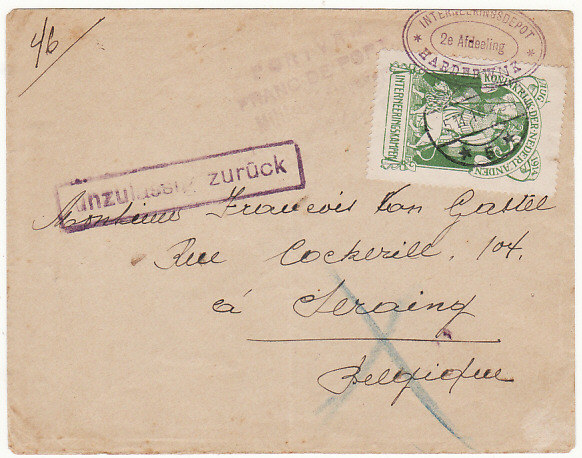
On 1 April 1916, Gabrielle Petit was, at the insistence of German military, shot by a firing squad. Petit's story remained unknown until after the war, when she began to be seen as a martyr for the nation. A statue of Petit was erected in Brussels and this was said to be the first of a working-class woman. In her native Tournai, a square was named after her. Knowledge of what was actually happening at home in Belgium was largely unknown to the refugees in Teignmouth and Shaldon compounded by large amounts of returned mail.
