As the war continued supplies of food to Britain were severely affected by the intervention of German submarines (U-Boats) which targeted ships bound for the British Isles with the aim of cutting off supplies in the hope that the British would be starved in to submission.
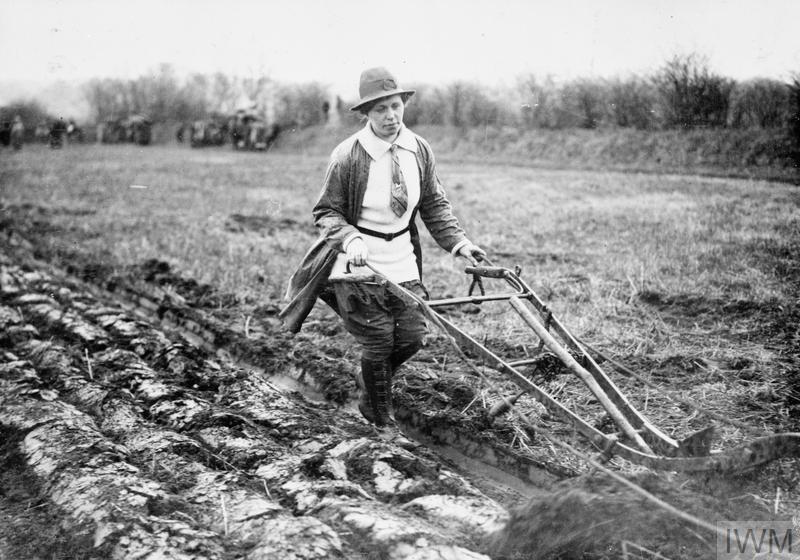 A member of the Women's Land Army operating a single-furrow plough on a British farm. © IWM (Q 54607)
With so many men away fighting battles in Europe increasing numbers of women were recruited to work on the land and fill the positions vacated by those at the Front.
The work was extremely hard particularly as farm horses which had, until the start of the war, been responsible for much of the heavy work on farms, had been requisitioned and sent overseas as part of the war effort.
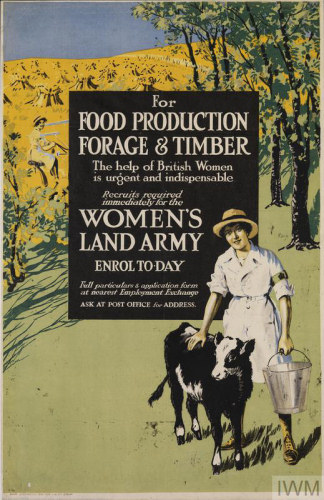 Land Army Poster © IWM (Art.IWM PST 5489)
During the war years tractors were introduced for the first time to take over some of the work (such as ploughing) that had previously fallen to the horses. Fuel restrictions however meant that manual physical labour unavoidable.
In addition to regular farming activity, the population was encouraged to dig up green spaces in which food could be grown.
Allotment Battles in Teignmouth
Newspaper articles from the Devon and Exeter Gazette (DEG) and the Western Times reporting the Teignmouth Urban District Council and other meetings provide an insight in to the struggle and local disagreements that arose as land for food production was proposed (and often rejected) in the Teignmouth and Shaldon area:
Finding land for allotments
Teignmouth
Mr W.B. Harris presided over yesterday’s meeting of Teignmouth Council. The Sub-Committee appointed to deal with all questions affecting the food supply, reported having received applications for allotments, but as there was no suitable land available in Teignmouth, no further action in the matter was desirable at present. With regard to Shaldon, it was decided to write to Lord Clifford’s agent with reference to the gardens behind two unoccupied houses in Ringmore-road being made available for allotments, and that the Chairman (Mr Slater) and Mr Follett were asked to interview the Trustees of the land known as the Recreation Ground, all arrangements for lettings to be left to the Trustees.
Mr Slater said the Committee regretted that they could not find any suitable land in Teignmouth.
Mr Full said he did not know what powers they had. What lands were the Council open to take? The Clerk (Mr A.P. Dell) Only land that is not rated to the poor rate.
Mr Full said it seemed very unfortunate when there was such a great outcry for the production of food, that there was no land available.
The Clerk said they had a certain number of applications, which were mostly from railway men, who wanted land at West Teignmouth. The Railway Company, however, had offered the men land for allotments free of cost. The others wanted land near their houses.
The Clerk said as regarded taking land that was suitable by compulsion the Committee went into the matter, and came to the conclusion that there was no land available that was not rated.
Mr Full: It seems to be an absurdity of the Local Government Board to make such a suggestion.
The Clerk said that undoubtedly in some districts they might have building estates which were not being used for agricultural purposes, and where there was a working class population that could take the land.
Mr Full: As against that I understand there is a great deal of land that is not being turned to best account, and over which the Sub-Committee had no control.
Mr Young said the Sub-Committee went into the matter thoroughly, and they found that the land in Teignmouth was practically highly cultivated either for milk production or for gardens. There was not a yard of land in Teignmouth that the Sub-Committee were aware of that they could take compulsorily. They considered that if they did take any land they would only be destroying good pasture and also interfering with the milk supply. They saw nothing in Teignmouth to encourage them to go on with the scheme.
How does that apply to the field above the cemetery? asked Mr Full
Mr Young: That is being cultivated. If Mr Full knows of any land the Committee will be glad to hear of it.
Mr Full: People don’t realise the possible grave necessity that the country is likely to be in with regard to food provision in the future.
Mr Young: If we have not got the land it is no use talking about it.
Mr Foster asked if it was not possible to get the land and gardens of unoccupied houses in Teignmouth.
The Clerk: Not compulsorily.
Mr Foster: Would not the owners put the gardens at the disposal of the Council?
The Clerk: there are few unoccupied houses of that description.
The report was adopted.
DEG of 7 Feb (p. 3) expands on the issue. The Clerk replied that they had only powers to acquire land compulsorily which was not previously rated. A certain number of applications for land were received, but not very many. There were ten or twelve railway men who applied but the Great Western Railway Company had offered them land for allotments.
Mr Foster: How many were sent in – fourteen?
The Clerk: More than that. Most of the applicants wanted land close to their houses. The men working for the Railway Company had been accommodated with land in West Teignmouth and had obtained the land under circumstances which were quite as advantageous, or even more so, than the Council could have arranged. As regarded the land, it must be remembered that all land was rated unless absolutely barren.
Western Times
Digging up the school lawn
Teignmouth. The inert manner in which the Teignmouth Urban District Council has treated the question of providing allotments for the town was freely criticised at a meeting of the working men held at the West Lawn School on Tuesday. Mr J. Nicholls presided.
This week the scholars of the West Lawn Council School have been engaged digging up the lawn for the planting of potatoes. Plots have been allotted the lads in the higher standards.
Western Times
The growing demand for allotments
The question of allotments was again the subject of discussion at yesterday’s meeting of the Teignmouth Urban Council, over which Mr W.B. Harris presided. The Subcommittee appointed to deal with questions relating to food reported that an application for leave to keep pigs less than 300 ft from a dwelling-house had been granted, subject to the pig-stye being kept clean and in proper condition. the Committee had resolved to reply to a letter received from the Board of Agriculture, enclosing copy of an anonymous letter received by the Board with reference to allotments, and point out that the allegations contained in that communication had no foundation. They had further instructed the Clerk to write Mrs Little, tenant of the Council’s field adjoining the cemetery, inquiring what portion of the field she was prepared to cultivate in the growing of potatoes an vegetables. The consideration of letting the remainder of the field for allotments was referred to a further meeting of the committee. The Clerk had also been requested to write to Mr H.C. Full, solicitor to the Trustees of the Shaldon Recreation Ground, asking him to do his best to arrange for the whole or part of such land to be let for allotments, all arrangements for such letting to be left to the Trustees.
At a subsequent meeting of the Sub-Committee Dr F.E. Little appeared before the Committee with reference to the cemetery field, and stated that Mrs Little had already gone to considerable expends in regard to the cultivation of a portion of the cemetery field, and upon this the Sub-Committee resolved that no steps be taken to let any part of the field for allotments. Mr J. Berry, of Exeter road, by invitation, appeared before the Sub-Committee and presented a memorial, on behalf of 56 residents, urging the provision of allotments by the Council, and reported that his Committee had failed in their efforts to get such allotments. The Sub-Committee approved of the action of the Clerk in writing Mrs Paul, Barnsley, Teignmouth and Messrs Robert Frost and Son, agents for Mr Butterfield, owner of the Winterbourne Estate, with a view to two fields suggested by the memorialists being acquired for allotments.
Mr J.W.G. French asked for a statement from the Clerk in regard to the memorial and the position as regards allotments generally
The Clerk, in doing so, denied the statements which, he said, had appeared in the Press to the effect that he had advised the Council not to elect outsiders on the Sub-Committee appointed to deal with the food question. It had also been suggested that the Council were not taking any steps in the matter, and he thought it was due both to the ratepayers and the Council that he should make a statement on it. It must be remembered that the Council had only compulsory powers as regards land that was not being used. They could only touch land if it was not being used in connexion with the milk supply or not being cultivated. What was done in regard to the memorial was this: Some time ago the Council advertised to know how many applicants wanted allotments. There were 22 replies, he believed, and of these eleven were from men working for the railway, and they got allotments from the GWR. The others wanted their allotments close to their houses. In the meantime he (the Clerk) learnt that a Committee had been formed to try and get land. None of the Committee asked the Council for land until it was found impossible to get it. Then Mr Berry told them they could not get land, and asked if the Council could obtain it. Mr Berry the next day came before the Council and explained the matter to them. that was the first time the Council had been approached by members of the Committee. Three people had been approached to allow some of their land to be used, but all had refused. There was one site the Council might be able to acquire, but the owner had absolutely refused to consent. Before the Council could acquire it they would have to communicate with the County War Ag Committee, and he hoped the County Committee would grant them the right. There was another site on Mr Lake’s farm at Coombe, where five people could be accommodated, and he hoped, in this case, as Mr Lake had expressed his willingness to let the land provided it was properly manured, a direct arrangement could be made between the people and Mr Lake.
Devon and Exeter Gazette (p.3),
Five acres secured for growing potatoes
The allotments question at Teignmouth seems to be settled for this year. Mr G. Lake, of Coombe Farm, has placed a field of five acres situate in Paddon’s-lane at the disposal of a committee for the purpose of growing potatoes for this year only. The field is already ploughed, and the rent asked is £1 an acre, Mr Lake paying rates. The offer was discussed at a meeting of men, held at the Council Chamber, Thursday, when promises to take half of the field for allotments was made. The holders are to provide manure and be prepared to give up the ground at the end of the year. Messrs J. Berry, C. Abbottt, J. Sankey and J. Nicholls were appointed as a committee to make the necessary arrangements. Mr A.P. Dell was thanked for his interest in the matter, and, in reply, said he was breaking up the lawn in front of his house for the purpose of planting potatoes.
Western Times
A proposal about the plant-houses on the Den
Teignmouth Urban Council … Mr W.H. Harris presiding …
Miss E.A. Langley, Teignmouth, wrote asking if the Council had considered the advisability of growing early potatoes and tomatoes of sale in place of flowers in the plant-houses on the Den this year, in view of the scarcity of vegetables. Having regard to the size of the plant houses, the Council replied that they considered the suggestion impracticable.
The Sub-Committee appointed to deal with the food supply etc., reported having assisted in negotiations whereby an outside Allotments Committee had procured from Mr G. Lake, Coombe Farm, a five acre field at £1 per acre, to be tilled solely for potatoes. The Committee appreciated Mr Lake’s generosity in placing the land at the disposal of the Allotments Committee at a loss to himself. In view of that arrangement, the Committee withdrew the application to the Devon War Agricultural Committee to compulsorily take Mrs Paul’s field. In view of the statements that had been made as to the failure of the Council to provide allotments, the Committee wished to emphasis the fact that those who had been provided with allotments omitted to apply to the Council as asked, because they were endeavouring to obtain permanent allotments, and that had they approached the Council in the first instance there was little doubt that the arrangements which were now made could have been made a considerable time ago.
Devon and Exeter Gazette
Flooding in Ringmore Road, Shaldon
Teignmouth Urban Council, Mr W.B. Harris presiding. The Surveyor (Mr F.W. Knight) reported on complaints he had received as to alleged flooding with tidal water from the Council’s storm water systems of certain allotments in Ringmore Road, Shaldon, and on the claims for alleged damage to crops. As the result of his investigations the Council decided to repudiate the claims.
Western Times
School crops a success despite butterfly damage
Teignmouth School Managers, Rev J. Veysey presiding …Mr W.J.B. Banbury reported that the crops on the allotments had been most successful. Mr Dominy and the boys were to be congratulated. Rev B.B. Liptrott said a lady who was interested in the crops of the boys had taken notice of the serious damage done by butterflies and caterpillars, and she was willing to give £1, to be divided amongst the children at 1s for each hundred butterflies or caterpillars caught. The pest this year was due to doing away with the Wild Bird Protection Act. The offer was accepted with thanks, and Mr Dominy (headmaster) asked to superintend the matter.
DEG of same date, p,4, names the school as West Lawn School
Devon and Exeter Gazette
Horticultural instruction
Teignmouth. Mr C. Berry, instructor in horticulture to the Devon County Council, gave the first of a series of lectures in the Town Hall on the cultivation of allotments. Out of an attendance of about 20 half were ladies. Mr Berry advised those present to peg away at the Urban District Council with a view to their providing permanent allotments.
Devon and Exeter Gazette
The Allotment Holders’ Association is formed
There was a large attendance at Teignmouth Town Hall on Tuesday at the third and final lecture by Mr C. Berry, instructor to the Devon County Council, on the cultivation of the potato. Great interest was evinced in the subject. The average yield of potatoes at present in this country, Mr Berry said, was about six tons per acre. This ought to be increased to twenty tons, and it was the fault of the allotment holder and farmer if this were not obtained. He advocated the present as the best time for preparing the ground, and not waiting until Good Friday. The question of disease was also dealt with, and Mr Berry hoped that all potatoes affected, as well as the haulm, would be burnt in order to save the crop next month.]
Following the lecture, a meeting was held for the purpose of forming an Allotment Holders’ Association. This institution would be worked on co-operative lines, the main issue, of course, being the provision of allotments. Mr J.M. Gray presided, and spoke of the necessity of providing each man with a piece of land at the present time when they were asked to assist in helping the food supply of the country. Close upon fifty men gave their names as members. Mr Gray was elected chairman of the Committee; Mr E. Godfrey, vice-chairman; Mr W.J. Nicholls, secretary; Mr J. Whitear, treasurer; and Messrs C. Abbot, C. Chaleel, J. Sankey, J. Hooper, W.D. Williams, and J. Berry the Committee. Mr A.P. Dell (Clerk to the Council) was present, and promised the newly –formed Association all the assistance he could.
Western Times, 22 December 2017
A largely attended meeting of working men was held at Town Hall, Teignmouth, Thursday night to consider the question of allotments. Mr J.N. Gray presided, and Mr W.B. Angus, Organising Secretary of the South Western Distract of the Agricultural Organisation Society, gave an address. As the result of the meeting the Teignmouth Co-operative Allotments’ Association was formed to be affiliated to the A.O.S. It was resolved that the shares be 10s with 2s 6d paid up. During the evening it was mentioned that there is every likelihood of allotments being provided for next season. Close upon 100 persons have been enrolled which shows the demand there is amongst mechanics for plots.
The land above Teignmouth cemetery
Teignmouth Urban District Council … The Sub-Committee appointed to deal with the questions affecting the food supply reported having received letters from Mr J.M. Gray, chairman (pro tem) of the Teignmouth Co-operative Allotment Holders’ Association in reference to the provision of allotments, and the Clerk was instructed to make enquiries as to certain fields. Mr Turpin asked if any reply had been received with regard to the cemetery field, and the Clerk replied in the negative. The report was accepted.
Western Times
The land above Teignmouth cemetery
Teignmouth Co-operative Allotments Association has accepted the offer of the Urban District Council’s field above the Cemetery. the plots will be allotted at a meeting of the Association on Thursday night.
Western Times
The land above Teignmouth cemetery
At the meeting of the Teignmouth Co-operative Allotment Holders’ Association it was stated that, although a representative of the County War Agricultural Committee had been and inspected an eight-acre field suggested to provide the 100 members with allotments about a month since, nothing had been heard as to the results, although four letters had been written and a telegram sent to the offices of the Committee by the Urban District Council.
WT of same date (p.3) adds. The Chairman mentioned that if people with spare land only realised the need of cultivating more food, the hundred members of the Association would soon have their plots of ground. He paid a tribute to the untiring efforts made by the Council and their officials in pressing the matter. Twenty-one ten-yard plots at the Council’s field above the Cemetery were drawn for, the successful members congratulating themselves on being able to make a start. Mr Gray mentioned that a gentleman had kindly presented a silver teapot for the best cultivated allotment.
Devon and Exeter Gazette
The land above Teignmouth cemetery
Teignmouth Council. Mr W.B. Harris presided yesterday … It was decided that the Cemetery Field be let for allotments at a rental of £7 10s per annum, subject to twelve months’ notice on either side. Mr J.A. Mallett inquired if an application had been received for the use of the football field for allotments. The Clerk required that an inquiry had been made but it was found that the ground was unsuitable.
Western Times
The land above Teignmouth cemetery
Teignmouth. On Saturday afternoon the first allotments at Teignmouth, secured by the Co-operative Allotments Association, were apportioned off. The site is the District Council’s field above the Cemetery, which provided 22 men with ten yards apiece. Mr J.M Gray (Chairman), Mr Cl. Abbott, and Mr J. Whitear (Hon Treasurer) measured off the plots and several of the lucky occupants commenced work forthwith; in fact, some of the ground is already planted. Mr Gray, in asking Mr C. Chaleel to cut the first sod, congratulated the men upon being able to assist in producing food. The Committee were doing their best, and he hoped that before long all the men of the Association would have their allotment. Mr Chaleel cut the first sod amid applause. After a little presentation to Mr Chaleel by the Chairman of the Association, the work commenced in earnest. As a result of a canvass amongst the members, the Headway Cross Field has been abandoned, but negotiations are in progress with one of Teignmouth’s most public men, with a view to acquiring land quite close to the town.
DEG 13 Feb p. 3 gives brief account and mentions that Mr W.F. Knight, surveyor to the Teignmouth District Council, has kindly offered to peg off the ground in ten rod plots. Up to the present applications for 300 rods have been received, at 6d per rod.
Western Times
Concern over lack of production (potatoes vs oats)
Under the auspices of the Food Production Department of the Board of Agriculture and Fisheries, a lecture on potato cultivation was given in the Town Hall, Teignmouth on Thursday, by Mr James B. Riding. Mr J.M. Gray presided over a sparse attendance. The lecturer remarked that his ardour was somewhat dampened by the fact that he had been told that there were practically no allotments in Teignmouth. That this state of things existed now, in the fourth year of the war, showed that there was something wrong somewhere more especially so as the Government was doing its utmost to encourage allotment holders. He would interest himself in the matter on their behalf, and would interview the Agricultural Commissioner for the three Western Counties within the next day or so, and see if something could not be done. He could scarcely understand the laxity that was being displayed, more especially so as it was so imperative that more potatoes should be grown this year. Mr Riding dealt with the planting of the tuber and disease, and at the close was asked many questions. He was cordially thanked by the Chairman for his lecture.
In the conversation that followed the meeting it was stated by a farmer present that there was every likelihood of a diminishing quantity of potatoes being grown in the district this year. Farmers were compelled to grow more food, and were cultivating oats instead of potatoes because it entailed less labour.
In view of the situation, the question is being asked whether it is not time that the Council took off their gloves and tackled the question of the provision of allotments in a manner that will ensure success? The local Allotment Holders’ Association have 60 applications for plots up to six or seven acres, but there is no ground for them, at least for the present.
Western Times
Demand for land continues
Mr W.B. Harris JP presided over a meeting of Teignmouth Food Economy Committee on Tuesday when Miss Doberts [sic but later Roberts]. hon secretary, reported the receipt of a letter from Mr C.T.K. Roberts of Exeter, asking the Committee to urge on the question of providing allotments as the matter was important. The Chairman: There is an Allotment Committee of the Urban District Council. Miss Roberts: The matter is most urgent, as the ground ought to be ready for planting potatoes by this time Mr Arrowsmith said they must not be up against the Council Committee if they did anything. There must be no overlapping, and he moved that they as a Food Economy Committee take no steps in the matter as it was being dealt with in extenso by the Urban District Council Committee. At the same time he appreciated the importance of the matter. The resolution was carried, the chairman remarking that the difficulty in the past has been the getting of a field suitable to the Committee.
Western Times
Keeping pigs
Mr W.B. Harris presided over a meeting of Teignmouth Food Economy Committee when Mrs Mountford Spencer, The Hill, wrote offering the free use of a large shed and a quarter of an acre of land to any responsible person who wished to keep pigs.
A discussion took place on the delay of providing allotments in the town, over 80 would-be cultivators still waiting for ground. On the motion of Mr A. Jackman, seconded by Mr Follett, it was decided to urge the Food Production Committee to take immediate action in securing the necessary allotments. It was agreed to send the resolution to the Board of Agriculture and the Devon Food Production Committee.
[this is more fully reported in WT of same date p. 3 which details Miss Roberts as secretary reporting the pig-keeping offer and also about lectures on economical cookery being arranged to take place at the Exeter-road Domestic Subjects Centre.
Then: Miss Roberts said she had also received a communication from two ladies asking for garden ground for growing vegetables. Mr Follett said as far as he could see allotments at Teignmouth were as far off as ever. The Chairman said the Council were doing all they could in the matter. Mr Courtier: Some authority is hanging the matter about. It was decided to ask the Food Production Committee to take immediate action in securing allotments for Teignmouth, there being already over 100 applicants.
Devon and Exeter Gazette
Keeping pigs
Teignmouth … At a meeting of the Urban Council … it was reported that a sub-committee had considered matters in connection with the food supply. In view of the difficulties as to finance, management and working, they could not recommend that the authority to undertake the establishment of a municipal piggery at the present time. Teignmouth Allotment Holders’ Association wrote stating that they were unable to agree to water being supplied to the allotments at the Grange and Cemetery fields by meter.
Western Times
Broadmeadow allotments proposed
Yesterday morning a deputation of the Teignmouth Allotment Holders’ Association, comprising Mr J.M. Gray (chairman) C. Chaleel and J. Nicholls, hon. secretary, attended before the Food Supply Committee of the Urban District Council with reference to the provision of further allotments. It was reported that further applications for plots had and were being received, and it was estimated that about six acres more land would be required at once. Mr A.P. Dell (Clerk to the Council) reported on the negotiations which had taken place with regard to some fields previously suggested, and stated that the members of the Allotments Association had come to the conclusion that such of those fields as would be acquired under compulsory powers were unsuitable, whilst others were too far from the town. At the request of the deputation, it was decided, failing the consent of the respective tenants, to apply at once for powers to take compulsorily three fields (two at Coombe and one at Broadmeadow) for temporary allotments. It is understood that the fields suggested will increase by about seven or eight acres the amount of land under cultivation as allotments.
Western Times
Broadmeadow allotments proposed
An inspector of the Board of Agriculture was at Teignmouth, Tuesday, concerning the provision of allotments for the town. At noon he met the Food Supply Committee of the Urban District Council, and afterwards visited some of the fields under discussion. It is understood that a field adjoining ‘The Grange’ in Exeter-road is favourably looked upon. It is also understood that compulsory powers have been obtained with regard to the field at Broadmeadow, and whether any further steps regarding the fields at Coombe will be taken remains to be seen.
Western Times
Allotments at Broadmeadow and The Grange
Teignmouth Allotment Holders. ‘I have good news for you, we have got the land’, were the opening remarks of Mr J.M. Gray, who presided over the first general meeting of the Teignmouth Co-operative Allotment Holders Association held at the Town Hall on Thursday. The Chairman mentioned that some applicants required 20 yards of ground at The Grange field, but he did not think they would be able to allot that amount, as Miss Leigh, the owner, who had met them handsomely, wished to reserve the piece in front of the residence from which she enjoyed a pretty view of the area. The field at Broadmeadow was about 2 ½ acres and that at The Grange about 4 ½ . They would first allot 10-yard plots, and, if there was any surplus, those who required 15 yards could have it.
The Association was now registered, so that the power was in the hands of the members. The members of the old Committee were re-elected, and thanked for their services. Mr Gray was appointed Secretary, and the vacancy caused by the retirement of Mr J. Nicholls was filled by the election of Mr J.W. Welham. An exhibition in the summer was recommended, and prizes were offered. The draw for plots at Broadmeadow field and for The Grange field were proceeded with. There appeared to be more applicants than there was ground.
Western Times
Allotments at Broadmeadow and The Grange
Teignmouth Council yesterday were informed by Mr J.M. Gray (Secretary of the Allotment Holders’ Association) that the land now obtained for allotments would be sufficient for present needs.
Devon and Exeter Gazette
Water requirements
Teignmouth Urban Council … Having received an application from Mr J.M. Gray, on behalf of the Teignmouth Co-operative Allotment Holders’ Association, offering 15s per annum for water to be used at the Grange field, and 16s per annum in respect of the Cemetery field, inclusive of the rent of meters in each case, the Council decided not to accede to the request, and saw no reason to treat the allotment holders differently to the other ratepayers who had gardens.
Mr P. Foster stated that, in view of the lot of talk, he wold at the next meeting ask for a statement as to the payments made to allotment holders at Shaldon for damage caused by flooding. Mr French said he was in a position to state that money over and above what was subscribed had been paid out.
DEG same date, p. 3 says that it was the Water Committee’s recommendation that the Council not accede to the water request.
Western Times
Water requirements
Mr W.B. Harris presided over the monthly meeting of the Teignmouth Urban District Council … The Water committee reported that they had decided water could not be supplied to the allotment at the Grange and Cemetery fields other than by meter at the usual charges. Unless the Allotment Association agreed to this, the water supply would be discontinued forthwith.
Mr H.C. Full desired to make a personal explanation with regard to the distribution of money which was subscribed the Council and officials when they refused to admit liability on a claim by allotment holders for alleged damage by flooding. The money was handed to him by the Surveyor, and he interviewed the allotment holders with the result that two of them said they would be quite satisfied if the defects were remedied. In two other cases he gave one man 5s and another 1s and subsequently gave one of the men another 1s. So far as he knew, that settled the matter.
Mr F. Foster said he gave notice of the matter because there had been some talk in Shaldon that certain individuals who considered they had suffered damage did not receive anything.
Mr W. Turpin said he had notes of the meeting in May of last year, and of the amount subscribed, making a total of 12s.
Mr Full. The money I have had I distributed in the way I stated and those were the only sums I have received.
Mr French said he was a little bit disgusted at some of the remarks which were made at the last meeting of the Council on this matter [argument continues but next business successfully moved.]
Western Times
A discovery at The Grange
Whist digging in his allotment at The Grange Field, Teignmouth, Mr W.R. Gilpin of Regent-street, came across a Charles 1 half a crown in a good state of preservation.
Western Times
Increase in allotment rent
Teignmouth Urban District Council, presided over by Mr W.B. Harris .. Application is to be made to the Board of Agriculture for repayment of the money expended by the Council in respect of allotments; the local Allotment Holders’ Association is to be informed of the suggested increase of rents, and asked for particulars of the allotment holders and their holdings, and whether there was any demand for more land. Miss Leah and Mr Whiteway-Wilkinson are to be asked if they are prepared to let their fields as permanent allotments.
Western Times
