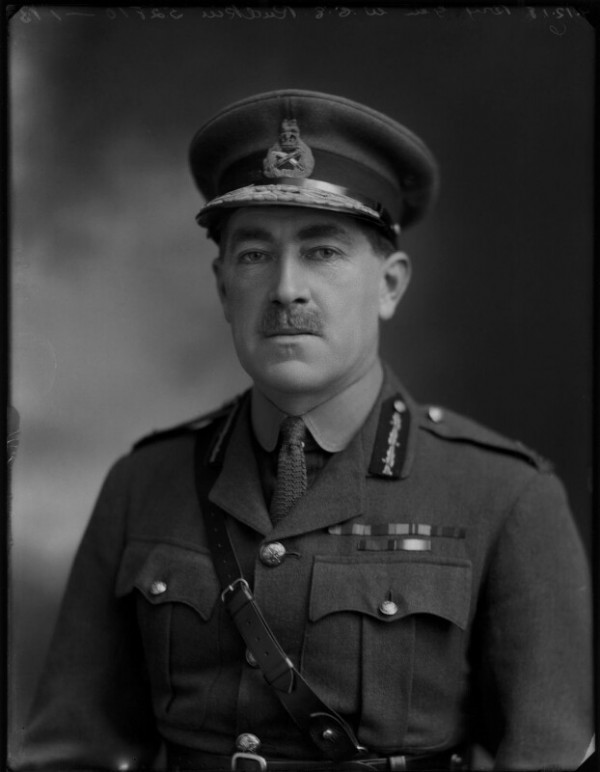
Brigadier General William Charles Eric Rudkin CMG DSO
Royal Artillery
Date of Birth: 24th of February 1875
Place of Birth: East Riding, Yorkshire
Date of Death: 1st of January 1930
Buried: Teignmouth Old Cemetery, plot U52
Knight of the Grand Cross and awarded the Distinguished Service Order, Mentioned in despatches 7x, awarded the 1914 Star, the British War, and Victory Medals and the Queen's Medal with 4 clasps
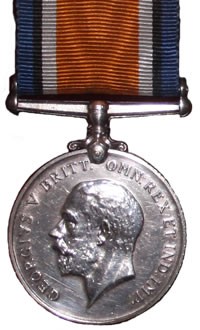
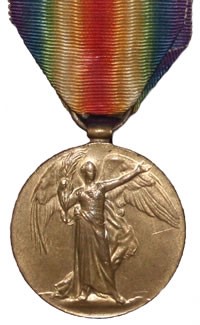
William Charles Eric Rudkin was born on the 24th of February 1875 and baptized on the 21st of March 1875 at Elvington, Yorkshire (East Riding), Anglican. His father was George Mark Archibald Rudkin and mother, Amy Frances.
William was listed in the British Army, Royal Artillery Officers 1716-1899, date range 1894-1895.
William was a Lieutenant in the Royal Field Artillery during the Anglo Boer wars, 1899-1902. He also served with Q Battery Royal Horse Artillery, as a Captain.
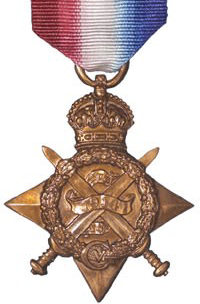
Mentioned in Despatches [London Gazette, 13th of March 1908], and received the Medal with clasp.
He was awarded a Companion of the Distinguished Service Order [London Gazette, 13th of March 1906]: " William Charles Eric Rudkin, Captain, Royal Artillery (late employed with the West African Frontier Force). In recognition of his services with the Owa Column during operations in Southern Nigeria".
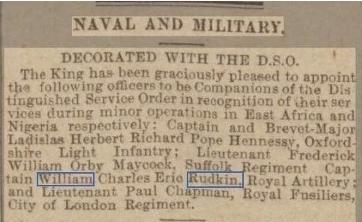 Manchester Courier and Lancashire General Advertiser 1908 14th March
He was promoted Major on the 29th of November 1911.
Major Rudkin served in World War 1. He was awarded the Brevet of Lieutenant Colonel on the 3rd of June 1915, and was Temporary Lieutenant Colonel from November 1915, until promoted to substantive rank on the 22nd of June 1916; was promoted Temporary Brigadier General to command the 57th Division, British Armies in France, on the 16th of August 1918; given the Brevet of Colonel on the 3rd of June 1919.
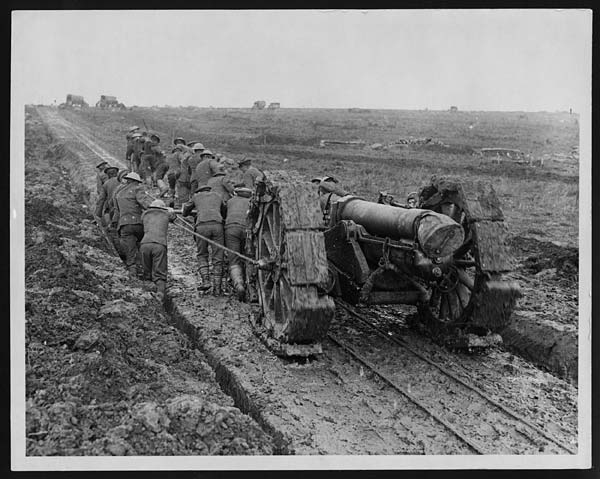 First World War Official Photographs - Photographer Ernest Brooks C.1005 - Moving big guns up to the front by hand CC BY 4.0
He was created a CMG in 1918; became one of HM the King's Aide-de-Camps on the 3rd of June 1919, and was mentioned in Despatches seven times.
The Most Distinguished Order of Saint Michael and Saint George is a British order of chivalry founded on the 28th of April 1818 by George, Prince Regent, later King George IV, while he was acting as regent for his father, King George III. It is named in honour of two military saints, St Michael, and St George. It is awarded to men and women who hold high office or who render extraordinary or important non-military service in a foreign country and can also be conferred for important or loyal service in relation to foreign and Commonwealth affairs.
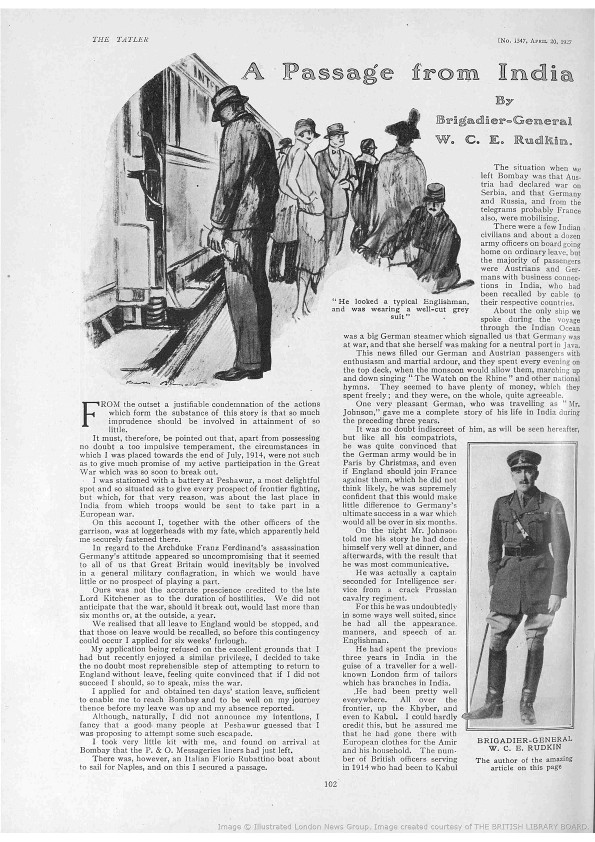 The Tatler April 20 1927 - A passage from India - WCE Rudkin
THE TATLER - No, 1347, APRIL 20, 1927 A Passage from India By Brigadier-General W. C. E. Rudkin.
From the outset, a justifiable condemnation of the actions which form the substance of this story is that so much imprudence should be involved in the attainment of so little.
It must, therefore, be pointed out that, apart from possessing no doubt a too impulsive temperament, the circumstances in which I was placed towards the end of July 1914, were not such as to give much promise of my active participation in the Great War which was so soon to break out.
I was stationed with a battery at Peshawur, a most delightful spot and so situated as to give every prospect of frontier fighting, but which, for that very reason, was about the last place in India from which troops would be sent to take part in a European war.
On this account, I, together with the other officers of the garrison, was at loggerheads with my fate, which apparently held me securely fastened there.
In regard to the Archduke Franz Ferdinand's assassination, Germany's attitude appeared so uncompromising that it seemed to all of us that Great Britain would inevitably be involved in a general military conflagration, in which we would have little or no prospect of playing a part.
Ours was not the accurate prescience credited to the late Lord Kitchener as to the duration of hostilities. We did not anticipate that the war, should it break out, would last more than six months or, at the outside, a year.
We realized that all leave to England would be stopped and that those on leave would be recalled, so before this contingency could occur I applied tor six weeks furlough.
My application being refused on the excellent grounds that I had but recently enjoyed a similar privilege, l decided to take the no doubt most reprehensible step of attempting to return to England without leave, feeling quite convinced that it l did not succeed should, so to speak, miss the war.
I applied for and obtained ten days' station leave, sufficient to enable me to reach Bombay and to be well on my journey thence before my leave was up and my absence reported.
Although naturally, I did not announce my intentions, I fancy that a good many people at Peshawur guessed that I was proposing to attempt some such escapade.
I took very little kit with me and found on arrival at Bombay that the P&O Messageries liners had just left.
There was, however, an Italian Florio Rubattino boat about to sail for Naples, and on this, I secured a passage.
The situation when we left Bombay was that Austria had declared war on Serbia and that Germany and Russia, and from the telegrams probably France also, were mobilizing.
There were a few Indian civilians and about a dozen army officers on board going home on ordinary leave, but the majority of passengers were Austrians and Germans with business connections in India, who had been recalled by cable to their respected countries.
About the only ship, we spoke during the voyage through the Indian Ocean was a big German steamer which signalled us that Germany was at war and that she herself was making for a neutral port in Java.
This news filled our German and Austrian passengers with enthusiasm and martial ardour, and they spent every evening on the top deck when the monsoon would allow them, marching up and down singing "The Watch on the Rhine " and other national hymns.
They seemed to have plenty of money, which they spent freely; and they were, on the whole, quite agreeable. One very pleasant German, who was travelling as "Mr. Johnson" gave me a complete story of his life in India during the preceding three years.
It was no doubt indiscreet of him, as will be seen hereafter, but like all his compatriots, he was quite convinced that the German army would be in Paris by Christmas, and even if England should join France against them, which he did not think likely, he was supremely confident that this would make little difference to Germany's success in the war which would all be over in six months.
On the night Mr. Johnson told me his story he had done himself very well at dinner, and afterward, with the result that he was most communicative.
He was actually a Captain seconded for Intelligence service from a crack Prussian cavalry regiment. For this, he was undoubtedly in some way well suited since he had all the appearance, manners, and speech of an Englishman.
He had spent the previous three years in India in the guise of a traveller for a well known London firm of tailors that has branches in India.
He had been pretty well everywhere. All over the frontier, up the Khyber, and even to Kabul. I could hardly credit this, but he assured me that he had gone there with European clothes for the Amir and his household. The number of British officers serving in 1914 who had been to Kabul...
The author of the amazing article on this page 102 Image Illustrated London News Group. Image created courtesy of THE BRITISH LIBRARY BOARD.
William C E Rudkin married one of these people, Elaine Haworth or Mabel Billard in the years 1926-1930 at Teneriffe, Spain. This was a Consular marriage.
Brigadier General William Charles Eric Rudkin died on the 1st of January 1930.
Photograph top of page:
William Charles Eric Rudkin
by Walter Stoneman,negative, 1919
Given by Walter Stoneman, 1951
Photographs Collection
NPG x66521
© National Portrait Gallery, London
http://creativecommons.org/licenses/by-nc-nd/3.0/
