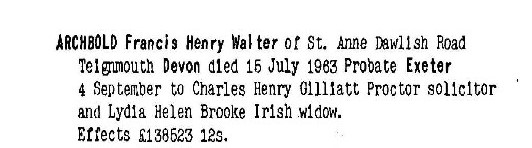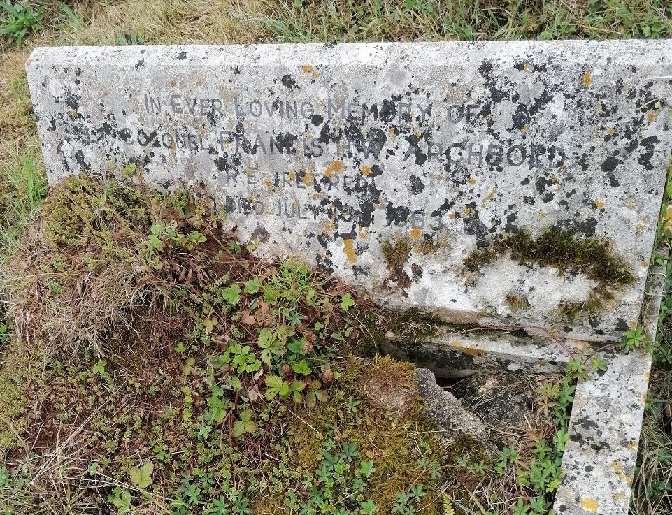
Lieutenant Colonel Francis Henry Walter Archbold
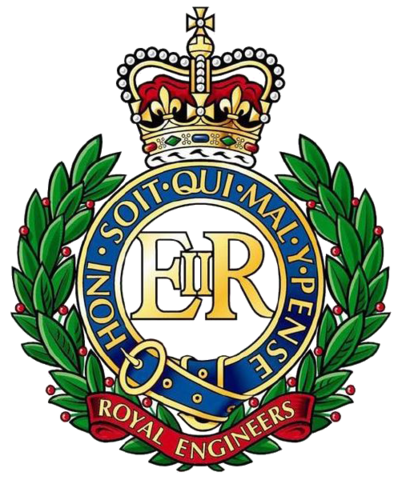
Field Service Regiment in the Royal Engineers
Date of Birth: 1st quarter 1880
Place of Birth: Iraston, County Cork, Ireland
Date of Death: 15th of July 1963
Buried: Teignmouth Cemetery, plot 2R57
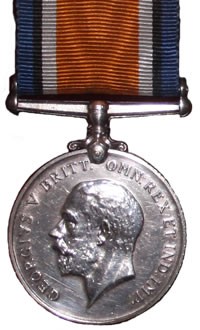
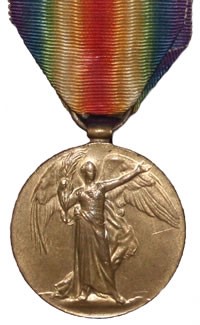
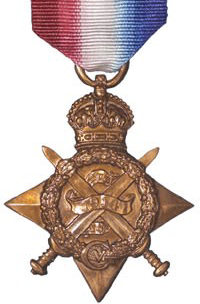
Awarded the British War Medal, the Victory Medal, and 1914-15 Star
Francis was stationed at Gillingham, Kent in 1901. He was a 2nd Lieutenant in the Royal Engineers.
Francis was promoted to Captain in the Royal Engineers in 1910. He is stationed at Colchester, Essex in the 1911 census.
Tochi Valley WW1
According to Francis' medal card, on the 14th of November 1914, he was with the Field Service Regiment, Royal Engineers, theatre of war, Tochi Valley, Waziristan, on the North-West Frontier of India, now Pakistan.
When WW1 commenced, German agents based in Persia, now Iran, stirred up agitation amongst the frontier tribes along India’s north-west border region.
When Turkey entered the war on Germany’s side and declared Jihad (Holy War) against its enemies a religious dimension was exploited.
Some frontier Muslim soldiers deserted from the Indian Army whilst a few others mutinied.
The consequences of most of these internal incidents were satisfactorily and discretely controlled by the British authorities but when raiders crossed the border from Afghanistan conventional military tactics had to be used.
In late 1914 the Khostwals, tribesmen inhabiting the Khost region of Afghanistan adjacent to the Indian border, were subject to fanatical preaching by influential mullahs, religious leaders.
This resulted in around 2,000 armed Khostwals advancing through Indian territory down the Tochi Valley to Miranshah.
The Tochi rises in Afghanistan and flows eastwards across the border before joining the Kurram River, the Tochi Valley was a pedestrian gateway into British territory and large groups of men could move down the valley quickly.
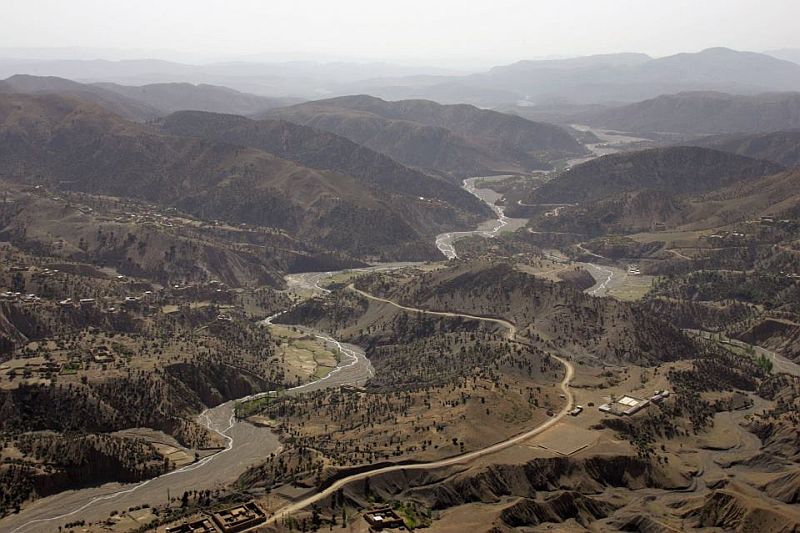 Waziristan Terrain
The tribesmen were well-armed with rifles either bought from members of the Afghan Army or gun-runners operating from Oman.
As news of the Khostwal Lashkar, raiding group, was received the Commander of the Bannu Brigade, Major General H. O’Donnel CB, DSO, advanced his Moveable Column up the Tochi Valley, arriving at Miranshah on the 3rd of December 1914.
However, the Column did not come into action on this occasion because all the fighting was done by the North Waziristan Militia.
A very able and professional officer, Major Gerald Bassett Scott, 27th Punjabis, commanded the North Waziristan Militia.
Gerald Scott concentrated what men he could and on the 29th of November sharply attacked the Khostwal advance. This confused the Afghans who had not expected to meet opposition so soon, and they withdrew to re-group.
The Khostwal Lashkar advanced again in January 1915 and attacked the militia post at Spina Khaisora.
Major Scott moved to relieve the post and mounted an attack against very heavy odds. For a time the fighting was desperate but the attack succeeded and the Khostwals gave ground.
In late March, the Khostwals invaded again with a large Khostwal Lashkar of 7,000 to 8,000 men that moved to threaten Miramshah.
Brigadier General V.B. Fane CB, advanced the Bannu Moveable Column to meet the threat. The Moveable Column included the 25th Cavalry Frontier Force, the 10th Jats, the 52nd Sikhs Frontier Force and the 29th Mountain Battery.
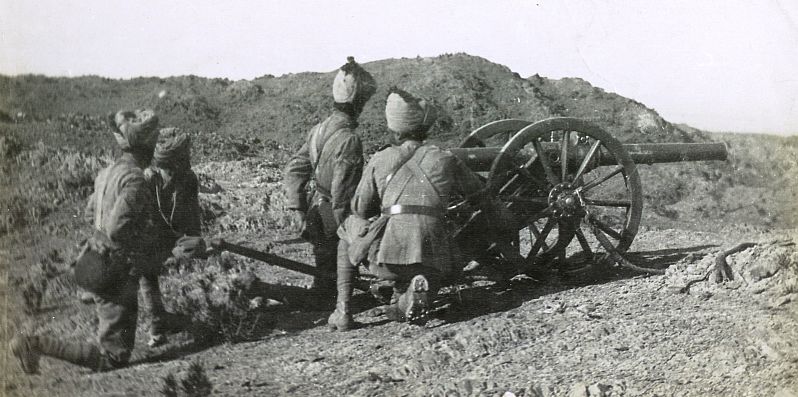 Tochi Valley - Public Domain
Gerald Scott and his North Waziristan Militia deployed in strength in support.
On the 26th of March 1915, Force ‘A’ made a frontal attack on the enemy Khostwal Lashkar whilst the cavalry protected the right flank.
The 29th Mountain Battery, commanded by Major F.R. Patch, Royal Artillery, provided very effective fire that dismayed the Khostwals and to which they had no answer.
Colonel Lowis’ objective was a hill located behind open ground followed by ridges with steep forward slopes and steeper reverse slopes.
The guns opened fire just after 07:00 hours and the infantry advanced in rushes, covering fire being provided by the guns and Force ‘B’.
This combination of good aggressive tactics and concentrated firepower was too much for the Khostwals who retreated from their first line of sangars (stone breastworks) to their second line and then withdrew from the battlefield altogether.
Francis was promoted to Major on the 2nd of November 1916 which was reported in the London Gazette on the 21st of November 1916.
After WW1, Francis was living at Lee, near Ilfracombe, North Devon.
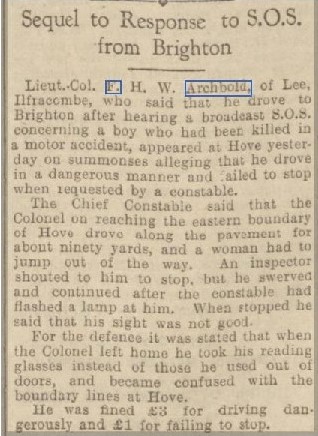 Western Times 1st of April 1932
Sequel to Response to S.O.S. from Brighton
Lieutenant-Colonel F.H.W. Archbold, of Lee, Ilfracombe, who said that he drove to Brighton after hearing a broadcast S.O.S. concerning a boy who had been killed in a motor accident, appeared at Hove yesterday on summonses alleging that he drove in a dangerous manner and failed to stop when requested by a Constable.
The Chief Constable said that the Colonel on reaching the eastern boundary of Hove drove along the pavement for about ninety yards, and a woman had to jump out of the way. An Inspector shouted to him to stop, but he swerved and continued after the Constable had flashed a lamp at him. When stopped he said that his sight was not good.
For the defence, it was stated that when the Colonel left home he took his reading glasses instead of those he used out of doors, and became confused with the boundary lines at Hove.
He was fined £3 for driving dangerously and £1 for failing to stop.
Teignmouth Warning
Imposing a fine of 10 guineas on
Colonel Francis Henry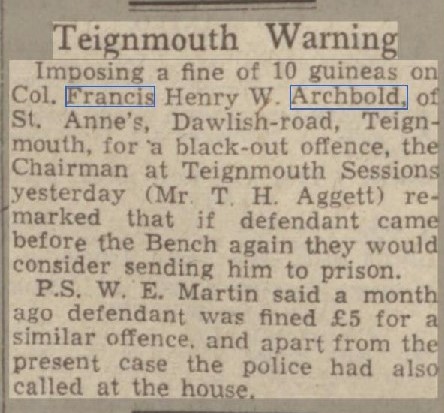 W. Archbold, of St. Annes's, Dawlish Road, Teignmouth, for a blackout offence, the Chairman at Teignmouth Sessions yesterday, Mr T.H. Aggett, remarked that if the defendant came before the bench again that he would consider sending him to prison.
P.S.W.E. Martin said a month ago defendant was fined £5 for a similar offence, and apart from the present case, the Police had also called at the house.
Lieutenant-Colonel Francis Henry Walter Archbold died on the 15th of July 1963 whilst still living at Teignmouth, Devon.