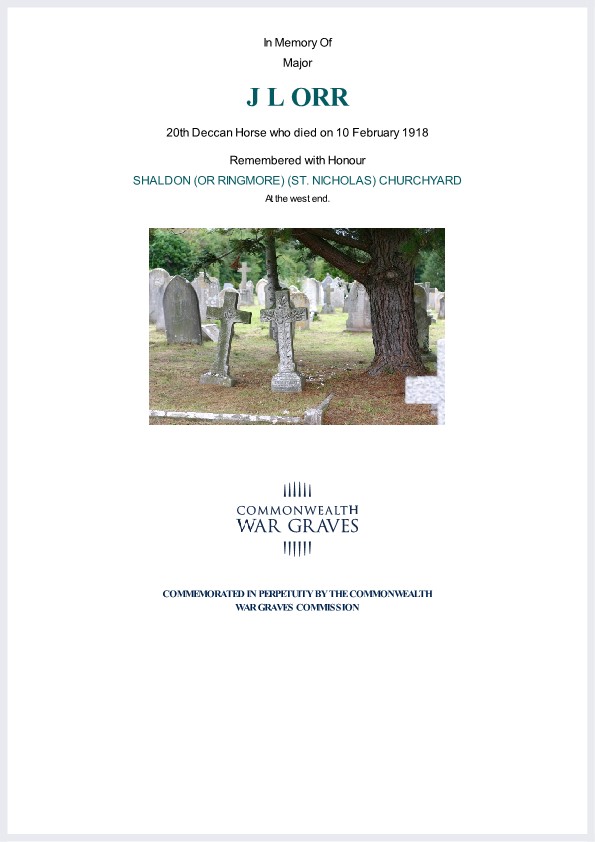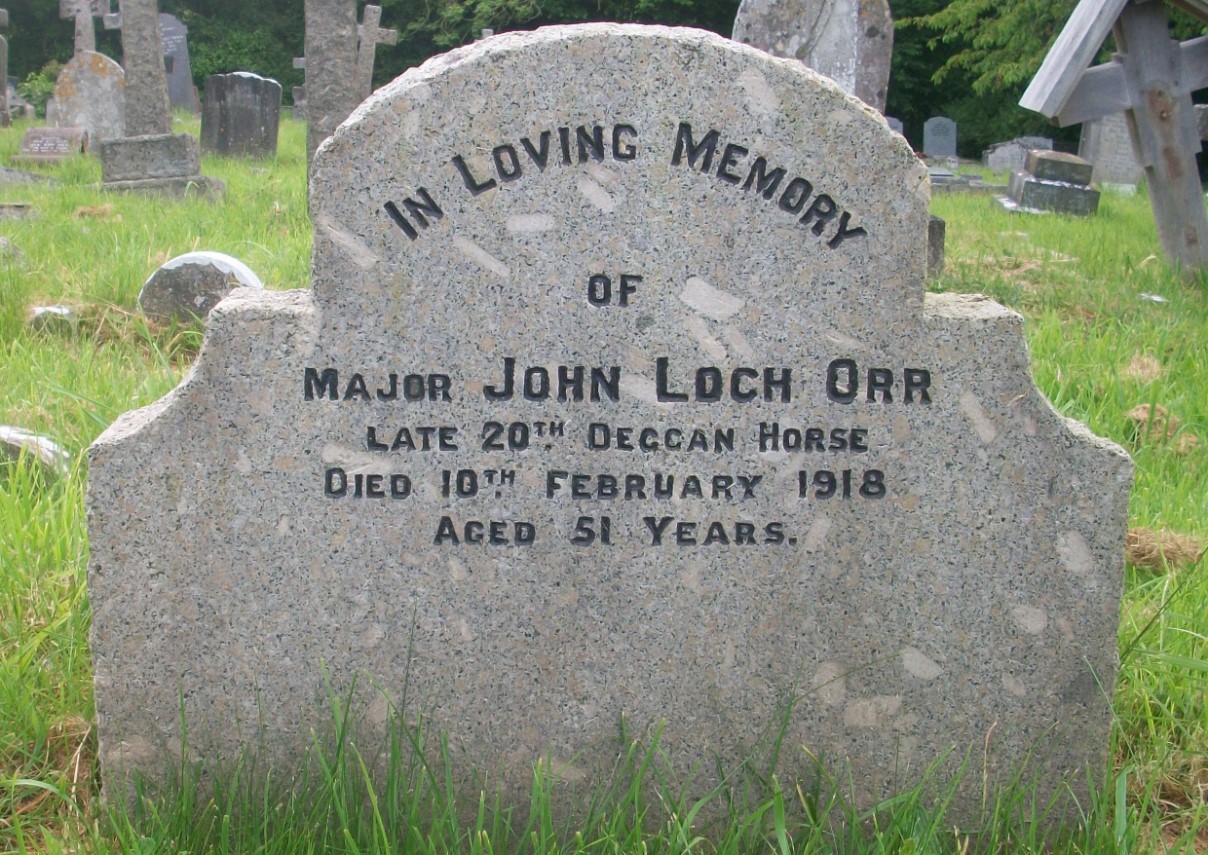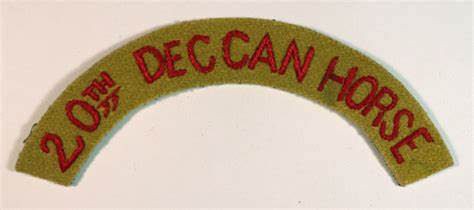
Major John Loch Orr
20th Deccan Horse, Indian Army
Date of Birth: 1866
Place of Birth: Kirkden, Angus, Forfarshire, Scotland
Date of Death: 10th of February 1918
Buried: Shaldon, or Ringmore, St. Nicholas Churchyard. At the west end.
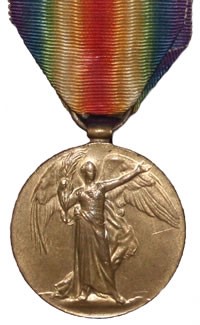
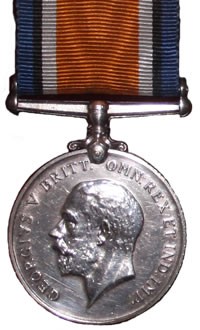
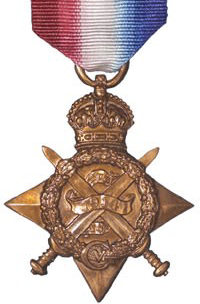
Awarded the 1914 Star, Victory, and British War Medal
John Loch Orr was born in 1866 at Kirkden, Angus Forfarshire, Scotland. His father was John Henry Orr and his mother, Emily Ann Twenilow.
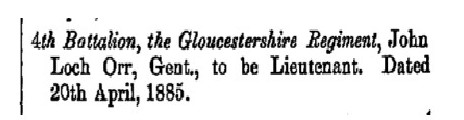 The London Gazette 1st May 1885
4th Battalion, the Gloucester Regiment, John Loch Orr, Gent, to be Lieutenant. Dated 20th April 1885.
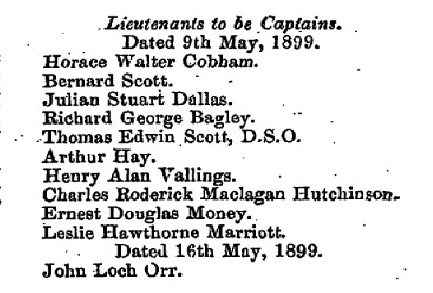 London Gazette 1899 18th July
Lieutenants to be Captains. Dated 9th May 1899.
Captain John Loch Orr fought in the Anglo Boer war, 1899-1902, Imperial Light Horse, and was wounded severely on the 21st of October 1899 at Elandslaagte, a farm in Natal Colony (Klip River district, KwaZulu-Natal), 20 km north-east of Ladysmith, which gives its name to a station on the Ladysmith-Newcastle railway line.
In the 1914 Hart's List, Major John Loch Orr, Indian Army, was listed as retired on the 19th of May 1913. His promotion to Major was on the 16th of May 1906.
20th Deccan Horse in WW1
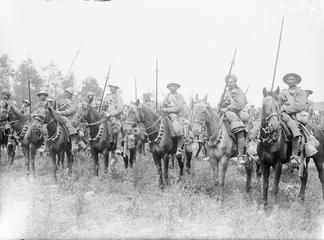 The 20th Deccan Horse, part of the 2nd Indian Cavalry Division, in Carnoy Valley shortly before their unsuccessful attack at High Wood on the evening of 14 July. Together with the 7th Dragoon Guards, they suffered 102 casualties and lost 130 horses.
It was composed of one squadron of Sikhs, one of Jats, and two of Dekhani Musalmans.
Battle of Bazentin Ridge, 14–15 July 1916
German defensive lines, High Wood, Somme 1916
The Fourth Army attacked High Wood with divisions from XV Corps on the 14th of July, during the Battle of Bazentin Ridge.
The wood was abandoned by the Germans but delays meant that the British did not attempt to occupy it until 7:00 pm Rawlinson had ordered the 7th Division forward at 12:15 pm but the order was over-ruled by Lieutenant-General Henry Horne, the XV Corps commander, because the capture of Longueval, on the flank of the proposed advance was incomplete.
The 7th Division advanced and two battalions managed to occupy the southern half of the wood after German reserves had arrived and counter-attacked several times.
On the right flank, a squadron from each of the 7th Dragoon Guards and the 20th Deccan Horse of the 2nd Indian Cavalry Division had been ordered forward at 7:40 am but took until early evening to make their way across trenches and devastated ground.
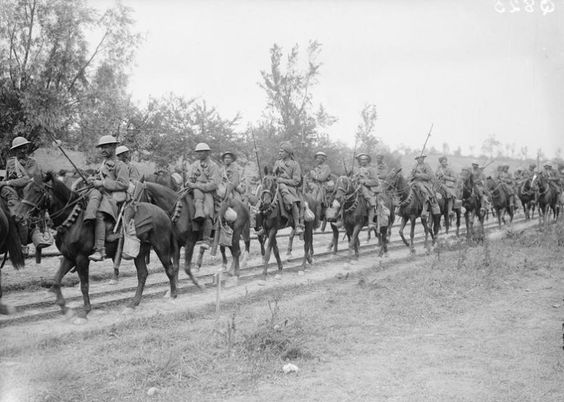 The 20th Deccan horse 14th July 1916 on their way towards Highwood and destiny
The 20th Deccan Horse made the only cavalry charge of the Battle of the Somme, against III Battalion, Infantry Regiment 26 concealed in crops east of the wood.
The crew of an aircraft of 3 Squadron RFC saw the infantry and cavalry advance and the pilot dived at the German troops, strafing them from a height of 300 ft.
The observer dropped a sketch of the German dispositions onto the cavalry before the aircraft departed, having been riddled by ground fire.
Reserves of the 2nd Guard Division were incapable of assisting the defenders, as they had been caught by British machine-gun fire as they moved up towards Bazentin-le-Petit, and machine-gunners in Longueval were silenced by the cavalry machine-guns.
German heavy artillery had been withdrawn and field artillery was unable to take aim at such a fast-moving target. About 100 Germans were killed or taken prisoner in the cornfields, eight cavalrymen were killed, about 100 were wounded and 130 horses were killed or wounded.
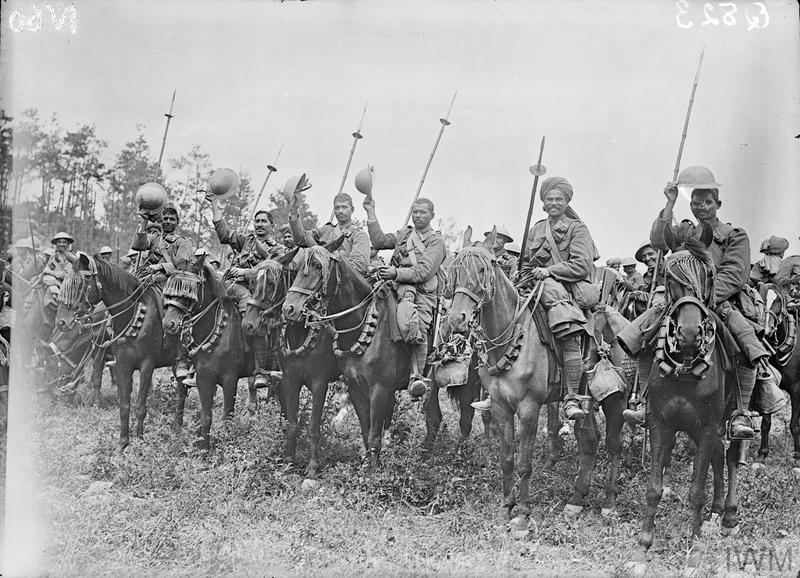 The 20th Deccan horse on the 14th of July 1916
Deccan Horse, Bazentin Ridge
The cavalry took up a line from Longueval to the southern corner of High Wood until the early morning of the 15th of July and began to withdraw from 3:40 am.
Alarmist reports that the British cavalry had broken through between Longueval and Pozières and was advancing beyond High Wood, reached the German IV Corps and 2nd Army headquarters.
General Fritz von Below, the German 2nd Army commander put the 8th, 5th, 24th Reserve, and 8th Bavarian Reserve divisions at the disposal of General Friedrich Bertram Sixt von Armin the IV Corps commander, to counter-attack the British breakthrough.
When the truth emerged, the counter-attack was called off and the 5th and 8th Bavarian Reserve divisions went back into reserve.
At 9:00 am on the 15th of July, the 7th Division attacked the wood with the 91st Brigade. The British infantry was stopped by machine-gun fire from the Switch Line where it ran through the wood.
After a bombardment by German artillery, II Battalion, Infantry Regiment 165 of the 7th Division and III Battalion, Infantry Regiment 72 of the German 8th Division, which had relieved the 183rd Division, counter-attacked at 2:30 pm and recaptured part of the wood, until driven out by the brigade reserve.
At 4:45 pm the British attacked after a bombardment which inflicted many casualties on the German infantry but failed to overwhelm the defenders.
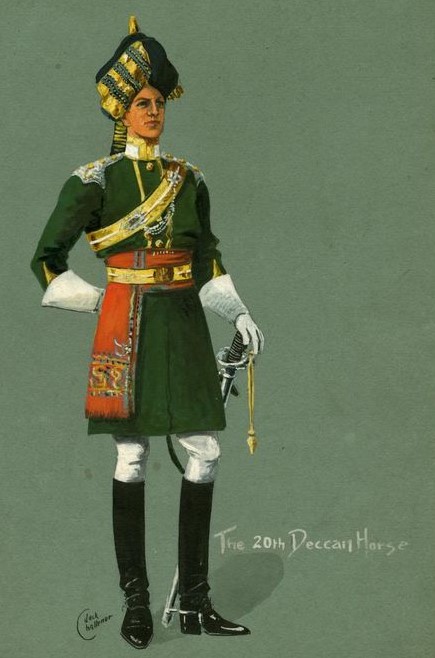 An Officer's uniform of the 20th Deccan horse
High Wood was not visible to British ground observers and at 5:00 pm a 3 Squadron reconnaissance, reported that British troops were in the west of the wood and south of the Bazentin-le-Petit road.
Flags were seen in the west side of the wood but the east side was full of Germans and the Switch Trench was seen to be packed with German infantry.
High Wood was judged to be untenable and at 11:25 pm the 91st Brigade was withdrawn and the wood was bombarded by the divisional artillery.
The 1/9th Highland Light Infantry (HLI) of the 33rd Division had also attacked the wood at 9:00 am on the 15th of July, during an attack on the Switch Line, when three platoons advanced on the west side of the wood.
Machine-gun fire from the II and III battalions of Infantry Regiment 93 in High Wood, hit the attackers from the flank and the attack was repulsed.
The 16th Battalion, King's Royal Rifle Corps, and the 2nd Worcester were sent forward as reinforcements but were back on the start line by 4:00 pm.
Two German infantry companies worked southwards from the Switch Line for 500 yd later in the evening but a renewal of the counter-attack was found to be impossible, due to the tremendous volume of British barrage fire and the presence of British reconnaissance and artillery observation aircraft.
Casualties
From the 11th until the 27th of July, the 1st Division had 3,078 casualties and from 14–20 July, the 7th Division lost 3,413 casualties.
The German 7th and 8th divisions lost 9,498 men from 15–27 July, on the front from Delville Wood to High Wood.
From the 22nd of July until the 7th of August, the 51st Division had 2,120 casualties and the 47th Division lost more than 4,500 men from the 15th until the 19th of September.
At least 8,000 British and German soldiers died in the wood in 1916.