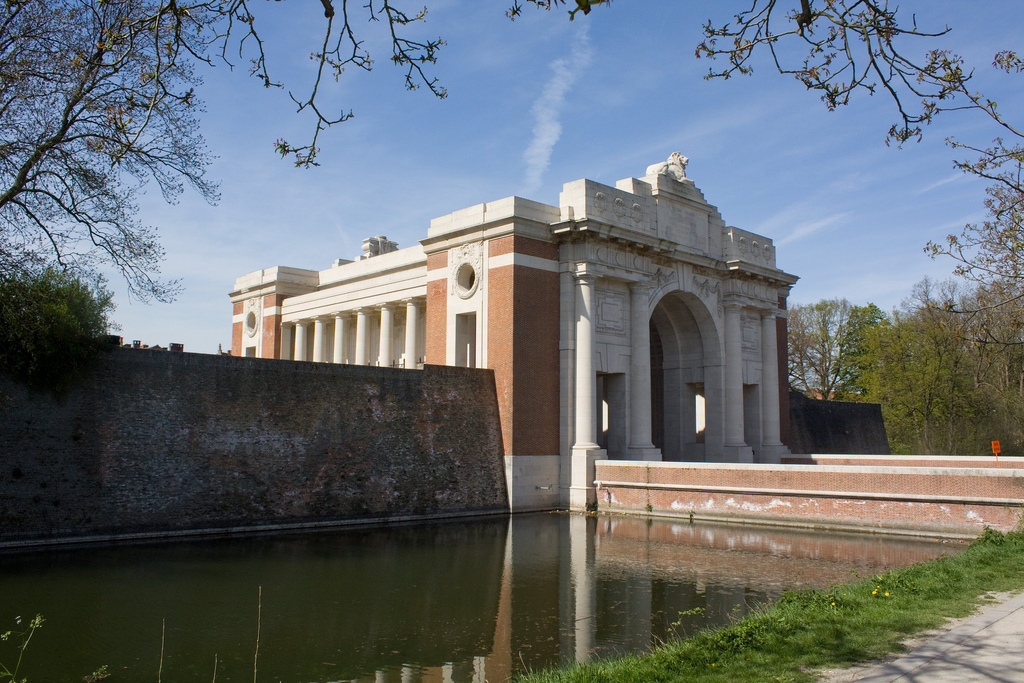
 Menin Gate War Memorial, Ypres. Photo by By Johan Bakker - Own work, CC BY-SA 3.0
The Ypres (Menin Gate) Memorial, often referred to simply as the Menin Gate, bears the names of more than 54,000 soldiers who died in Belgium and have no known grave.
Between October 1914 and September 1918 hundreds of thousands of servicemen of the British Empire marched through the town of Ypres's Menin Gate on their way to the battlefields.
The memorial now stands as a reminder of those who died who have no known grave and is perhaps one of the most well-known war memorials in the world.
In the First World War six million men went missing and were never found, their bodies were lost in the mud.
Sometimes bodies would be found as new trenches were dug.
From October 1914 to October 1918, five major offensives occurred at Ypres (now Ieper) in Belgium. By the time the last shells fell in Ypres in October 1918, nearly 200,000 Commonwealth servicemen had been killed. The Menin Gate is one of four memorials to the missing in Belgian Flanders which cover the area known as theYpres Salient.
Broadly speaking, the Salient stretched from Langemarck in the north to the northern edge in Ploegsteert Wood in the south, but it varied in area and shape throughout the war. The Salient was formed during the First Battle of Ypres in October and November 1914, when a small British Expeditionary Force succeeded in securing the town before the onset of winter, pushing the German forces back to the Passchendaele Ridge.
The Second Battle of Ypres began in April 1915 when the Germans released poison gas into the Allied lines north of Ypres. This was the first time gas had been used by either side and the violence of the attack forced an Allied withdrawal and a shortening of the line of defence.
There was little more significant activity on this front until 1917, when in the Third Battle of Ypres an offensive was mounted by Commonwealth forces to divert German attention from a weakened French front further south.
The initial attempt in June to dislodge the Germans from the Messines Ridge was a complete success, but the main assault north-eastward, which began at the end of July, quickly became a dogged struggle against determined opposition and the rapidly deteriorating weather.
The campaign finally came to a close in November with the capture of Passchendaele. The German offensive of March 1918 met with some initial success, but was eventually checked and repulsed in a combined effort by the Allies in September.
Six local men are remembered here:
Location of the (Ypres) Menin Gate Memorial
Menenstraat, 8900 Ieper, Belgium.
