
Lieutenant Colonel Percy Roger Whalley DSO
3rd Battalion, Worcestershire Regiment
Date of Birth: September 1881
Place of Birth: South Hook Fort, Herbranston, Pembrokeshire
Date of Death: 19th of February 1956
Buried: Tor Parish Church, Devon
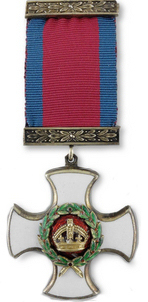 Distinguished Service Order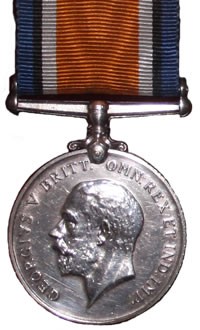
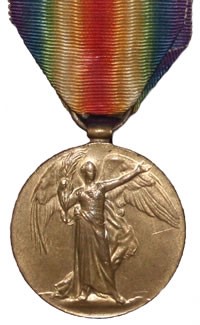
Awarded the DSO, 1914 Star, British War, and Victory medal
Percy Roger Whalley was born at South Hook Fort, Herbranston, Pembrokeshire, in September 1881.
He was the son of Lieutenant-Colonel Percy C. Whalley, R.A., and was educated at Kelly College, Tavistock and R.M.C. Sandhurst.
Percy was commissioned Second Lieutenant, 2nd Battalion, Worcestershire Regiment in March 1901.
| Percy Roger Whalley 1881 | Barbara T L Whalley 1884 |
| Pamela D C Whalley 1887 | Cynthia T M Whalley 1889 |
In the 1891 and 1901 censuses, the Whalley family were living at Woodway Cottage, Woodway Road, East Teignmouth.
Cynthia Theodosia Monica Whalley was a Nurse, Voluntary Aid Detachment (VAD), during WW1.
Percy served during the Second Boer War with the Battalion in operations in the Transvaal in May 1901, and in the Orange Free State, May 1901 - May 1902. Percy served as a Railway Staff Officer, 26th of November until the 21st of December 1901, and advanced to Lieutenant in April 1902.
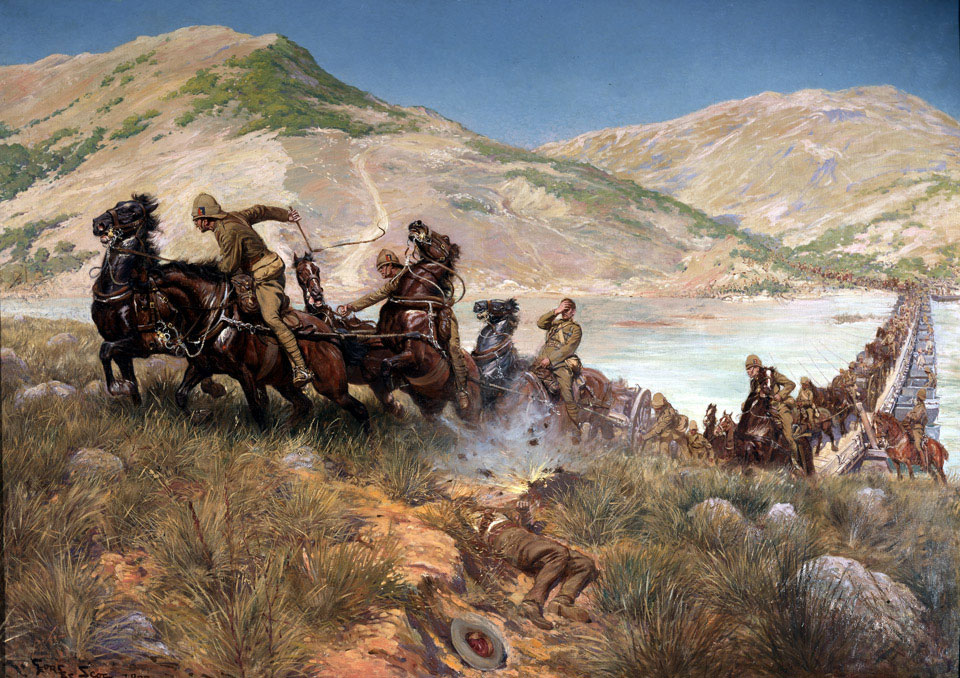 Final Crossing of the Tugela - National Army Museum, Out of Copyright
Percy and the 2nd Battalion finally left South Africa in September 1904, and he continued to serve with the Battalion in India from 1906.
Percy, in company with Lieutenant L. Watson, received the Battalion’s new Colours during a presentation by the Viceroy of India. He advanced to Captain in March 1909 and served with the 5th (Militia) Battalion, Worcestershire Regiment.
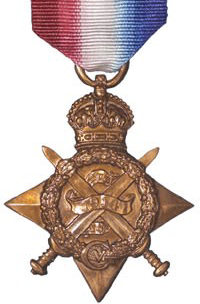
He was appointed Adjutant of the 1/8th Battalion, Worcestershire Regiment in April 1914, and was serving in that capacity at the outbreak of the Great War. He served during the Great War with the Battalion in the French theatre of war from April 1915.
The 1/8th Battalion found themselves in or near the front line covering Ploegsteert Wood, north of Armentieres, between April and June 1915.
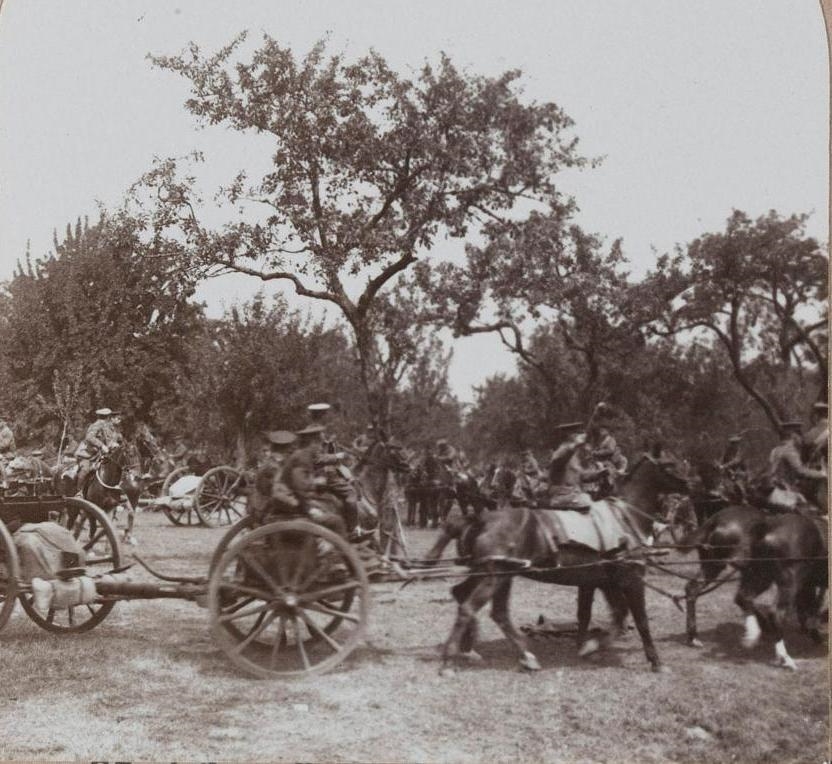 Onslaught at Ploegsteert during the dogged defence of Ypres, 1915 - National Army Museum, Out of Copyright
The following month they moved south to the Picardy area, as part of the 144th Infantry Brigade. Percy served as Brigade Major, 144th Infantry Brigade, from October 1915 until March 1916.
He served in the same capacity with 143rd Infantry Brigade, from March until September 1916, before being appointed to the command of 3rd Battalion, Worcestershire Regiment, with the rank of Acting Lieutenant-Colonel, on the 5th of September 1916.
He commanded the 3rd Battalion from September 1916 until April 1919, apart from the 16th until the 22nd of September 1918 when he was required to temporarily assume command of the 57th Infantry Brigade.
Percy joined his battalion when they were in the line at Ovillers/Leipzig Salient/Thiepval area. They moved north in October and wintered at Armentieres. He distinguished himself during the Capture of Westhoek, Ypres, 10th until the 12th of August 1917.
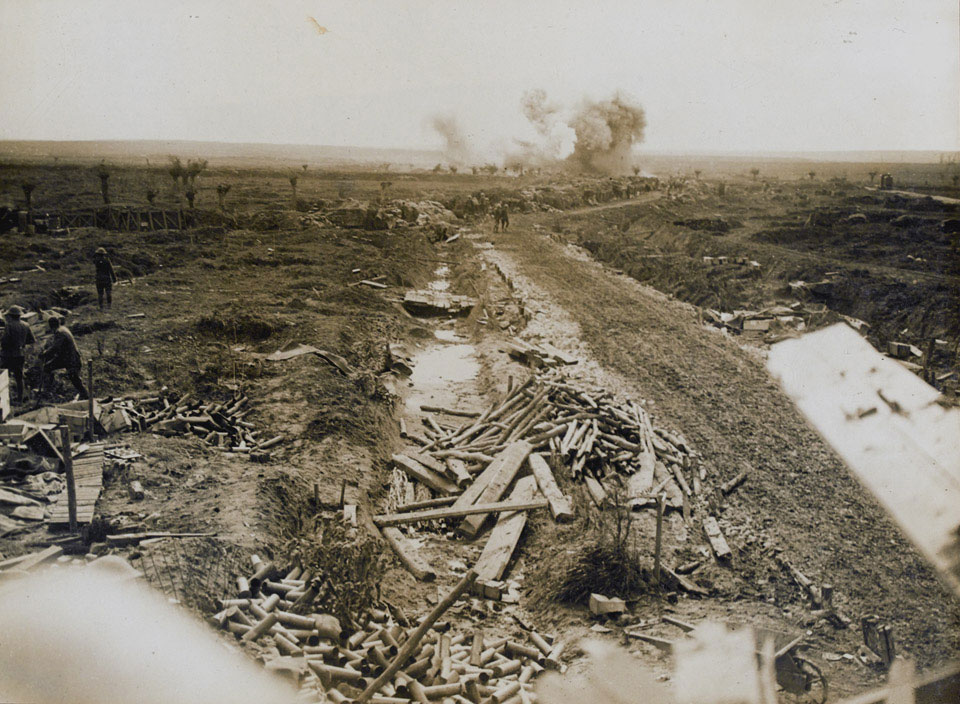 Battle of the Menin Road. Scene on a road over newly captured ground, September 1917 - National Army Museum, Out of Copyright
During the aforementioned action, the 3rd Battalion Worcestershire Regiment was present as part of the 25th Division against Westhoek: The attack of the 25th Division was to be made by the 74th Brigade, with the 7th Brigade in close support. After dark on the 9th of August the 3rd Battalion Worcestershire moved into the support trenches on the Bellewaarde Ridge, the trenches which they had held a week before.
An hour before the attack was due to start, “A” and “C” companies were ordered forward to take a position close behind the right battalion of the attacking Brigade, the 13th Cheshire.
At dawn on August 10th, the British artillery opened fired simultaneously with one tremendous crash, and the assaulting battalions charged forward as swiftly as was possible in the heavy mud. They just avoided the reply of the enemy’s artillery, which within three or four minutes struck all along the line of the British front trenches.
The two companies of the Worcestershire lying in close support suffered more severely than did the attacking troops who, taking the enemy by surprise, fought their way forward up Westhoek Ridge, topped the crest-line and pushed down the further slope. Their advance was checked.
The reverse slope of the Ridge sheltered several concrete block-houses, still undamaged. The 13th Cheshire was held up and sent back messages for help. “A” and “C” companies of the 3rd Worcestershire were ordered forward. Second Lieutenant A. W. Vint led “A” Company up and over the Ridge.
 German prisoner of war captured during the Battle of Menin Ridge, 20 September 1917 - National Army Museum, Out of Copyright
By the time he reached the forward platoons of the Cheshire, the protecting barrage had lifted and the enemy machine-guns were sweeping the bare ground. He organized an attack and led his men forward, working from shell-hole to shell-hole across several hundred yards of bare ground till he could close on the block-house, which was captured by with a brave rush.
Within half-an-hour, from the start, the objective of the attack had been gained and the victorious troops were endeavouring to establish defensive posts along the swampy valley of the Hannebeek. Orders were sent back for “B” and “D” companies of the 3rd Worcestershire to move up to the old front line below the Westhoek Ridge.
Then, as had been anticipated, began the severest trial. From the north, east and south the enemy’s shells came over to burst along the captured ridge; worse still, on the right flank the 18th Division after a hard struggle in Glencourse Wood had been driven back to that wood’s western edge, thus exposing the right flank of the 13th Cheshire.
Soon they were taken in enfilade by machine-guns from the wood on the slope above them. By 11 o’clock all the senior officers of the Cheshire battalion had been hit and, at the request of their wounded C.O., Lt. Colonel Percy Roger Whalley, commanding the 3rd Worcestershire, went forward, and took command.
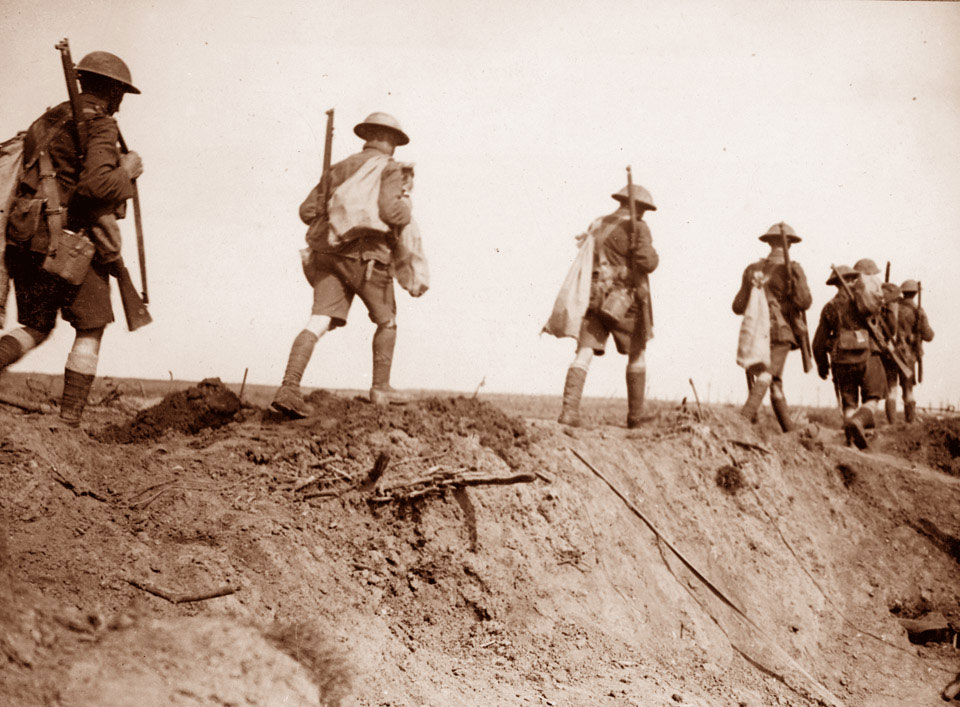 Battle of Menin Road, North-country troops bring up rations, 1917 - National Army Museum, Out of Copyright
By that time enemy counter-attacks were beginning. Bodies of the enemy could be seen struggling forward through the swamps of the Hannebeek. Again and again, they came on, but they were easily shot down by the British fire.
All counter-attacks were repulsed, though the fire from the machine-guns still swept the ground from the right flank.
Throughout the day, Percy commanded both battalions inspiring all with his courage and determination and was awarded the D.S.O.
Darkness closed down. The 3rd Worcestershire reassembled west of the Ridge and reckoned their losses - some fifty in all, including three officers: marvelously light considering the intensity of the fire. (The Worcestershire Regiment in the Great War, by Captain H.F. Stacke, M.C., refers) Early during the German offensive of March 1918, Percy Roger Whalley was ordered to report for duty at Head Quarters of the 74th Infantry Brigade.
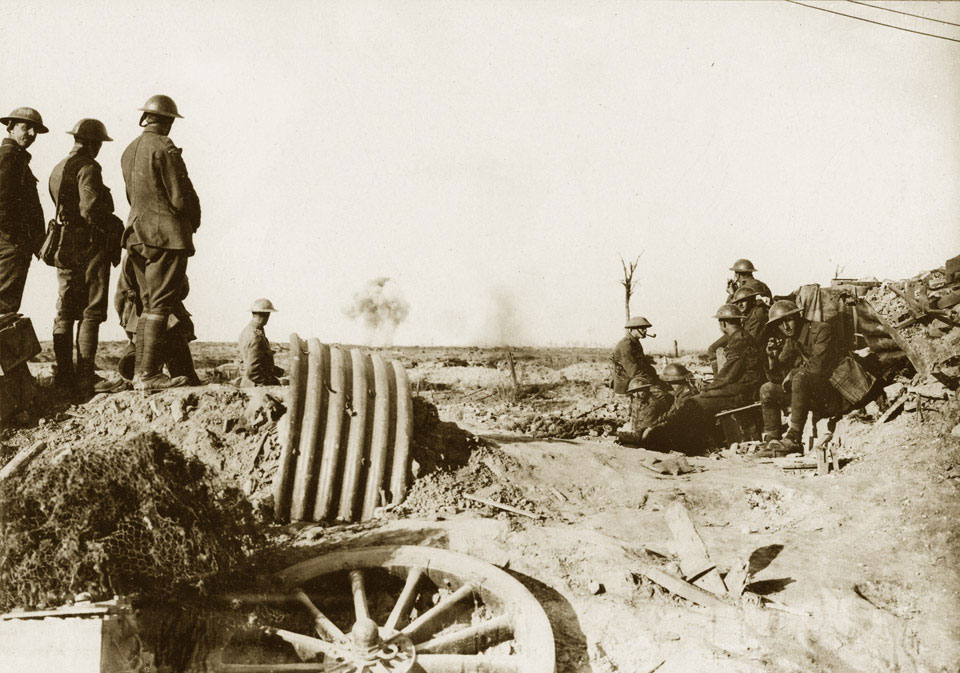 British troops near Boesinghe, 18 August 1917 - National Army Museum, Out of Copyright
He returned to the 3rd Battalion during the first week of April and was invalided on the 6th of April 1918. After a period of recuperation in England, he rejoined his battalion in France, on the 10th of June 1918. Percy temporarily commanded the 57th Brigade, from the 16th until the 22nd of September 1918, before returning to lead the Battalion at ‘The Affair of Shepherd’s Redoubt’, on the 25th of September 1918.
The success of which was duly noted by the Divisional Commander, ‘a warm message of congratulation to Colonel Whalley and the whole Battalion was sent by the Divisional Commander General Jeffreys; and the Brigadier [A. J. F. Eden, commanding the 57th Brigade] in forwarding the message added, “I realise that the Regimental Motto “FIRM” is as much inwardly implanted in the mind of every officer and man of the 3rd Battalion The Worcestershire Regiment as it is outwardly displayed.’
 Camouflaged tanks and infantry moving up to the attack, 26 September 1917 - National Army Museum, Out of Copyright
After the war
Percy served as Brigade Major, Gloucestershire and Worcestershire Infantry Brigade, Southern Command, April 1920 until March 1922. He advanced to Brevet Lieutenant-Colonel and was posted for service with the 1st Battalion, Worcestershire Regiment, at Meerut, India, in November 1923.
Percy was appointed Lieutenant-Colonel, Reserve of Officers, and served as commanding officer of the 2nd City of London Regiment (The Royal Fusiliers), Territorial Army for four years until May 1930.
In later life, he resided at Hunstmead, Moretonhampstead, Devon, and died at a nursing home in Torquay, on the 19th of February 1956.
His funeral took place at Tor Parish Church on the 23rd of February 1956.
The photograph of Lieutenant Colonel Percy Roger Whalley is from http://www.worcestershireregiment.com/wr.php?main=inc/o_whalley
© WorcestershireRegiment.com (2002-2015) by Louis Scully
