During the First World War, many people wrote about Belgians in Britain. Two renowned war poets mentioned them in their letters.
Julian Grenfell wrote:
"We’ve been assisting at this battle for the last week, but have been no nearer the fighting than getting shelled a bit. I’m writing this in a Belgian farm, where we are billeted. It’s full of refugees–old men and old women and young children. You see them all day streaming down the roads, carrying everything they can in their arms, and with little carts drawn by dogs; it is too pathetic."
Whereas the even more iconic Rupert Brooke, who wrote his war poems based on the only action he saw in and around Antwerp, included the following in a letter:
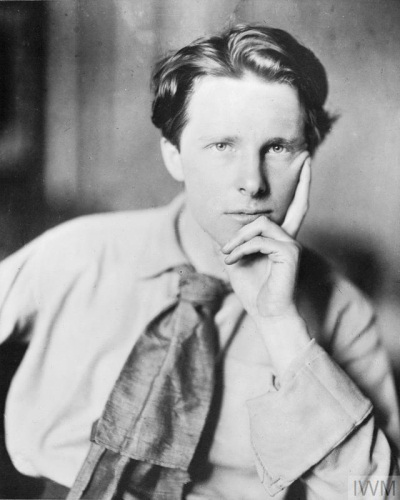 The war poet Rupert Brooke © IWM (Q 71073)
"The march through those deserted suburbs, mile on mile, with never a living being, except one rather ferocious looking sailor, stealing sulkily along. The sky lit by burning villages and houses; and after a bit we got to the land by the river, where the Belgians had let all the petrol out of the tanks and fired H.
Rivers and seas of flame leaping up hundreds
of feet, crowned by black smoke that covered the entire heavens. It lit up horses wrecked by shells, dead horses, demolished railway stations, engines that had been taken up with their lines and signals, and all twisted round and pulled out, as a bad child spoils a toy.
And there we joined the refugees, with all their goods on barrows and carts, in a double line, moving forwards about a hundred yards an hour, white and drawn and beyond emotion. The glare was like hell. We passed on, out of that, across a pontoon bridge, built on boats. Two German spies tried to blow it up while we were on it.
They were caught and shot. We went on through the dark. The refugees and motor-buses and transport and Belgian troops grew thicker. After about a thousand years it was dawn."
And he continued:
"After a bit we got to the land by the river, where the Belgians had let all the petrol out of the tanks and tired it. Rivers and seas of flame leaping up hundreds of feet, crowned by black smoke that covered the entire heavens. It lit up houses wrecked by shells, dead horses, demolished railway stations, engines that had been taken up with their lines and signals, and all twisted round and pulled out, as a bad child spoils a toy ... [Hoboken] was like Hell, a Dantesque Hell, terrible.
But there - and later - I saw what was a truer hell. I hundreds of thousands of refugees, their goods on barrows and hand-carts and perambulators and wagons, moving with infinite slowness out into the night, two unending lines of them, the old men mostly weeping, the women with hard white drawn faces, the children playing or crying or sleeping. That's what Belgium is now: the country where three civilians have been killed to every one soldier ... It's queer to think one has been a witness of one of the greatest crimes of history. Has ever nation been treated like that? And how can such a stain be wiped out?"
