
Private Sydney Thomas Adams
1/16th (County of London) Battalion (Queen’s Westminster Rifles), Service Number 7109, formerly the West Kent Regiment, 553480
Date of Birth: 30th of June 1889
Place of Birth: Teignmouth, Devon
Date of Death: 1975
Buried: Teignmouth Cemetery, plot 2Q90
Awarded the Victory Medal the British War medal
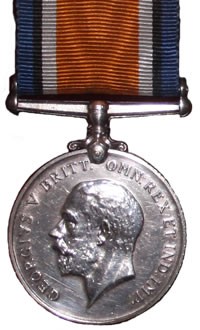
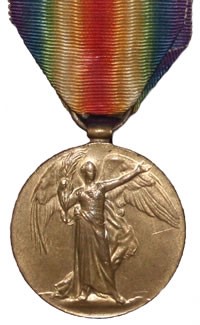
Sidney Thomas Adams was born on the 30th of June 1889.
The 1891 census shows thar the family was living at 12, Model Cottages, Teignmouth. Sidney's father, William Henry, was a House Painter, and his mother's name was Harriett Jane.
| William Adams 1883 | Alice Adams 1885 |
| Private Sidney Thomas Adams 1889 | Private Frank Henry Adams 1895 |
| Violet Lilian Adams 1901 |
Both of Sidney's brothers Frank Henry Adams and William James George Adams also attested. Frank was deemed unfit to serve in 1916 and no further information has been found on William concerning his military record.
 Frank Henry Adams
 William James George Adams
By 1901, the family were living at 23, Daimonds Lane, West Teignmouth.
The family moved to 22, Exeter Street, Teignmouth in 1911 and Sidney was a Cabinet Maker.
Sidney married Hilda May Wood on the 13th of April 1911 and they had their first child, Mabel Emily Adams on the 7th of February 1913.
Sidney (or Sydney) attested and enrolled as ready for military service on the 19th of November 1915 and was mobilized on the 17th of April 1916.
Sidney was posted to the Royal West Kent Regiment on the 19th of April 1916 and transferred to the 16th London Regiment on the 28th of August 1916, (the 16th London Regiment transferred to the 169th Brigade of the 56th Division on the 10th of February 1916).
The 56th Division of the British Expeditionary Force (BEF)
A summary of the battles that Sidney's Regiment was involved in.
On 5 September 1916, the 56th Division went back into the line during the Battle of Ginchy, the Somme. The 168th Brigade attacked before dawn with partial success but lost direction, and their relief later in the day by 167th Brigade caused some problems.
For the Battle of Flers–Courcelette on the 15th of September, the 167th Brigade attacked Bouleaux Wood with two of the new tanks in support. The attack went in at 06.20, but one tank had broken down, while the other was hit by a field gun and set on fire after giving early support.
 The Battle of Ginchy - © IWM (Q 1302)
And because neighbouring troops could not take the flanking strongpoint known as 'the Quadrilateral' the brigade's attack made little progress and the attack was called off in the afternoon. It was the same story when the division made a second attempt on the 18th of September, but at least the Quadrilateral fell. When the division attacked again on the 25th of September (the Battle of Morval), German resistance began to crumble, and by midnight the 167th Brigade was fighting in the lower part of Bouleaux Wood and beyond the derelict tank from the 15th of September.
 A Tank used at the Battle of Morval in 1916 © IWM (Q 2488)
In early October, the 167th Brigade occupied a line of linked-up outposts in a sea of mud and the planned attack on the 5th of October. It went in on until the 7th of October (the Battle of Le Transloy) and the 167th Brigade on the left was fairly successful, but in the follow-up attack at 15.30 on the 8th of October, 1/3rd Londons failed to make any appreciable advance against machine gunfire.
 The first Anzac Corps joined the 4th Army's attack at Le Transloy in early November 1916. National Army Museum, Out of Copyright
The division was relieved the following night. There followed months of light training and line-holding in the Neuve Chapelle sector while the units of 56th Division were slowly rebuilt. Despite further casualties, while holding the line and raiding the enemy, 1/3rd Londons attained a strength of almost 1100 all ranks when it returned to active operations in March 1917.
On the 28th of March 1918, the enemy launched a great attack north of the Somme River from Puisieux to the north-east of Arras. This attack was a considerable extension of the original front of the attack. But it had been foreseen and arrangements had been made to meet the assault.
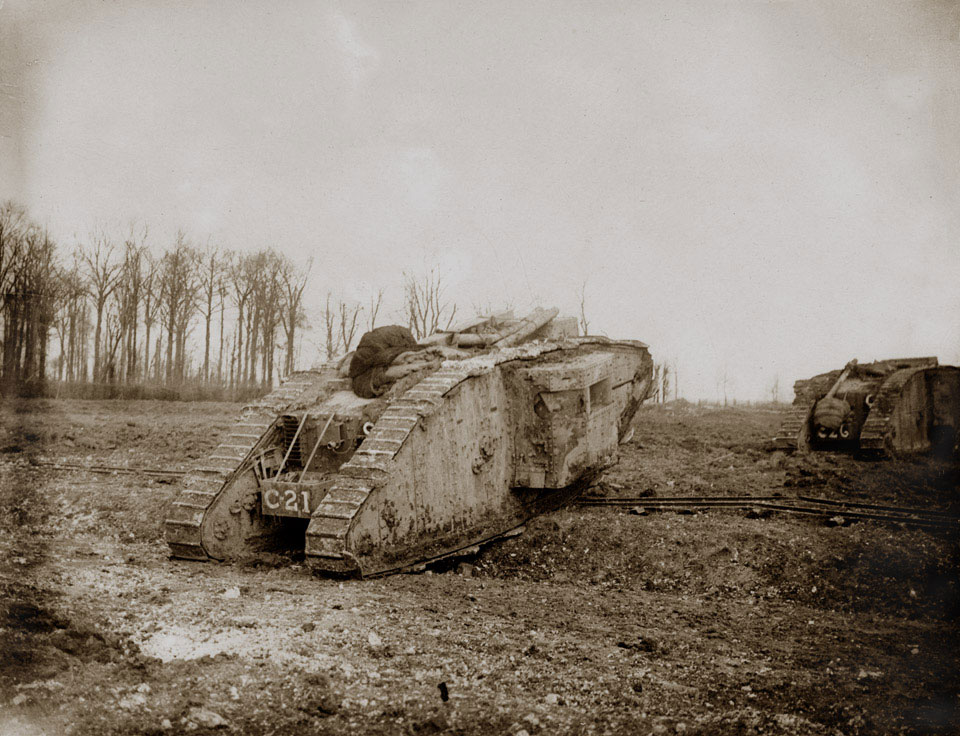 Two 'Mark II Tanks (C21 and C26) of 'C' Battalion The Tank Corps go into action during the Battle of Arras. National Army Museum, Out of Copyright
Two 'Mark II Tanks (C21 and C26) of 'C' Battalion The Tank Corps go into action during the Battle of Arras. Over 50 Mark IIs took part in that engagement and several were knocked out by German gunners firing armour-piercing machine gun ammunition.
The enemy attached the greatest importance to this attack, in which he hoped to recapture the Vimy Ridge and carry the ground east of Lens. "After a bombardment of great violence," state the official despatches, "three fresh German divisions advanced to the assault along the northern bank of the Scarpe River: they were supported by the two German divisions already in the line.
The enemy's immediate objective was to gain the general line Vimy-Bailleul-St. Laurent-Blangy. On the following day, three special assault divisions were to carry the Vimy Ridge.
 A captured German concrete gun emplacement amongst the shattered trees of Farbus Wood. National Army Museum, Out of Copyright
"Immediately south of the Scarpe four German divisions were engaged, two of which were assigned the tasks of capturing Arras and the heights overlooking the town. This assault, the weight of which fell on the 3rd and 15th British Divisions, was supported by powerful attacks in which eleven hostile divisions were engaged along our whole front southwards to beyond Bucquoy."
A second attack, north of the Scarpe, launched during the afternoon after another heavy bombardment, was also completely repulsed and, broken and disappointed, the enemy fell back to his original line.
 New Zealand troops loading ammunition limbers near Albert, 1918. National Army Museum, Out of Copyright
In late 1917, the British Army decided to attack Hindenburg Line (German Defensive position) at Cambrai in France. The main objective of this offensive was to gain control of the area and the destruction of the Hindenburg Line to weaken German strength in the West Front. After detailed consideration, the British army decided to attack German forces with a new strategy using a combination of artillery-infantry tactics and a sizeable engagement of tanks.
It is estimated that the British forces suffered 44,000 casualties and lost 179 tanks in the Battle of Cambrai.
 The 4th Battalion was part of the 88th Brigade in 29th Division. The unit is pictured here going back to the rear for a rest after sustaining heavy losses during the Battle of Cambrai in 1917. National Army Museum, Out of Copyright
The Battle of the Sambre in November 1918 was one of the last Allied offensives of the 'Hundred Days' - a series of attacks launched on the Western Front in the aftermath of the Battle of Amiens the previous August. Although elements of the German Army continued to resist and inflict high casualties on the Allied attackers, by this stage of the war German morale was declining and thousands of men were surrendering on a daily basis.
 Thousands of German prisoners captured in the final rout of the German armies on the Sambre, 1918. National Army Museum, Out of Copyright
Sidney's war ended at Athis, north of Bavaria, Belgium.
After the War
In 1920, Sidney and his wife Hilda were living back at 26, Daimonds Lane, Teignmouth.
In 1930, they had moved to 19a, Bank Street.
In 1939, the family had moved to 22A, Fore Street, Teignmouth. Sidney is a Cabinet Maker and Decorator.
Hilda May Adams died in 1970 and was buried in plot 2Q90 of Teignmouth Cemetery on the 23rd of March 1970.
Sidney Thomas Adams died in 1975 and was buried in plot 2Q90 on the 31st of July 1975.
 Inscription: In loving memory of Hilda Adams nee Wood 1888 - 1970 also Sidney Adams 1889 - 1975 R.I.P.
Inscription: In loving memory of Hilda Adams nee Wood 1888 - 1970 also Sidney Adams 1889 - 1975 R.I.P.
