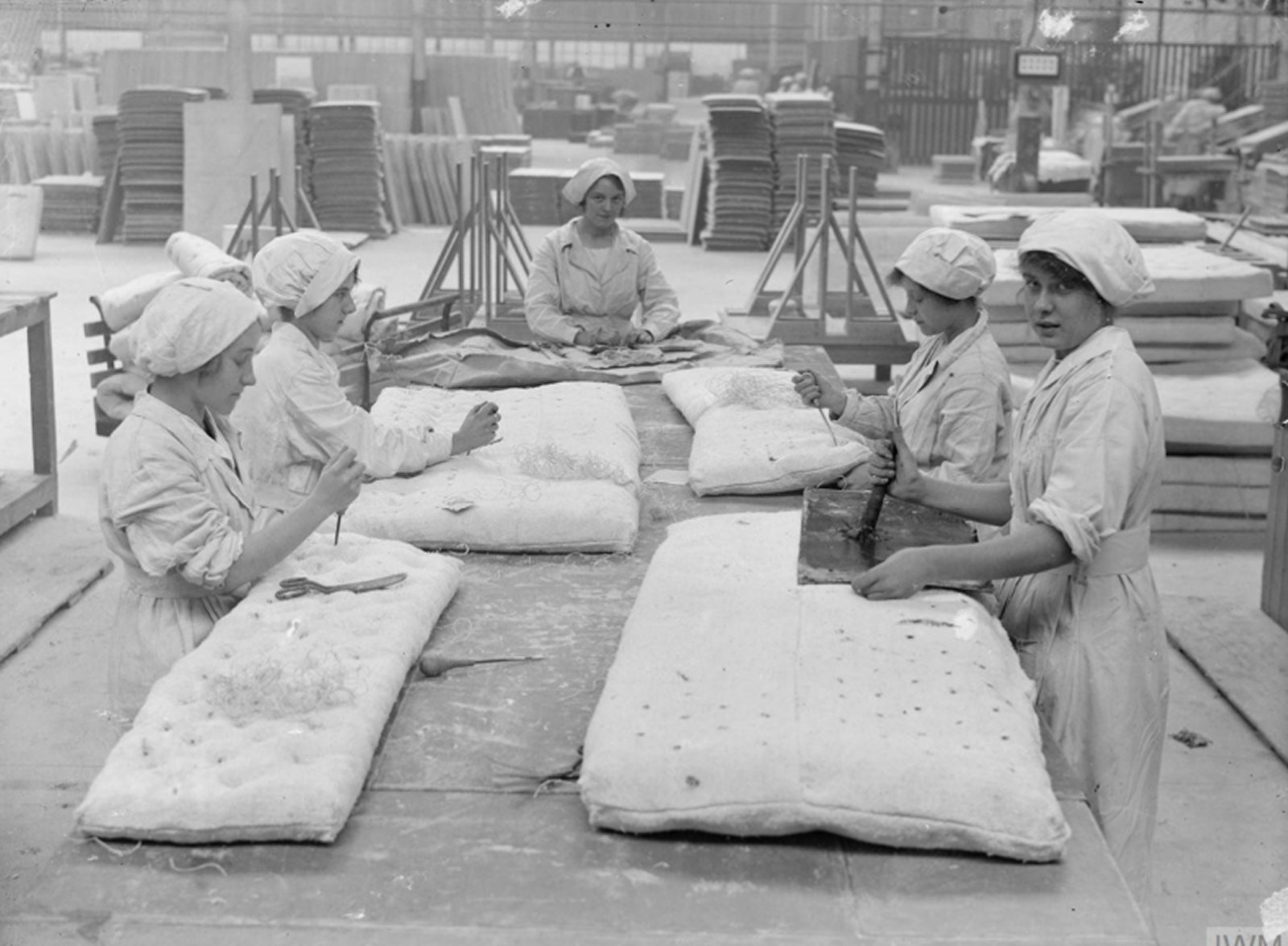
For many women the war was "a genuinely liberating experience".
By taking an active part, they were not only participating fully, but finally had freedom and wages, previously only enjoyed by men.
 Munitionettes. Two female workers push a truck load of shell cases at the Royal Arsenal. © IWM (Q 27847)
Approximately 1,600,000 women joined the workforce between 1914 and 1918.
Roles included working in Government departments, public transport and in the post office, as clerks, land workers and in factories.
Factory work included working in the dangerous munition factories. By Armistice Day, 950,000 women were employed in these factories, compared to 700,000 in Germany.
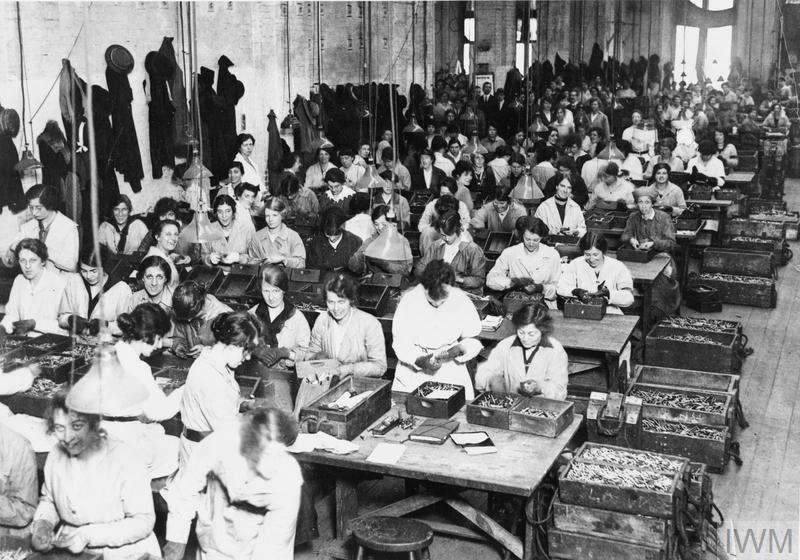 Female workers in the examination room where cartridges and bullets are given their final inspection. © IWM (Q 110355)
Women were excellent workers, surprising men with their ability to undertake heavy work and with efficiency.
By the middle of the war they were regarded as a force to be proud of, part of the glory of Britain.
However, at the start of the war, the women were greeted with hostility for the usual sexist reasons. Also, the men were worried that because women would work for lower wages, they would be put out of work.
Munition Factories
With the majority of the men now at the Front, women were needed to complete complex skills tasks for which they had no training. Factories therefore broke intricate tasks into simpler activities so that the untrained women workers could easily carry out.
 A trolley loaded with shells is driven across a busy factory floor. 21 August 1917. © IWM (Q 30023)
The women employed in munitions factories were known as munitionettes.
Munitionettes produced 80% of the weapons and shells used by the British Army.
Daily they risked their lives working with poisonous substances without adequate protective clothing or the required safety measures.
These brave women were astonishingly seen as cheap, easily replaceable labour.
 83 tonnes of TNT exploded at the explosives factory in London. 19 January 1917. © IWM (Q 15364)
The Canaries
The 'canaries' (nicknamed because of the yellow tinge that their skin, exposed to sulphur, acquired) experienced dreadful working conditions.
Trade-unionist Mary MacArthur of the Women's Trade Union League, led a campaign to demand the women were paid as much as the men doing the same job. The women only got half the men's wages. By the end of the war there was little change.
The Women's Land Army
The Government also invited women to join the ranks of the Women's Land Army, offering cheap female labour to farmers not always keen to employ women.
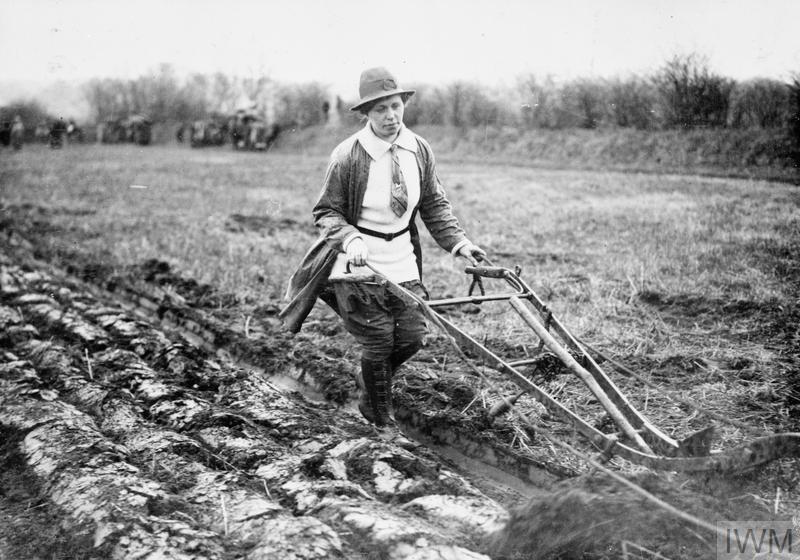 A member of the Women's Land Army operating a single-furrow plough on a British farm. © IWM (Q 54607)
260,000 women volunteered and were given little more than a uniform and orders to work hard.
Fuel restrictions meant manual physical labour unavoidable.
Women remained positive accepting hardship in order to make working the land as cheap as possible.
At the end of the war, women were at the forefront of the painful process of re-adjusting to the return of loved ones from the battlefields.
Hundreds of thousands of men returned from the war injured in some way. Women bore a large part of the burden of caring for these men.
Many women lost their fathers, husbands, lovers, brothers and sons.
For all of these women, life would never be the same.