
Teresa March
Nurse, Voluntary Aid Detachment (VAD), British Red Cross
Date of Birth: Quarter 2, 1892
Place of Birth: Teignmouth, Devon
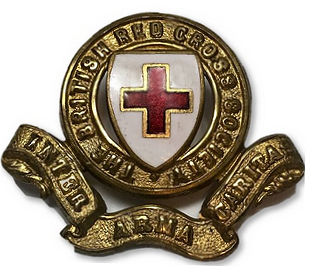 VAD hat badge
Teresa March was born in the 2nd quarter of April 1892 in Teignmouth, Devon.
Her mother was Rosura March, she was born c. 1861 in Peru.
Teresa's father was Edward Bernard March (1843-1919), he was a British Consul to Fiji and later to Callao, Peru. Edward was born in Spain.
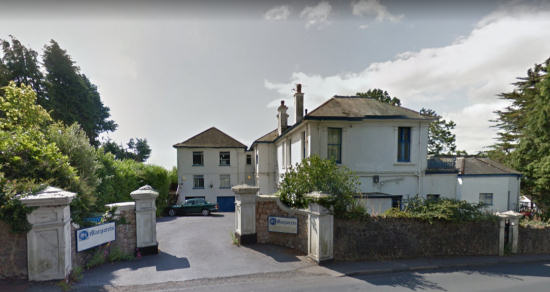 The building that was Pentlands, New Toad, Teignmouth. Image Capture July 1915 © 2019 Google (cropped)
In 1891 Teresa's parents and some of her siblings were living at Pentlands, New Road Teignmouth.
At this Teresa's father had retired from the Diplomatic Service and Teresa had not yet been born.
The children were all of school age and the family had three servants (Anne Dougherty, Thurza Bryant, Rosa Moyer) and a Governess (Alexa Penwarden) living with them.
| Teresa and her siblings | |
| Father Leopold March (priest) 1882–1969 |
Major Bernard Oswald March |
| Mary March 1884– |
Grace Francisca March 1886–1919 |
| Mercedes March 1888–1985 |
Private George Frederick March 1889–1917 |
| Teresa March (VAD) Nurse 1891–1921 |
Joseph Cyril March 1897–1970 |
In 1901 the family were still at Pentlands and there were two young additions to the family Teresa and Cyril (Joseph). Leopold was becoming a Roman Catholic priest and Bernard was elsewhere.
Teresa's paternal Grandmother Marcella March (born c. 1820 in Spain) had joined the family at Pentlands by 1901. Marcella died on 30 January 1907 aged 87 and is buried in the Catholic ground of Teignmouth Old Cemetery grave F65.
 61 Parkwood-road, Boscombe. Image capture: Jun 1019 © Google
After Marcella's death the family left Teignmouth and in 1911 Teresa, her parents and her siblings Mary, Grace and Mercedes were living at 38 Grove Road Ramsgate.
They had one live-in servant living with them.
Bernard had become a police officer and Joseph was at boarding school in Ware, Hertfordshire.
Before the outbreak of WW1 Teresa's brother George had been working as a China Customs Officer (Peking).
He was a Territorial with the Inns of Court Officers Training Corps and was embodied in 1916. George had contracted tuberculosis whilst in China and died in a sanatorium in the Royal Chelsea hospital in 1917. His home address at the time was 61 Parkwood Road Boscombe (Bournemouth) Dorset.
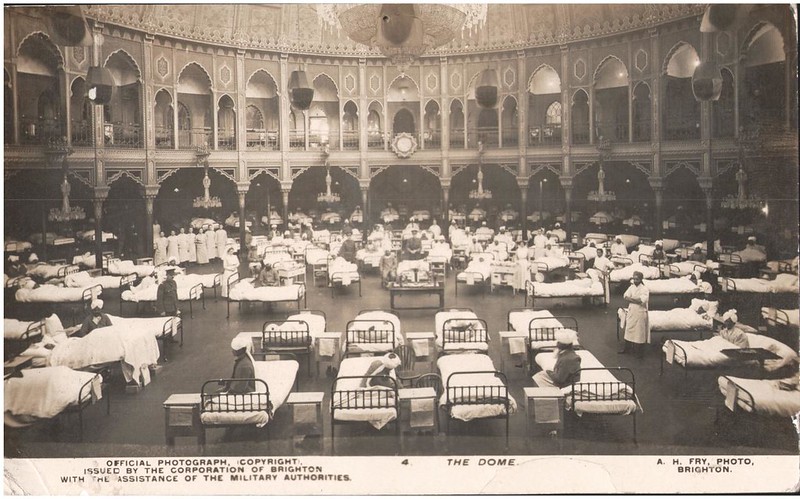 The converted Royal Pavilion in Brighton Indian war hospital. Postcard. Public Domain
Teresa was engaged with V.A.D. (Voluntary Aid Detachments) from April 1917 - October 1918.
She served as a Nurse at the Brighton Military Hospital and at the Netley Royal Victoria Military Hospital, Near Southampton, Hampshire.
Theresa gave her permanent address as 61 Parkwood Road, Boscombe when she joined VAD.
She died soon after the war in 1921 aged 29 in Christchurch, Bournemouth.
Several buildings in Brighton were converted into hospitals during the First World War to treat the thousands of Indian soldiers who were wounded while fighting in France.
Netley Royal Victoria Military Hospital, Hampshire.
During WW1 the regular Army Nursing Corps of the hospital were serving overseas so most of the staff at Netley were Army Nurse Reserves or Red Cross V.A.D. (Voluntary Aid Detachment) nurses.
Women, often as young as 18, many with no previous medical experience, found themselves nursing wounded men from the front.
Men who had lost arms, legs, faces, or who watched their brothers be blown into pieces.
A railway line allowed up to three ambulance trains a day to bring wounded direct from Southampton docks.
Netley had a military asylum, called D Block where men with the most severe psychosis were treated.
A half of all the men in WW1 suffering "shellshock" went to Netley.
This was the largest military hospital ever built, town-sized, covering 200 acres, with its own gasworks, school, stables, bakery, reservoir and prison.
Before WW1 the brick hospital was a quarter of a mile long, with over a thousand beds. In 1914, an extension was built to allow for 2,500 more beds by building a large Red Cross hospital of huts in fields at the rear of the main hospital.
In total some 50,000 patients were treated at Netley in WW1.
There is a serious prevalence of desertion to avoid duty in the trenches, especially in the 8th Brigade and I am sure that the only way to stop it is to carry out some death sentences.
General Sir Horace Smith-Dorrien, commander of the 2nd Army (reviewing a case in 1915)
Voluntary Aid Detachment (VAD) Records
Date of engagement with VAD: 13th April, 1917 to 22 October, 1918.
Rank: Nurse.
Service rendered at:
Brighton Military Hospital.
Netley Royal Victoria Military Hospital, Near Southampton, Hampshire.
Voluntary Aid Detachment (VAD) Cards
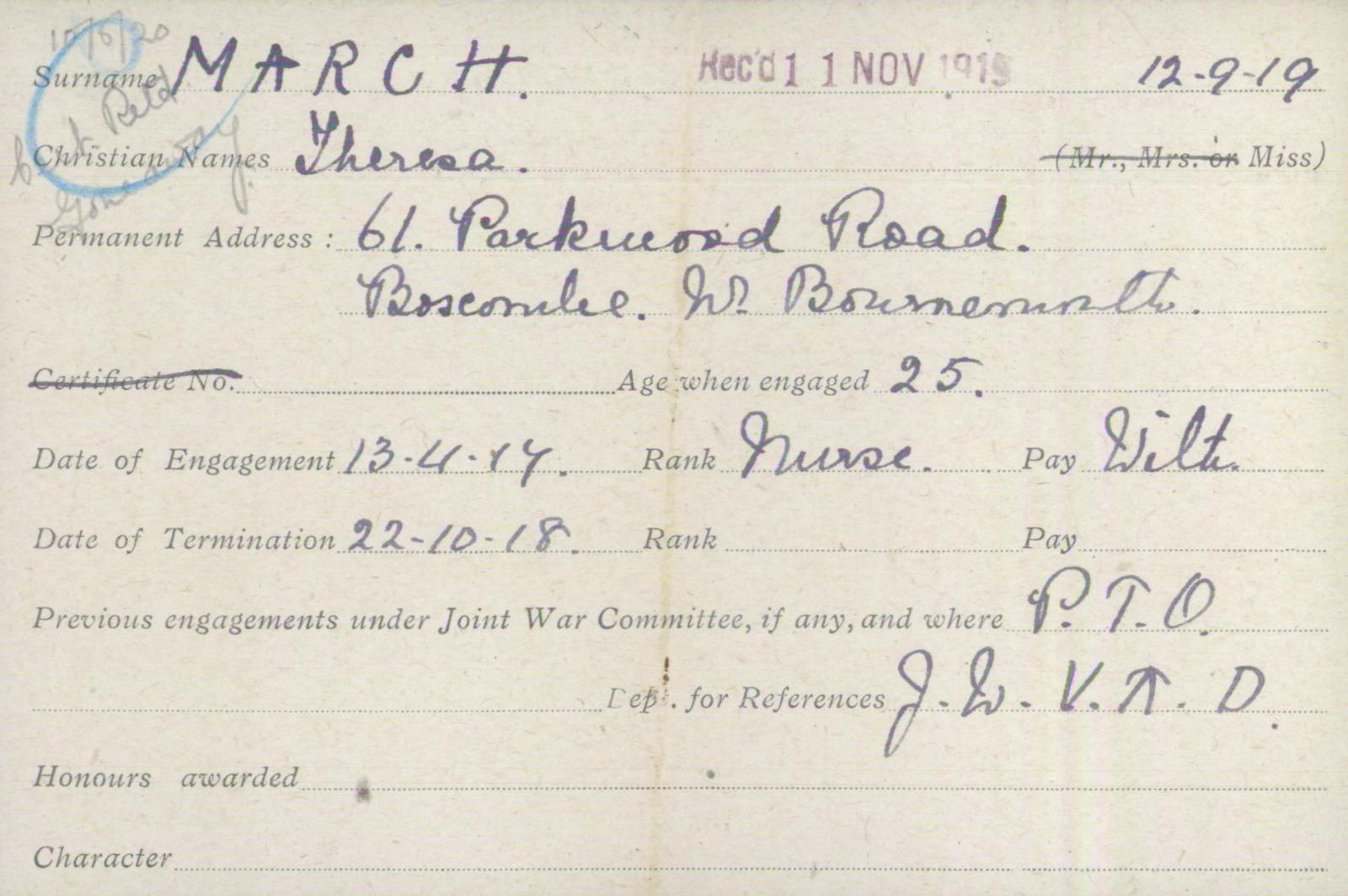 Voluntary Aid Detachment (VAD) Card. ©2018 British Red Cross (CC BY-NC 2.0 UK)
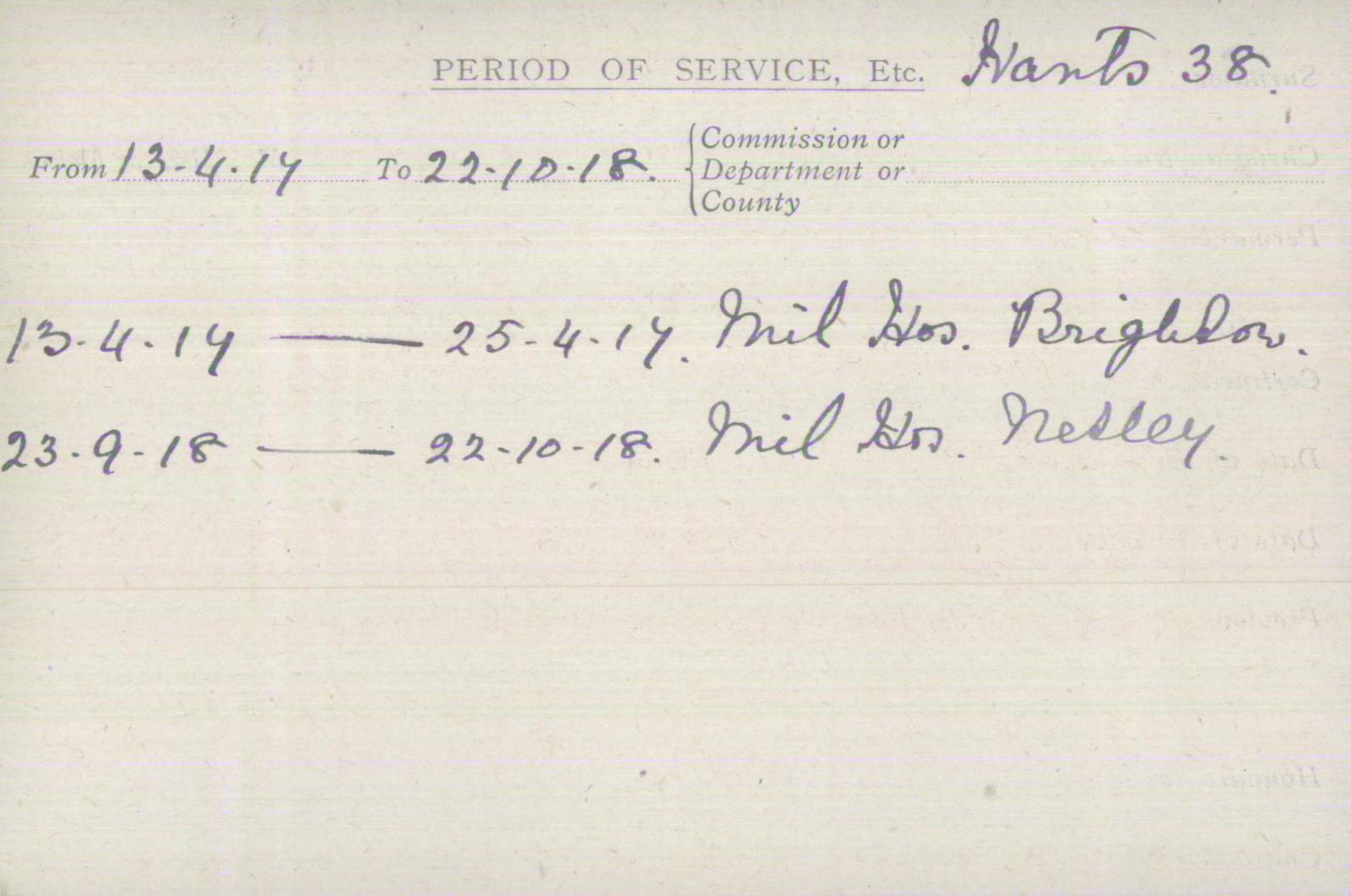 Voluntary Aid Detachment (VAD) Card. ©2018 British Red Cross (CC BY-NC 2.0 UK)
