World War 1: Inshore fisheries in Devon
A much neglected aspect of the Home Front.
Fish ‘Free’ Food
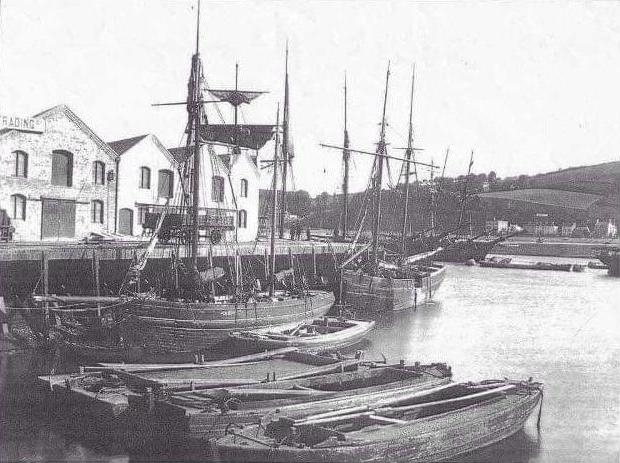 The Teignmouth Quay from the Teign Heritage collection
Although there had been a steady decline in fishing in the years before 1914, the nation’s inshore (as opposed to deep sea) fishing industry was largely based in Devon and Cornwall. The main catches were herring, mackerel and sprats as well as lobsters. Herring was salted and exported to Germany and Russia.
The Ministry of Agriculture and Fisheries set up the so-called Devon and Cornish Committee (1912/13) to address the fishermen’s increasing concerns and proposed:
- Fisheries to be on equal status with agriculture.
- Centrally funded from London
- Improved landing sites
- Local Inspector
- Funding of engines for fishing boats
- Co-operative marketing
- Fishing boat insurance
The outbreak of war in August 1914 helped hasten the implementation of these recommendations, despite the disruption and closure of selected fishing grounds which were required by the Royal Navy. Another major difficulty was the depletion of manpower as many fishermen had been trained in the Royal Naval Reserve (RNR) and were immediately called up. It was common for at least half a family of fishermen to join the RNR and the remainder, often the older or less fit ones, to stay behind to support the wives and children.
The first major setback to affect the county was the sinking of HMS Monmouth at the Battle of Coronel in November 1914; the entire crew (735) drowned and many were RNR former Devon fishermen.
Permits were required for fishing in selected local waters and heavy fines were imposed on those who breached the regulations. In 1916 conscription was introduced which resulted in considerable tension between the remaining fishermen and the Royal Navy at Devonport in Plymouth.
The navy neither understood nor was interested in the fishing industry; for example fishing boats were unnecessarily commandeered.
Fishermen were by nature hardy and often fearless but not all were well suited to taking orders from those who very likely had less experience of the sea.
Stephen Reynolds was appointed District Inspector for the South-West Naval Command and was based in his hometown, Sidmouth, in Hope Cottage (now the Museum). He was a fisherman before the war and his loyalties were always with the fishermen, despite their anger should they be conscripted.
As the war progressed, and as the German U-Boat threat depleted merchant ships, so the importance of fish as ‘free’ food increased. The nation was urged to eat more fish and imaginative ways of preparing herring were described in leaflets and newspaper articles, such as ‘Tasty Ways of cooking Fish’ and ‘Herring – the King of Fish’. The success of the inshore fishing industry, by the time hostilities ceased, can be judged by the fact that fish was never rationed unlike many other foods, including meat.
Spratts are important
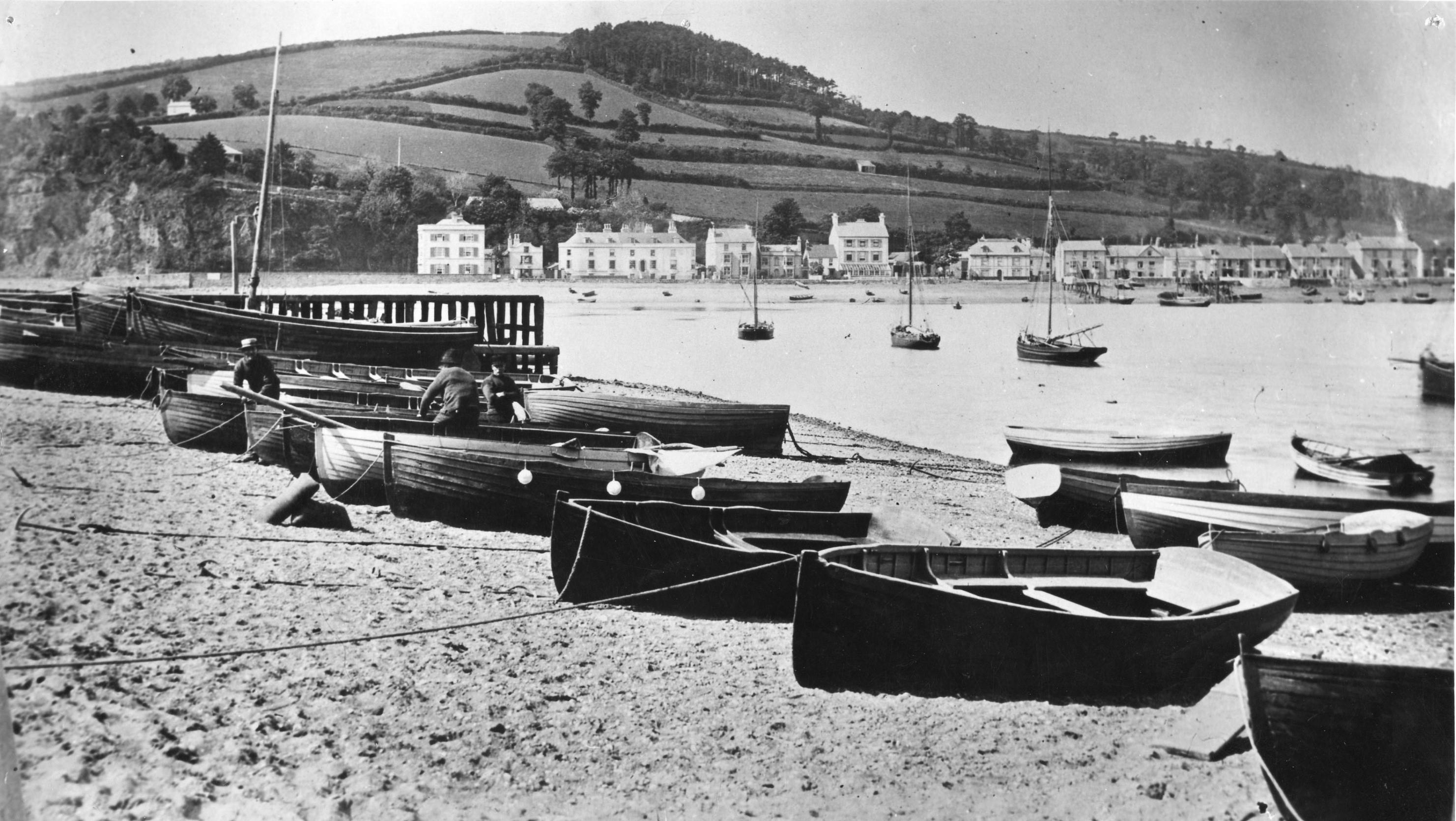 Boats on Teignmouth back beach from the Teign Heritage collection
In Teignmouth and Shaldon 1900 - 1925
The town of Teignmouth, Devon is situated on the east side of the mouth of the river Teign; a road bridge crosses the river to the village of Shaldon on the west bank. Both places were associated with the fishing and boatbuilding industries in this area.The 1901 census shows a population of 8,499 with a figure of 202 fishermen and boys in 1900.
1914-1919
Another 13 boats came onto the register in the period from 1914 - 1917, of these, 8 are fitted with motors as the local fishermen are realising the advantages of using this type of boat. The majority of the boats are larger than before averaging 24 - 25 ft. in length and mainly carrying 3 or 4 crew members.
Thus at the beginning of August 1914, many of the RNR reservists were called up and were seen hurrying away by train in the first week. Due to the haste of this call up many men were unable to complete the separation allowance forms, leaving their families with no income. This was brought to the attention of the local council and reported in the Teignmouth Post.
Arrangements were made to help the families until the problem could be addressed. The call up affected many of the local families and there are records showing several fishing families where the majority of the sons served during the war.
In a couple of cases the parents who were often elderly carried on the fishing and there are instances in the local newspaper from 1916 onwards, following the National Conscription Act, of appeals for the youngest son to remain to work in the fishing industry as all his elder brothers are already serving.
We know of at least 6 young fishermen who were killed during the war.In February 1915, local pilots were called up to take charge of patrolling craft who were watching the coast for submarines.
During this year the sprat season was very poor, with only a couple of good catches throughout the whole year, but there were reasonable supplies of crab. This led to three Teignmouth men being prosecuted for illegally fishing in the close season and catching mullet in a small mesh net which was also illegal.
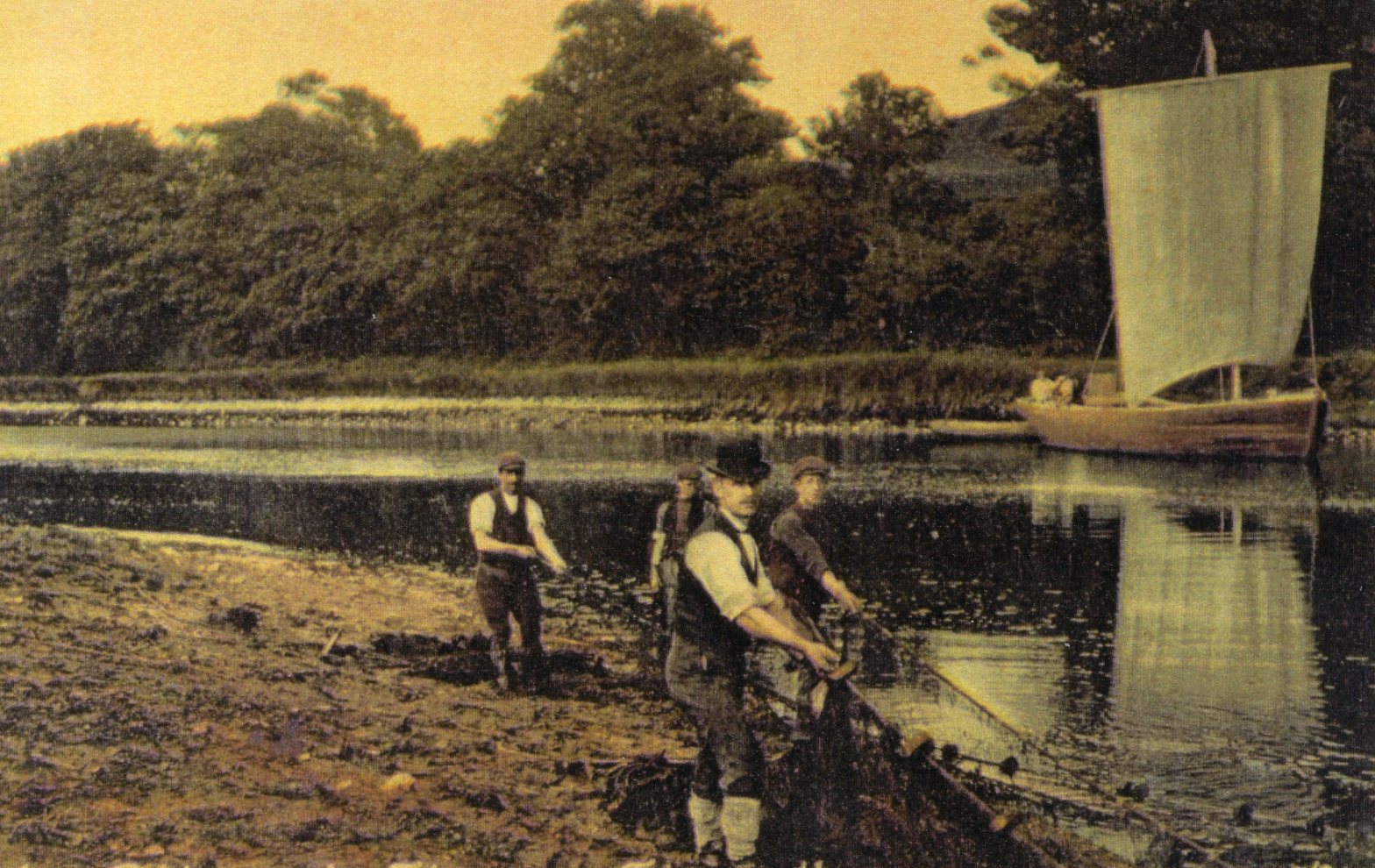 Salmon fishing on the Teign Kind thanks to the Ball Clay Heritage Society
Visit the Ball Clay Heritage Society web site to learn more, and see an extensive gallery of local photographs relating to the ball clay industry.
They had notified the water bailiff about what they were going to do and the event took place in the river Teign above the Shaldon Bridge on 29th December. Their defence was that “they were doing good for the people due to the poor season”. They were fined £3 each. Ironically, a month later in January 1916, large quantities of herrings and sprats were caught, these all made a good amount of money with the majority being packed and sent to the up-country markets.
The smallest fish were kept for the local market. The local fishermen gave a barrel of fish for the benefit of the hospital. Meanwhile the advent of submarines off the south Devon coast meant that fishing became more dangerous for both inshore and offshore fishermen.
 Fishing trawler © IWM (Q 19012)
To cut down on these risks the Motor Loans Committee installed motor engines in more fishing boats. A quote from Hansard states “A motor fishing boat is able to follow and catch the fish and hustle back into harbour and catch the train, and the fishermen now are often saying they would sooner be without their boats than without their engines.” (Hansard - 26 May 1916, 1841) More shoals of fish were caught up the coast at Budleigh Salterton, and the Teignmouth men who had invested in motor boats saw very good returns as they were able to travel there and back far more quickly.
Supplies of fish continued to increase during this year and also in 1917, when Teignmouth men were allowed to fish with seine nets for mullet in the river during the close season to help maintain food supplies, as long as they obtained permission first.
In December 1917 at a meeting of Devon County Council the possibility was discussed of withdrawing protection afforded to gulls, as they were destroying the mussels which were laid out on the “Salty” for four hours for cleansing. The Western Times reported that the council were told; “The fishermen of Teign deserve well of the county, as no less than 75% of the men had joined the Colours and there was nobody left behind but ‘old crocks’”.
After discussion it was decided to look into the benefits of the cleansing and report back to the council. In 1917/1918 there are instances of large catches of sprats being caught, but due to a shortage of men and carts, much of the fish was unable to be sent to market, but were sold locally and sometimes wasted. No new boats came onto the register during 1918/1919 and six of the existing boats are sold outside of Teignmouth during this period.
