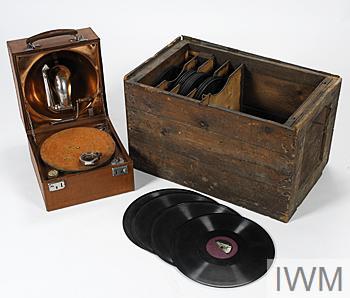
 Portable Decca gramophone and 32 records stored inside a wooden box originally for ammunition. © IWM (EPH 7660)
The songs popular in World War 1 were often more than just simple entertainment.
Some were adopted by the troops themselves, sometimes as marching songs, sometimes as early forms of protest, but often just as a wistful lament for home.
On the home front, for many families, popular songs expressed their feelings of hope and loss and they would listen to them at the music hall or, if they were lucky, at home on a Gramophone.
Governments recognised the potential of popular songs for propaganda. Many songs employed subtle propaganda, for instance promoting a rosy view of the home front and promoting it as an ideal worth fighting for, whilst other songs were more forthright.
Broadly, World War 1 songs can fall into these categories:
- Marching Songs
- Barrack Room and Trench Songs
- Recruitment Songs
- Marching Songs
 Bronze statue commemorating Jack Judge in Stalybridge, By Cyan22 CC BY-SA 3.0
One of the most popular songs of the war was "It's a Long Way to Tipperary", the story of a young Irishman who leaves his best girl behind to find his fortune in London.
The song was written a couple of years before the war, in 1912.
Legend has it that the composer, music hall singer Jack Judge, composed the song in a pub for a bet.
The wager was that he couldn't write a song in time for the following evening's performance.
He won his five shilling bet and his song soon saw service as a marching song when it was adopted by British soldiers.
It's a long way to Tipperary
One of the first regiments to march to the song were the Connaught Rangers, who sang it as they marched from Boulogne at the very beginning of World War One. The Daily Mail's war correspondent reported seeing their march on 13th August 1914 and the paper published the story days later.
Soon more regiments were singing the song and in November John McCormack, a famous tenor, recorded the song. It became a worldwide hit, and the lyrics were adapted to suit other nationalities.
It's a long way to Tipperary
It's a long way to Tipperary,
It's a long way to go.
It's a long way to Tipperary,
To the sweetest girl I know.
Goodbye Piccadilly,
Farewell Leicester Square,
It's a long, long way to Tipperary,
But my heart's right there.
"Pack All Your Troubles (In Your Old Kit Bag)"
This was another music hall song that was adopted by the troops for marching.
Written in 1915 by George Powell under the pseudonym George Asaf, the song was entered into a competition for the best morale building song.
It won and became a classic, although in retrospect its cheery optimism jars with the dreadful reality of trench life, a fact noted by war time poet Wilfred Owen.
George Powell's brother Felix, a Staff Sergeant, wrote the music for the song, but George himself was a pacifist and became a conscientious objector when conscription was introduced.
The poet Wilfred Owen took a line from "Pack All Your Troubles", a song he would himself have heard in France, and composed his own bitter, satirical poem inspired by one of the lines: Smile, Smile, Smile.
Pack up your troubles in your old kit bag
Pack up your troubles in your old kit bag
And smile, smile, smile.
While you’ve a ucifer* to light your fag,
Smile boys, that’s the style.
What’s the use of worrying?
It never was worthwhile so,
Pack up your troubles in your old kit bag
And smile, smile, smile.
(* lucifer - a brand of matches)
"It's a Long Way to Tipperary" and "Pack All Your Troubles" were by no means the only marching songs, but they were two of the most popular. Not all marching songs were so sentimental; others were more cynical and some would have been downright bawdy and probably frowned upon by the officers. Which leads onto the nect category....
Barrack Room and Trench Songs.
Marching song:
Goodbye
Brother Bertie went away
To do his bit the other day
With a smile on his lips
and his Lieutenant's pips
upon his shoulder bright and gay
As the train moved out he said,
'Remember me to all the birds.'
And he wagg'd his paw
and went away to war
Shouting out these pathetic words:
Goodbye-ee, goodbye-ee,
Wipe the tear, baby dear, from your eye-ee,
Tho' it's hard to part I know,
I'll be tickled to death to go.
Don't cry-ee, dont sigh-ee,
there's a silver lining in the sky-ee,
Bonsoir, old thing, cheer-i-o, chin, chin,
Nap-poo, toodle-oo, Goodbye-ee.
"Oh! It's a Lovely War", with its first line "Up to your waist in water, up to your eyes in slush, using the kind of language that makes the sergeant blush" probably gives a better picture of the life of the troops than many other songs. The song inspired the title of the musical film, "Oh! What a Lovely War" and was featured in the film, along with many other popular World War One songs.
Oh it’s a lovely war!
Up to your waist in water, up to your eyes in slush,
Using the kind of language that makes the sergeant blush,
Who wouldn’t join the army? That’s what we all enquire.
Don’t we pity the poor civilian sitting by the fire.
(Chorus)
Oh, oh, oh it’s a lovely war.
Who wouldn’t be a soldier, eh? Oh it’s a shame to take the pay.
As soon as reveille has gone we feel just as heavy as lead,
But we never get up till the sergeant brings our breakfast up to bed.
Oh, oh, oh, it’s a lovely war
What do we want with eggs and ham when we’ve got plum and apple jam?
Form fours. Right turn. How shall we spend the money we earn?
Oh, oh, oh it’s a lovely war.
When does a soldier grumble? When does he make a fuss?
No one is more contented in all the world than us.
Oh it’s a cushy life, boys, really we love it so:
Once a fellow was sent on leave and simply refused to go.
(Chorus)
Oh What A Lovely War was written in 1917 by J.P.Long and Maurice Scott as a music hall tune and adapted by the soldiers. This is the version which is now taken to be the original.
----------
Barrack Roomand Trench Songs
Daily life in the trenches or further behind the lines could be monotonous and soldiers would amuse themselves by singing. Not all of their songs were music hall fare and many of them probably wouldn't have sung these songs in front of their mothers or sweethearts. One favourite was "Mademoiselle from Armentieres", a song to which many new verses, rarely complimentary to the mademoiselle, were added. The song was often known as "Hinky Dinky Parley Voo". Another version, to the same tune, was "Three German Officers Crossed the Rhine" which concerned the amorous adventures of the three officers and an inn-keeper's enthusiastic daughter, all couched in very Anglo-Saxon language, none of which would be repeatable in a sitting room back home.
Officers would probably have disapproved of the bawdier songs, but turned a deaf ear. However, they would probably have complained about the songs which began to emerge in the trenches which had a more anti-war and anti-establishment theme. "Hanging on the Old Barbed Wire" poked bitter fun at the politicians and army hierarchy who were out of harm's way whilst the whole battalion were "hanging on the old barbed wire". Again, "Bombed Last Night" was not popular with officers, as it bemoaned the lack of gas respirators, "one respirator for the four of us".
Hanging on the Old Barbed Wire
If you want to find the lance-jack, I know where he is
I know where he is, I know where he is
If you want to find the lance-jack, I know where he is
He's scrounging round the cookhouse door.
I've seen him, I've seen him
Scrounging round the cookhouse door, I've seen him,
Scrounging round the cookhouse door.
The company sergeant...He's laying on the latrine floor
The quarter master...Miles and miles behind the lines.
The sergeant-major...Thieving all the squaddies' rum.
The buckshee private...Buried in a deep shell hole.
The C.O....Down in a deep dugout.
The brasshats...Drinking claret at Brigade HQ.
The politicians....Drinking brandy at the House of Commons bar.
The whole battalion...Hanging on the old barbed wire.
lance-jack - lance-corporal
quarter master - officer in charge of supplies
sqaddies - ordinary soldiers
buckshee private - ordinary soldier
C.O. - Commanding Officer
brasshats - senior officers
battalion - army unit
Bombed last night
Bombed last night, and bombed the night before.
Going to get bombed tonight if we never get bombed anymore.
When we're bombed, we're scared as we can be.
Can't stop the bombing from old Higher Germany.
They're warning us, they're warning us.
One shell hole for just the four of us.
Thank your lucky stars there are no more of us.
So one of us can fill it all alone.
Gassed last night, and gassed the night before.
Going to get gassed tonight if we never get gassed anymore.
When we're gassed, we're sick as we can be.
For phosgene and mustard gas is much too much for me.
They're killing us, they're killing us.
One respirator for the four of us.
Thank your lucky stars that we can all run fast.
So one of us can take it all alone.
“Bombed last night” is again an original song from the war, and is typical of much trench music. Firstly, it is sung as a chant; enabling soldiers of all voices to join in. Secondly, it relies on repetition and imagination on the soldiers’ behalf. This meant that one soldier could “lead”, making up the lyrics, which everyone else could then accompany him. Other verses include “Drunk last night” and “shelled last night”
I want to go home
I want to go home, I want to go home.
I don't want to go in the trenches no more,
Where whizzbangs and shrapnel they whistle and roar.
Take me over the sea, where the Alleyman can't get at me.
Oh my, I don't want to die, I want to go home.
I want to go home, I want to go home.
I don't want to visit la Belle France no more,
For oh the Jack Johnsons they make such a roar.
Take me over the sea, where the snipers they can't get at me.
Oh my, I don't want to die, I want to go home.
----------
Forward Joe Soap's Army (Tune: 'Onward Christian Soldiers')
Forward Joe Soap's army, marching without fear,
With our old commander, safely in the rear.
He boasts and skites from morn till night,
And thinks he's very brave,
But the men who really did the job are dead and in their grave.
Forward Joe Soap's army, marching without fear,
With our old commander, safely in the rear.
Recruitment Songs
Many World War One songs had an element of propaganda woven into the lyrics, whether it was plain old patriotism or the picture of a home worth defending. Some had more a more forthright message and were clearly recruitment songs. These tended to be more popular at the beginning of the war; by 1916 the army couldn't rely on the power of song to fill the ranks and conscription was introduced.
Paul Rubens' song "Your King and Your Country Want You" was a firm music hall favourite at the start of the war. They lyrics praise a young man's sporting prowess, but tell him that it is now time to join up as he is needed for the war. He is promised that he will be missed but loved no matter what fate befalls him. The song was also sung at recruitment rallies and those young men who resisted its enlistment message would often be handed white feathers.
"I'll Make a Man of You" was another music hall recruiting song, a little saucy in tone. The young lady singing the song recalls her many "suitors", all of them young men in uniform. She has made men of them all. Her one woman plan for solving the army and navy's recruitment woes is that she is "willing, if only you'll take the shilling, to make a man of any one of you".
Some soldiers may have remembered hearing "I'll Make a Man of You" and parodied it in the song "I Don't Want to Join the Army", a song very bitter in tone in which a man says that he doesn't want to go to war and get shot to pieces but would rather stay in England living off the earnings of a "lady typist", or in another version "a high class lady" (presumed to be euphemisms for a prostitute) and fornicate his life away.
I'll make a man of you(music hall recruitment song)
The Army and the Navy need attention,
The outlook isn't healthy you'll admit,
But I've got a perfect dream of a new recruiting scheme,
Which I think is absolutely it.
If only other girls would do as I do
I believe that we could manage it alone,
For I turn all suitors from me but the sailor and the Tommy,
I've an army and a navy of my own.
On Sunday I walk out with a Soldier,
On Monday I'm taken by a Tar,
On Tuesday I'm out with a baby Boy Scout,
On Wednesday a Hussar;
On Thursday a gang ootwi' a Scottie,
On Friday, the Captain of the crew;
But on Saturday I'm willing, if you'll only take the shilling,
To make a man of any one of you.
I teach the tenderfoot to face the powder,
That gives an added lustre to my skin,
And I show the raw recruit how to give a chaste salute,
So when I'm presenting arms he's falling in.
It makes you almost proud to be a woman.
When you make a strapping soldier of a kid.
And he says 'You put me through it and I didn't want to do it
But you went and made me love you so I did.'
On Sunday I walk out with a Bo'sun.
On Monday a Rifleman in green,
On Tuesday I choose a 'sub' in the 'Blues',
On Wednesday a Marine;
On Thursday a Terrier from Tooting,
On Friday a Midshipman or two,
But on Saturday I'm willing, if you'll only take the shilling,
To make a man of any one of you.
----------
I don't want to join the Army
I don't want to join the army,
I don't want to go to war.
I'd rather hang around dear old London town,
Living off the earnings of a lady typist.
I don't want a bayonet in my belly,
I don't want my bollocks shot away.
I'd rather stay in England, in merry, merry England,
And fornicate this bleedin' life away.
Taken from the music hall song “On Sunday I walk out with a sailor” this song reverses recruitment propaganda into intensely resentful verse. A "lady typist" is slang for a prostitute.
----------
A Rediscovered WW1 Song: Bravo Bristol!
In 2011 a man researching his family history at the Bristol Records Office chanced upon the sheet music to a long-forgotten World War 1 song. "Bravo Bristol" was written in 1914 by Fred Weatherly and set to music by Ivor Novello. The song was designed to rouse men to join the Bristol Battalion. The writer and composer pledged all proceeds to Battalion funds and after its rediscovery, the song is once again benefiting servicemen.
Extra wartime verse
That's the wrong way to tickle Mary,
That's the wrong way to kiss!
Don't you know that over here, lad,
They like it best like this!
Hooray pour le Francais!
Farewell, Angleterre!
We didn't know the way to tickle Mary,
But we learned how, over there!
Other warmtime songs:
Fred Karno's army
If You Want the Old Battalion
Never Mind
Far, far from Wipers (Soldiers’name for Ypres/Ieper)
Whiter than the Whitewash on the Wall
There’s a Long, Long Trail
Christmas Day in the Cookhouse
Kaiser Bill(Tune: 'Pop goes the Weasel')
They Were Only Playing Leapfrog(Tune: 'John Brown's Body')
I Wore a Tunic(Tune: 'I wore a Tulip')
When This Lousy War is Over(Tune: 'What a friend we have in Jesus')
The Bells of Hell
Keep the Home Fires Burning
And When They Ask Us(Tune: 'They wouldn't believe me')
Fred Karno's army
We are Fred Karno's army, the ragtime infantry.
We cannot fight, we cannot shoot, what bleedin’use are we?
And when we get to Berlin we'll hear the Kaiser say,
'Hoch, hoch! Mein Gott, what a bloody rotten lot, are the ragtime infantry'
Fred Karno was a popular American entertainer who toured the USA with several large companies. Before Charlie Chaplin was signed to Keystone, he was a leading member of this troupe. Ragtime was a popular music style.
--------------------
----------
If You Want the Old Battalion
If you want the old battalion,
We know where they are, we know where they are,
We know where they are,
If you want the old battalion, we know where they are,
They're hanging on the old barbed wire,
We've seen them, we've seen them,
Hanging on the old barbed wire,
We've seen them, we've seen them,
Hanging on the old barbed wire.
A song sung on the march, where the repetitions kept the rhythm and helped to take the soldiers’ minds off the distances they had to travel. The lyrics give a fairly typical view of the war as it is presented today: highlighting the incompetence of the commanding officers, and emphasizing the cannon-fodder attitude to the troops.
----------
Never Mind
If the sergeant drinks your rum, never mind
And your face may lose its smile, never mind
Though he's just a bloody sot, he's entitled to the lot
If the sergeant drinks your rum, never mind
When old Jerry shells your trench, never mind
And your face may lose its smile, never mind
Though the sandbags bust and fly you have only once to die,
If you get stuck on the wire, never mind
And your face may lose its smile, never mind
Though you're stuck there all the day, they count you dead and stop your pay
If you get stuck on the wire, never mind
If the sergeant says your mad, never mind
P'raps you are a little bit, never mind
Just be calm don't answer back, cause the sergeant stands no slack
So if he says you're mad, well - you are.
This is sung to the tune of “If you’re happy and you know it, clap your hands”, and is taken from a 1913 tune.
----------
Far, far from Wipers (Soldiers’name for Ypres/Ieper)
Far, far from Wipers I long to be.
Where German snipers can't get at me.
Dark is my dugout, cold are my feet.
Waiting for whizzbangs to send me to sleep.
Wipers was the soldiers' name for the Belgian town of Ypres, around which the British Army fought three battles.
Whiter than the Whitewash on the Wall
Whiter than the whitewash on the wall!
Whiter than the whitewash on the wall!
Oh wash me in the water that you wash your dirty daughter in,
So that I can be whiter than the whitewash on the wall!
On the wall, on the wall, On the wall, on the wall,
Oh wash me in the water that you wash your dirty daughter in,
So that I can be whiter than the whitewash on the wall!
Hush, here comes a Whizzbang
Hush, here comes a whizzbang.
Hush, here comes a whizzbang
Now you soldiermen get down those stairs
Down in your dugouts and say your prayers.
Hush, here comes a whizzbang,
And it's making right for you.
And you'll see all the wonders of No-Man's-Land,
If a whizzbang, hits you.
A whizzbang is a large shell, named for the noise it made on falling.
----------
There’s a Long, Long Trail
There’s a long, long trail a winding,
Into the land of my dreams.
Where the nightingales are singing,
And a white moon beams.
There’s a long, long night of waiting ,
Until all my dreams come true.
Till the day when I’ll be going down,
That long, long trail with you.
Sentimental songs seem to have been as popular as the more resentful tunes. Songs such as this, The Roses Of Picardy and Keep the Home Fires Burning were sung over and over again in the music halls at home, but there is evidence to show that the soldiers also enjoyed singing them. This was possibly because the songs reminded them of an idealized homeland away from the horror of the trenches.
----------
Christmas Day in the Cookhouse
It was Christmas day in the cookhouse,
The happiest day of the year,
Men's hearts were full of gladness
And their bellies full of beer,
When up spoke Private Shorthouse,
His face as bold as brass,
Saying, 'We don't want your Christmas pudding
You can stick it up your ...'
Tidings of comfort and joy, comfort and joy,
Oh, tidings of comfort and joy!
It was Christmas day in the harem,
The eunuchs were standing round,
And hundreds of beautiful women
Were stretched out on the ground,
When in strode the Bold Bad Sultan,
And gazed at his marble halls,
Saying, 'What do you want for Christmas, boys?'
And the eunuchs answered...
Tidings of comfort and joy, comfort and joy,
Oh, tidings of comfort and joy!
----------
Kaiser Bill(Tune: 'Pop goes the Weasel')
Kaiser Bill is feeling ill,
The Crown Prince, he's gone barmy.
We don't give a cluck for old von Fluck
And all his bleeding army.
----------
They Were Only Playing Leapfrog(Tune: 'John Brown's Body')
One staff officer jumped right over another staff officer's back.
And another staff officer jumped right over that other staff officer's back,
A third staff officer jumped right over two other staff officers' backs,
And a fourth staff officer jumped right over all the other staff officers' backs.
They were only playing leapfrog,
They were only playing leapfrog,
They were only playing leapfrog,
When one staff officer jumped right over another staffofficer's back.
----------
I Wore a Tunic(Tune: 'I wore a Tulip')
I wore a tunic, a dirty khaki tunic,
And you wore your civvy clothes,
We fought and bled at Loos,
While you were on the booze,
The booze that no one here knows.
You were out with the wenches,
While we were in the trenches,
Facing an angry foe,
Oh, you were a-slacking, while we were attacking
the Germans on the Menin Road.
----------
----------
When This Lousy War is Over(Tune: 'What a friend we have in Jesus')
When this lousy war is over,
No more soldiering for me,
When I get my civvy clothes on,
Oh, how happy I shall be!
No more church parades on Sunday,
No more putting in for leave,
I shall kiss the sergeant-major,
How I'll miss him, how he'll grieve!
Amen.
----------
The Bells of Hell
The bells of hell go ting-a-ling-a-ling,
For you but not for me,
And the little devils how they sing-a-ling-a-ling,
For you but not for me.
Oh death, where is thy sting-a-ling-a-ling,
Oh grave, thy victory?
The bells of hell go ting-a-ling-a-ling
For you but not for me.
----------
Keep the Home Fires Burning
They were summoned from the hillside,
They were called in from the glen,
And the country found them ready
At the stirring call for men.
Let no tears add to their hardship,
As the soldiers pass along,
And although your heart is breaking
Make it sing this cheery song:
Keep the home fires burning
While your hearts are yearning,
Though the lads are far away,
They dream of home.
There's a silver lining,
Through the dark clouds shining,
Turn the dark cloud inside out,
Till the boys come home.
-----------
And When They Ask Us (Tune: 'They wouldn't believe me')
And when they ask us, how dangerous it was,
Oh, we'll never tell them, no, we'll never tell them:
We spent our pay in some cafe,
And fought wild women night and day,
'Twas the cushiest job we ever had.
And when they ask us, and they're certainly going to ask us,
The reason why we didn't win the Croix de Guerre,
Oh, we'll never tell them, oh, we'll never tell them
There was a front, but damned if we knew where.
