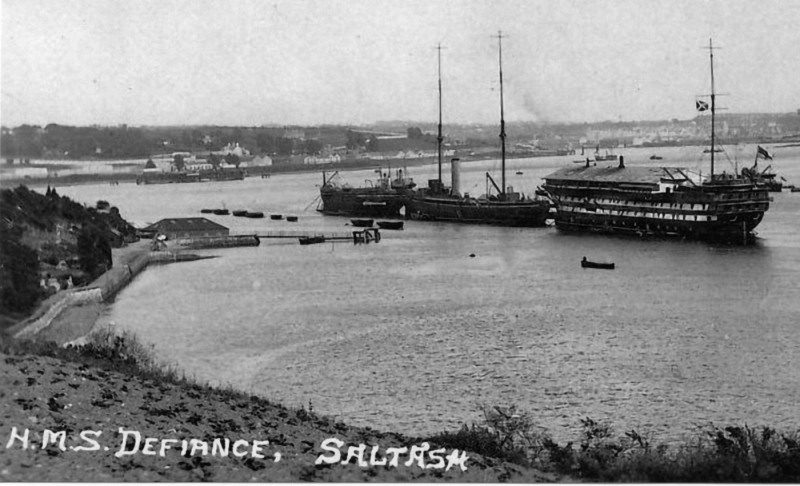
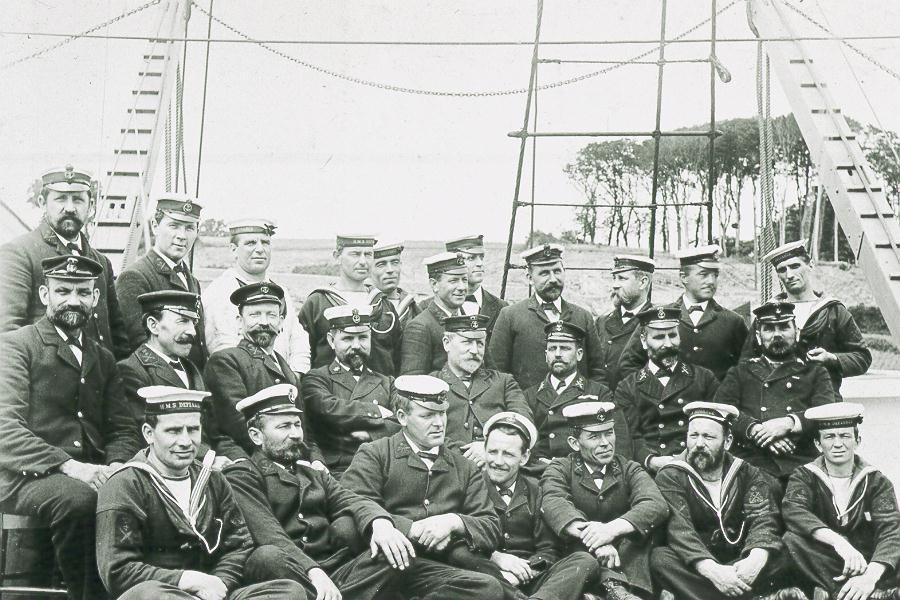
Crew of HMS Defiance. Photo Cyberheritage
Stoker (1st Class) Thomas William Wilson*
HMS Vivid, Royal Navy
Died in Military Service
Date of Birth: 1874
Place of Birth: Teignmouth, Devon
Date of Death: 29 December 1915 aged 39
Buried: Teignmouth Cemetery. Remembered on Seafront Memorial and St. Michael's Church Memorial, Teignmouth.
Stoker (1st Class) Thomas William Wilson*, age 39.
Thomas was born possibly in 1874 in Teignmouth and baptised on 24 February 1876 as Matthew William the son of Matthew, a mariner, and Emma Wilson (née Back).
The 1881 census showed him living with his mother and siblings at the home of his maternal grandparents in Bishopsteignton. In 1901 he was listed as a patient in RN Hospital, East Stonehouse, Plymouth.
The 1911 census showed him living with his wife, Elizabeth Jane, and daughter at 13 French Street, he was working as a haulier carter. He married Elizabeth Jane Loram in 1904 registered at Newton Abbot under the name William Matthew.
William was serving at HMS Vivid, Devonport, Plymouth. Previously retired and on the Royal Naval Reserve, service number DEV 280084.
He died of appendicitis at the RN Hospital, Stonehouse, Devonport, on 29 December 1915.
Buried in Teignmouth Cemetery.Remembered on Seafront Memorial and St. Michael's Church Memorial, Teignmouth.
*(There is some confusion over this man's name he seems to have been known as William Matthew and Thomas William, but various records show that he is one and the same.)
HMS Vivid
During the First World War HMS Vivid was a Royal Navy base at Devonport, a district of Plymouth.
A number of ships were renamed HMS Vivid whilst serving as depot ships for the base, HMS Cuckoo (launched in 1873), was a torpedo gunboat that was HMS Vivid between 1912 and 1920.
Some men served at the base for the duration of the war, others could be recorded as serving on HMS Vivid when between ships, on leave or on route to hospital etc.
The Stonehouse Naval Hospital was a mile from the Devonport base. For casualities coming to the UK from ships in the Atlantic, Stonehouse was the first large UK Naval hospital that they would reach.
![Arriving at the Naval Hospital Stonehouse by boat. <br />Cyber Heritage [Public domain]](/images/snippets/rnh3.jpg) Arriving at the Stonehouse Naval Hospital by boat. Cyber Heritage [Public domain]
Arriving at the Stonehouse Naval Hospital by boat. Cyber Heritage [Public domain]
There were a lot of casualties. Over 5000 British ships were lost in the First World War.
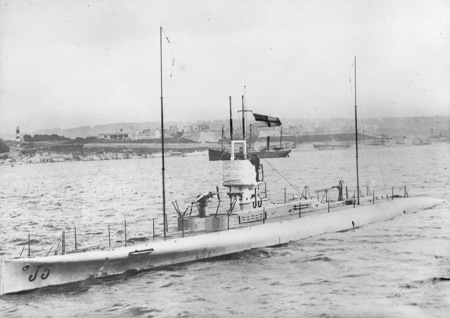 A J5 Class submarine built in the Devonport yard during WW1
(later transferred to the Australian Navy) © IWM SP3096
The Royal Navy Devonport dockyard was a part of the base. During WW1 the yard built battle cruisers, cruisers, dreadnoughts and submarines.
These all used the cutting-edge technology of the time as did the battle ship HMS Warspite and the steam-driven J5 submarine shown here.
Experts in every related field were gathered to help develop and test new designs for the best possible vessels and weapons to equip them.
The most capable people available would have trained those responsible for training others in using these newly developed technologies.
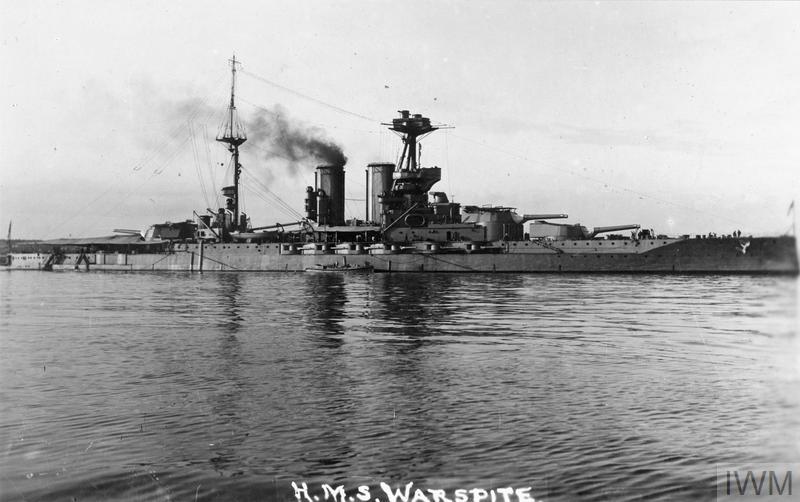 Battleship HMS Warspite. The battleship HMS Warspite (1913) was built at Devonport and was the most technically advanced ship of her era. She carried a company of more than 1,000 sailors and officers, holds more honours than any other in British naval history and served in both World Wars. At the Battle of Jutland in 1916, Warspite held off the German High Seas Fleet. © IWM (Q 75593)
Naval Trawlers
Vivid III was the part of the Devonport base relating to the Trawler Division.
At the outbreak of the First World War about 3000 civilian steam fishing trawlers were put into military service and more than 39,000 fishermen joined the Trawler Section of the Royal Naval Reserve to crew the ships they knew so well.
They cleared mines from sea routes, and attacked enemy submarines.
This was vitally important work, the Maritime Archeology Trust estimate that in 1918 alone, enemy U-boats sank 5896 British vessels.
Fishing vessels on Admiralty service played a role in something in the region of 20 per cent of all allied U-boat sinkings during 1918.
Fishermen, the Fishing Industry and the Great War at Sea: A Forgotten History.
By Robb Robinson page 161
