
Lance Corporal Hubert Frederick Hayman
26th (Service) Battalion (Bankers), Royal Fusiliers (City of London) Regiment
Killed in Action
Date of Birth: 4 August 1894
Place of Birth: Parkstone, Dorset
Date of Death: 15 September 1916 aged 22
Buried: Guards Cemetery Le Boeufs, France
Awarded the British War Medal and the Victory Medal
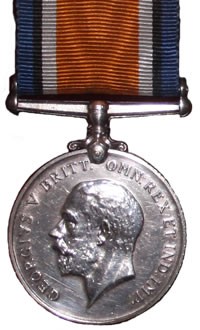
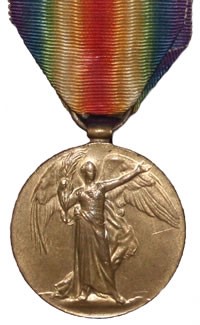
Lance Corporal Hubert Frederick Hayman age 22.
Hubert was born in Parkstone, Dorset, on 4 August 1894, his parents were Henry, a manufacturer, and Fanny Hayman, and he was their youngest son.
In 1901 the census showed him living with his family at 'Tancrede', Parkstone, Poole. He was still at this address with his family in 1911 and noted as a scholar.
He later worked as a clerk at Lloyd’s Bank, Teignmouth, Devon, having joined them on 12 May 1915.
Hubert resigned from the bank on 20 November 1915 to enlist in the army which he did at Newton Abbot.
He served with 26th Battalion, Royal Fusiliers (City of London) Regiment, service no. 20134, and was killed in action at Flers on 15 September 1916.
A gratuity was paid to his parents in Parkstone. His older brother Holroyd Edward Hamlyn was killed in 1917. Reburied in Guards Cemetery Le Boeufs.
Grave Inscription reads : “Greater love hath no man than this”
(Photo supplied by Lloyd’s Bank)
The 26th (Service) Battalion (Bankers) of the Royal Fusiliers
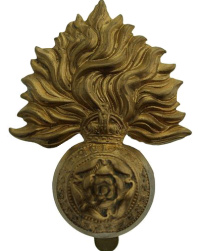 Royal Fusiliers Cap Badge
The battalion was called "the Bankers" because it was set up to recruit up men from the financial sector, such as bank clerks and accountants.
They went to Aldershot for training in November 1915 and became a part of the 124th Brigade, 41st Division.
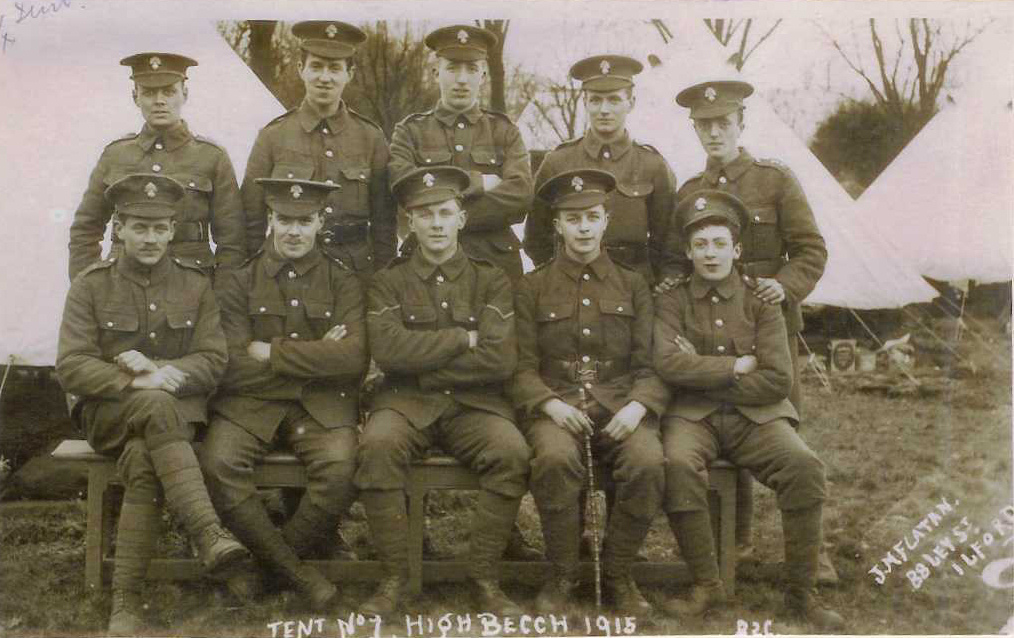 Group of new recruits, 26th Bankers' Battalion, Royal Fusiliers. High Beech Camp, Ilford, Essex. November - December 1915 This item is from The Great War Archive, University of Oxford (www.oucs.ox.ac.uk/ww1lit/gwa); (cropped) © Stephen Duncan
The battalion landed in France on 4 May 1916 and were at Vauchelles-les-Quesnoy on 31 August 1916.
They arrived at Fricourt September 7 1916, then moved to forward trenches north-east of Delville Wood.
Their first major action came when they attacked the Switch Line and Flers Trench (Courcelette), on 15 September 1916 suffering heavy losses.
![A tank is surrounded by infantrymen at Flers in France. The manner in which the soldiers are gathered together around the tank and looking directly at the camera, suggests that this could be a staged photograph taken for propaganda purposes. It is believed that this photograph was taken by John Warwick Brooke. The Battle of Flers-Courcelette formed a supplementary part in the third phase of the great Somme offensive in mid-September 1916. The battle is important because this was where tanks were first used during the conflict. Winston Churchill, then fighting as a lieutenant colonel of infantry on the Western Front, complained that Haig’s contentious decision to attack at Flers with a small number of tanks was wrong, and lamented that 'my poor 'land battleships’ have been let off prematurely on a petty scale'. [Original reads: 'OFFICIAL PHOTOGRAPHS TAKEN ON THE BRITISH WESTERN FRONT IN FRANCE. One of our Tanks at Flers.'] John Warwick Brooke. National Library of Scotland License: CC BY 4.0](/images/the-fallen/jwb-196.jpg) A tank is surrounded by infantrymen at Flers in France. The Battle of Flers-Courcelette formed a supplementary part in the third phase of the great Somme offensive in mid-September 1916. The battle was where tanks were first used during the conflict. National Library of Scotland License: CC BY 4.0
A tank is surrounded by infantrymen at Flers in France. The Battle of Flers-Courcelette formed a supplementary part in the third phase of the great Somme offensive in mid-September 1916. The battle was where tanks were first used during the conflict. National Library of Scotland License: CC BY 4.0
The same officer went forward to a tank lying south of Flers and arranged that the 26th would follow if the tank would lead. This arrangement was carried out.
The tank moved along the south side of Flers, assisting the troops who were in the village by firing on the retreating enemy and also assisting the 26th to get well ahead...
In the battle the 26th lost 9 officers (5 of them killed) and 255 other ranks killed wounded and missing.
The Royal Fusiliers in the Great War, (page 136)
by O'Neill, H. C. (Herbert Charles) 1922
In the First World War, there were usually about 1000 men in a battalion. The Commonwealth War Graves Commission has 626 recorded WW1 deaths for the 26th Bankers Battalion.
Hubert Frederick Hayman of Lloyds Bank, Teignmouth is one of them.
