
Private Fred Newbery
9th Battalion, Devonshire Regiment
Killed in Action
Date of Birth: 1 February 1898
Place of Birth: Brixham, Devon
Date of Death: 1 July 1916 aged 18
Buried: Remembered on Thiepval Memorial, Somme; and Seafront Memorial, Teignmouth, Devon.
Awarded the British War medal and the Victory Medal
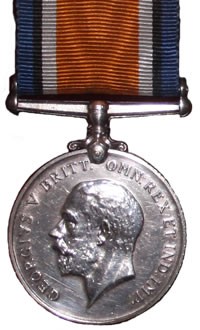
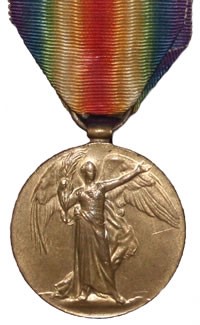
Private Fred Newbery (Newberry) age 18.
Born at Brixham on 1 February 1898, the son of Samuel, police officer, and Emily Newbery. Shown on 1901 census with his parents and siblings at Brixham. He attended Paignton National School from 1 February 1905 to 16 June 1911. Fred was living in Paignton in 1911 at the Public Hall where his father Samuel, a retired Sergeant of Police, now worked as a caretaker for the public hall company.
Fred enlisted in Paignton with the 9th (Service) Battalion, Devonshire Regiment, service number 20086.
On his medal card his name was spelt as Fred Newberry and shows he was awarded the War and Victory Medals, all other official records including his birth show him registered as Fred Newbery.
His gratuity was divided and paid to his mother and two older brothers, one of whom, William, was killed in action in 1917. They were the nephews of two Sergeants of Police, one the ex-Castle Keeper at Exeter and the other at Plymouth, they were related to the Newbery family in Teignmouth.
Fred was killed in action on 1 July 1916. Remembered on Thiepval Memorial, Somme; and Seafront Memorial, Teignmouth, Devon.
The 8th and 9th Battalions of the Devonshire Regiment
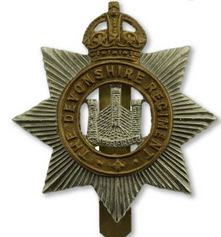 Devonshire Regiment
cap badge
The 8th and 9th Battalions of the Devonshire Regiment were formed in 1914 from war-time volunteers.
After very little training they landed at Le Havre in France on the 28th July, 1915 and moved to the Front in August 1915.
The men had only a very brief experience of trench warfare when on the 25th September 1915, the British Army launched a massed attack against the German defences, this was later to be known as the Battle of Loos.
At the Battle of Loos both sides used poison gas as a weapon.
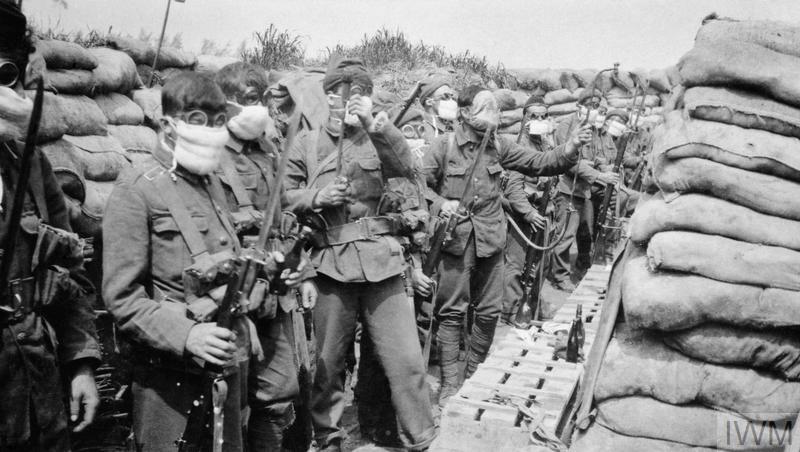 Men preparing for a gas attack © IWM (Q 51650)
This was the first time that the British used poison gas.
After they released the gas the wind changed and a green blanket of gas, dust and smoke as high as a two-storey house covered some of the British troops, it was very difficult to see anything, some men had terrible difficulty breathing and others died later because of the damaging effects of the gas.
'The gas hung in a thick pall over everything, and it was impossible to see more than ten yards. In vain I looked for my landmarks in the German line, to guide me to the right spot, but I could not see through the gas.'
Account by George Wilfred Smith, 2nd The Leicestershire Regiment, to his fiancée.
Before the men left the safety of their trenches and went 'over the top' to capture the enemy positions the Gunners would often fire a huge artillery barrage to shatter the enemy's barbed wire and other defences and kill defending troops.
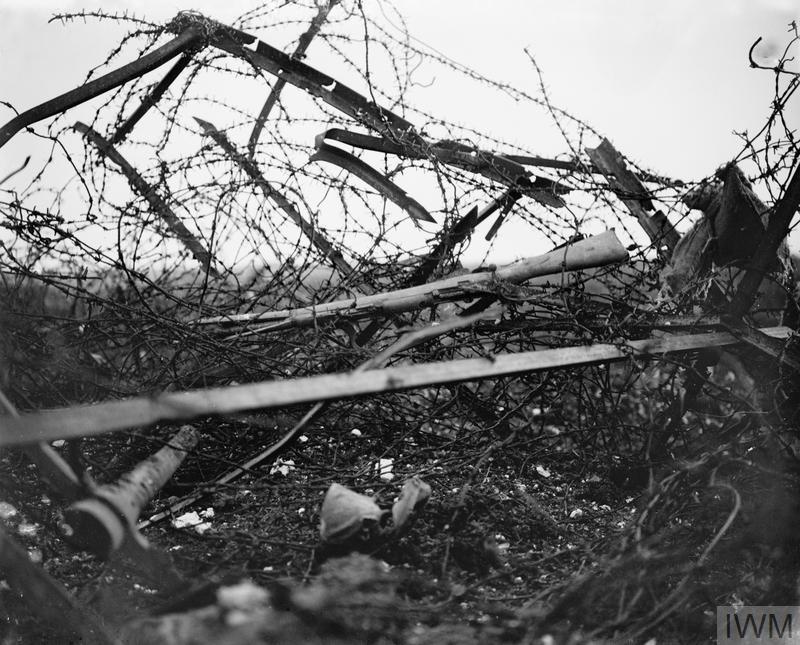 German barbed wire entanglement © IWM (Q 4593)
In this battle the artillery barrage had not cleared all the barbed wire, so the Devons had to cut their way through whilst the Germans fired machine-guns at them.
The 8th and 9th Devons were battalions with 1000 men in each unit. In a single day they had more than 1000 casualities and 500 men died or went missing.
Casualties at the Battle of Loos on the 25th September 1915 were the worst in a single day for the British army, with some 8,500 dead.
The Battle of Loos lasted from 25th September to 15th October, 1915.
The First Day of the Somme
On July 1, 1916 the 9th Devons, with the 8th Devons in support, headed the attack on the German front line near Marmetz.
The British artillery had bombarded the German Lines in preparation but this had failed to destroy machine-gun positions.
 A German machine gun crew, probably of the 18th Infantry Regiment, manning their Maxim machine gun. © IWM (Q 87923)
As the 9th entered No Man’s Land many of them were cut down by rifle and machine-gun fire.
The 9th Devons had started the day with 775 men but by the end of it 204 of them were killed (or missing) and 267 were wounded.
Of the 8th Devons 50 men were killed or missing.
The division secured Marmetz by the end of the day.
