Private Alfred Johnson
"D" Company, 1st Battalion, Royal Newfoundland Regiment
Killed in Action
Date of Birth: 1893
Place of Birth: Shaldon, Devon
Date of Death: 1 July 1916 aged 23
Buried: Remembered in the tranquillity of the Newfoundland Memorial Park, Beaumont-Hamel.
Awarded the British War Medal and the Victory Medal
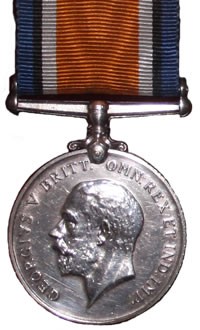
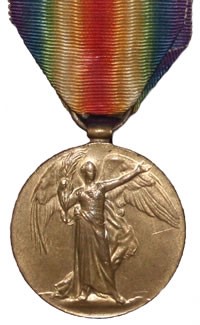
Private Alfred Johnson age 23.
Alfred was the son of Madeline Neiass (neé Robinson); apparently Alfred was adopted by Alfred and Mary Johnson (mother of Madeline). He was shown on 1901 census with Alfred, Mary and brother, William, at 2 Bitton Terrace.
The 1911 census showed him with Alfred and Mary at 26 Coombe Vale, Teignmouth, working as a merchant seaman. On both these census he was listed as their son.
Enlisting at St. John's, Newfoundland on 22 May 1915 he sailed for Egypt on 17 June. He joined his battalion in April 1916.
Alfred was serving with Royal Newfoundland Regiment, service number 1571, when he was reported as missing in action at Beaumont-Hamel on July 1, 1916, while serving with ‘D’ Company during the fighting of the first day of the Somme.
Some six months later, on December 31, he was officially presumed dead, killed in action on 1 July 1916. Remembered on Beaumont-Hamel Memorial, Somme; and Royal Newfoundland Regiment Memorials.
The son of Madeline Rebecca Neiass (also recorded as being his sister) – to whom he had allotted a daily allowance of sixty cents from his pay - of 21, Bitton Avenue, Teignmouth, Devon, England, he was apparently the adopted son of Alfred Johnson and Mary Ann Johnson, also of Teignmouth, Devon. His own place of residence was recorded as the above address – of his mother/ sister - in England.
Mrs. Neiass wrote a series of at least four letters to the Records Office during the years 1916 and 1917, one of which is reproduced below, together with the reply to one similar written and sent by her on January 1, 1917:
21 Bitton Ave.,
Teignemouth Devon
Oct 22nd/16
Dear Sir,
I am writing to ask you if you have any information to give me now of my Brother Pte Alfred Johnson 1571 which I have heard nothing of since 29 June. I should be glad to have any news of him at your earliest
I am yours.
Respectfully
M. Neiass
Mrs M Neiass
9th January 21,
Britton Avenue
Teignemouth, Devon
1571 Pte A Johnson
Madam:
I have received your letter of the 7th instant and beg to inform you in reply that every effort has been made to trace Private Johnson and it is greatly to be regretted, with no success.
Looking to the length of time that has elapsed since Private Johnson was reported missing, and to the fact that his name has not appeared in any list of Prisoners of War received from Germany, I am regretfully restrained to conclude that Private Johnson is dead, and that his death occurred either on or since the 1st day of July, 1916.
I am to express the deep sympathy and regret of the Newfoundland Government at your irreparable loss. The late Private Johnson’s next of kin is stated to be his father, whose address is your address.
In the ordinary course of events he would be notified, but as you have written, this letter in reply may be regarded as the official intimation. If articles or property of the late Private Johnson are found, they will be forwarded to this Office, but some time may probably elapse before their receipt, and they will naturally be subject to customary formalities regarding effects.
Application regarding the disposal of personal effects or of any amount that may eventually be found due to the late soldier’s estate, should be addressed to this office. Please convey these facts to Mr Johnson.
I am, Madam, Your Obedient Servant
Major Paymaster & Officer i/c Records
The 1st Royal Newfoundland Regiment at Beaumont Hamel
This was the only Dominion regiment advancing on the first morning of the battle.
 Royal Newfoundland Regiment Cap badge
Out of 810 Newfoundlanders who attacked the village of Beaumont Hamel, only 68 men - no officers- escaped serious injury, thus the regiment was literally annihilated.
It was a magnificent display of trained and disciplined valour, and its assault only failed of success because dead men can advance no further.
Major-General Sir Beauvoir de Lisle
Commander of the 29th British Division
![Mémorial terre neuvien de Beaumont Hamel La butte du caribou. Benîot [CC BY-SA 4.0 ]](/images/the-fallen/Mémorial_terre-neuvien_de_Beaumont-Hamel_-_La_butte_du_caribou.jpg) Mémorial terre neuvien de Beaumont Hamel La butte du caribou. Benîot [ CC BY-SA 4.0 ]
Mémorial terre neuvien de Beaumont Hamel La butte du caribou. Benîot [ CC BY-SA 4.0 ]
The men are remembered in the tranquillity of the Newfoundland Memorial Park, Beaumont-Hamel.
A ‘Danger Tree’ replica still stands in the park which marks the extent to which a very few men reached, and had been used as a marker.
The village of Beaumont-Hamel was one of the fortress villages located just behind the German lines.
This position commanded the valley over which the attacking troops had to cross. The British attack on this part of the line was undertaken on that day by the 29th Division, part of VIII Corps.
The 1st Essex Regiment was also heavily involved in the fighting with large casualties.
The first objective on the 1 July was a line just beyond the village, with the third objective an ambitious further mile and three-quarters beyond that.
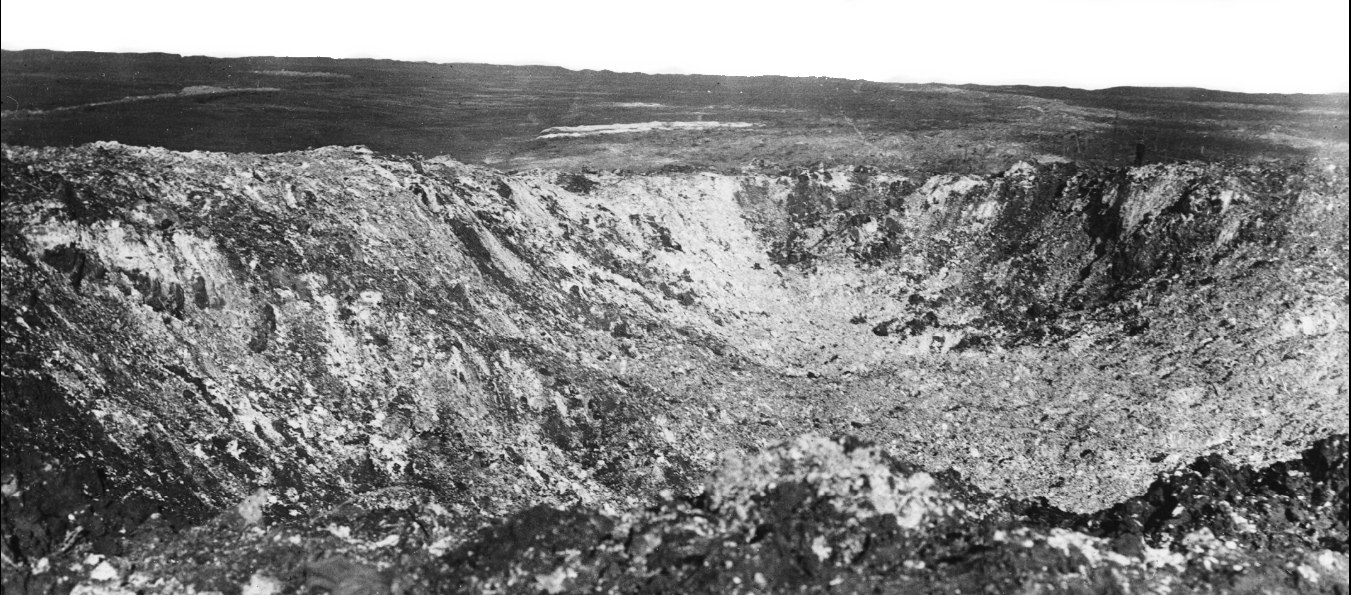
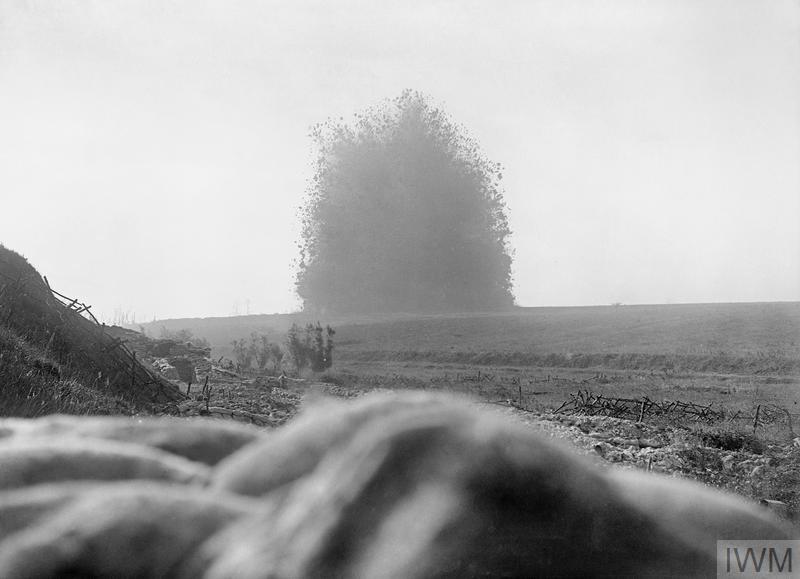 Battle of Albert. The mine under German front line positions at Hawthorn Redoubt is fired 10 minutes before the assault at Beaumont Hamel. 45,000 pounds of ammonal exploded. The crater was 130 feet across by 58 feet deep. Earnest Brookes. © IWM (Q 754)
The main reason that there was so much resistance in this area was the fact that the Hawthorn mine was set off at 7.20 at the request of the VIII Corps Commander, thus warning the Germans that the offensive was starting.
The vast majority of Allied troops that went over-the-top were killed or wounded almost immediately. The Germans suffered no casualties during this battle.
It was the explosion of this large mine close to the German line at Beaumont-Hamel that marked the beginning of the Battle of the Somme on July 1st 1916.