
Guardsman William Hamlyn Windeatt
4th Battalion, Grenadier Guards
Died of Wounds
Date of Birth: 1879
Place of Birth: Shaldon, Devon
Date of Death: 5 October 1916
Buried: Corbie Communal Cemetery Extension; remembered on Shaldon War Memorial, Devon
Awarded the British War Medal and the Victory Medal
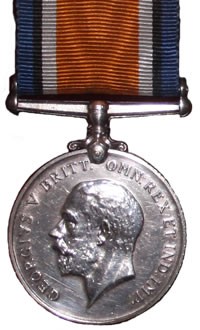
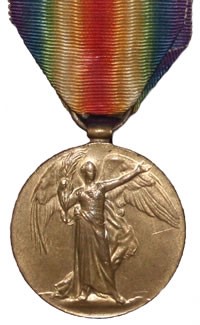
Guardsman William Hamlyn Windeatt, age 36.
He was the son of William Hamlyn Windeatt, master mariner, and Eliza Warren Whiteway, born in Shaldon in 1879.
William was baptised in St Nicholas Church, Liverpool but during his childhood lived with his mother and siblings at the home of his grandmother, Miriam Whiteway, at the ironmonger's in Fore Street, Shaldon.
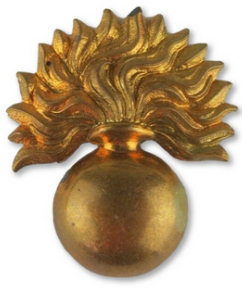 Grenadier Guards
Cap Badge
William enlisted in London and became a guardsman with the 1st Battalion Grenadier Guards, service no. 23663. They were involved in the Battle of Flers-Courcelette, 15 - 22 September.
This was a large-scale general renewal of the offensive after the weeks of attritional fighting for the third German system at Pozieres, High Wood, Delville Wood, Guillemont and Ginchy. It is noted for being the first time that tanks were used in battle*. Although few in number and mechanically unreliable those that actually went into action had an important and positive effect. High Wood and Delville Wood were finally cleared and a deep advance was made to Flers and towards Combles.
![A tank is surrounded by infantrymen at Flers in France. The manner in which the soldiers are gathered together around the tank and looking directly at the camera, suggests that this could be a staged photograph taken for propaganda purposes. It is believed that this photograph was taken by John Warwick Brooke. The Battle of Flers-Courcelette formed a supplementary part in the third phase of the great Somme offensive in mid-September 1916. The battle is important because this was where tanks were first used during the conflict. Winston Churchill, then fighting as a lieutenant colonel of infantry on the Western Front, complained that Haig’s contentious decision to attack at Flers with a small number of tanks was wrong, and lamented that 'my poor 'land battleships’ have been let off prematurely on a petty scale'. [Original reads: 'OFFICIAL PHOTOGRAPHS TAKEN ON THE BRITISH WESTERN FRONT IN FRANCE. One of our Tanks at Flers.'] John Warwick Brooke. National Library of Scotland License: CC BY 4.0](/images/the-fallen/jwb-196.jpg) A tank is surrounded by infantrymen at Flers in France. The Battle of Flers-Courcelette formed a supplementary part in the third phase of the great Somme offensive in mid-September 1916. The battle was where tanks were first used during the conflict. National Library of Scotland License: CC BY 4.0
A tank is surrounded by infantrymen at Flers in France. The Battle of Flers-Courcelette formed a supplementary part in the third phase of the great Somme offensive in mid-September 1916. The battle was where tanks were first used during the conflict. National Library of Scotland License: CC BY 4.0
This was followed by the Battle of Morval, 25 - 28 September. Having broken through the prepared lines of German defence, the British force now faced a new set of challenges as it was fighting in much flatter, open ground. Fighting was severe but gradually the British pushed forward. The weather began to turn autumnal, bringing rain, making the battlefield increasingly difficult and stretching men to limits of their physical endurance.
Private Windeatt was transferred from his battalion, owing to its almost total annihilation, to 4th Battalion just a few days before receiving fatal wounds. He died on 5 October 1916.
Buried at Corbie Communal Cemetery Extension; remembered on Shaldon War Memorial.
