
Miss Florence Maud Mary Birch
Nurse, Voluntary Aid Detachment (VAD), British Red Cross
Date of Birth: 19th February 1879
Place of Birth: Hurley, Berkshire
Date of Death: Quarter 2, 1947 aged 68
Buried: Died in Weston, Somerset, buried in Portishead, Somerset
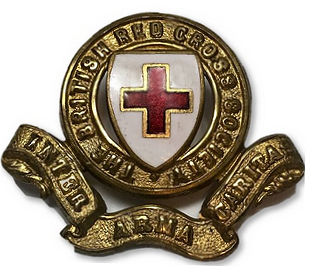 VAD hat badge
Miss Florence Maud Mary Birch was born in the rural village of Hurley in Berkshire on 19 February 1879.
Her father was Joseph Richard Birch (1842-1929), Joseph was born in the village of Penn, Buckinghamshire, the 1881 census shows him as a farmer.
Florence's mother was Eleanor Mary Plaidstowe (1850-1913), Eleanor was born in Wycombe, Buckinghamshire.
Dates of birth of Florence and her siblings:
| Rupert Plaistowe Birch (1871-1935) | Joseph Francis Birch (1875-1929) |
| Alfred Owen Birch 1876-1952 | (Hubert John Birch 1877- 1889) |
| Florence Maud Mary Birch (1879-1947) | Arthur Edwin Birch (1885-1966) |
Florence is shown in the 1911 census as a companion to a retired 'Mission Sister' (Charlotte Abbey born in Market Harborough, Liecestershire in 1843) and living at Mount Gould, Teignmouth, Devon.
Florence was engaged with Voluntary Aid Detachment (VAD) as a nurse from 30th April,1915 to 12th December, 1916, during that times she worked full-time at No. IV section Exeter War Hospitals which was based at Topsham (Wyvern) Barracks.
Her brothers Alfred, and Rupert emigrated to Canda between 1890 and 1901, a Florence Birch, Teacher, living in Sheffield is on passenger lists to and from Canada.
No. IV section Exeter War Hospital
 No. IV section Exeter War Hospitals, based at Wyvern/Topsham Barracks during WW1. Topsham Road Exeter, © Copyright David Smith (CC BY-SA 2.0)
War Hospitals in Exeter 1914 - 1919
Wounded or sick patients were sent to the UK from overseas by hospital ships.
 The interior of a coach of a British hospital train showing cots arranged down either side of the carriage leaving a wide central passageway in which the medical staff could work. © IWM (Q 33447)
Exeter was on the main Railway for the ports of Plymouth and Falmouth so patients travelled by ambulance train from to the city's hospitals.
Many of the wounded suffered from gas poisoning, blindness was one the results of the gas and men would walk in a long crocodile, each man holding on to the one in front before being taken to their VA Hospital.
Wounded men would be seen in the streets of the city, wearing their "hospital blues" blue uniforms with a red tie to distinguish them from soldiers on leave or returning to and from active duty at the front.
 Wounded soldiers from Exeter Military Hospitals at Teignmouth where they were entertained by Mr. and Mrs. G. Hardy Harris. "Gazette" photos.
Over 35,000 were treated in Exeter's hospitals during the war. By the war's end there were more than 1,400 beds for patients in the city.
Voluntary Aid Detachment (VAD) Records
Date of engagement with VAD: 30th April,1915 to 12th December, 1916.
Rank: Nurse.
Service rendered at:
No. IV section Exeter War Hospitals, Devon.
Paid: 1/6 per day (worked full-time).
Voluntary Aid Detachment (VAD) Cards
 Voluntary Aid Detachment (VAD) Card. ©2018 British Red Cross (CC BY-NC 2.0 UK)
 Voluntary Aid Detachment (VAD) Card. ©2018 British Red Cross (CC BY-NC 2.0 UK)
