
Miss Florence Elizabeth Dawes
Cook, Voluntary Aid Detachment (VAD), British Red Cross
Date of Birth: 13 October 1861
Place of Birth: Bermondsey, Surrey
Date of Death: 1943
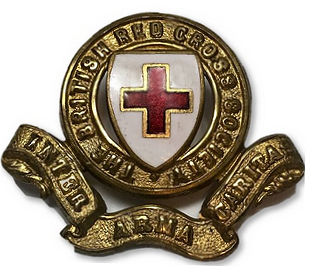 VAD hat badge
Florence Elizabeth Dawes née Bond was born on 13 October 1861 in Bermondsey, Surrey.
Her father George Bond, had been born in Newington, London (1833–1904) and was the son of Sarah and William, a Lighterman.
Florence's mother, Sarah Lambert Bond née Darnell (1834-1928), had also been born in Bermondsey and was the daughter of Sarah and her husband Edmond, a Tailor.
The 1871 Census shows Florence, her parents and her siblings George, Clarence, Selina and Oswald in Southwark. Florence's father had taken up his father's trade as a Lighterman.
| Florence and her siblings | |
| Sarah Susannah Bond 1858–1922 |
George Dannell Bond 1859–1899 |
| Florence Elizabeth Bond 1861-1943 |
Clarence Edgar Bond 1866–1937 |
| Selina Jane Bond 1867–1924 |
Oswald Herbert Bond 1869-1937 |
| Claudia Agusta Bond 1873–1947 |
Hilda Gertrude Bond 1875–1960 |
In 1885 Florence married Charles Robert Edward Dawes who was born in Bermondsey in 1885.
By 1891, Florence and her husband were were living at Hazeldene in Gloucester Road, Bermondsley and had three daughters (Daisy, Eva and Harriett). Charles was working as a Commercial Traveller.
In 1901 Florence and Charles were still living at Hazeldene. Their children Eva, Daisy, Muriel, Howard and Florence's niece Wihelmina F. Bond were present.
| Florence's children | |
| Eva Preston Dawes 1887–1952 |
Daisy Florence Dawes 1888–1951 |
| Muriel Violet Dawes 1890– |
Phyllis Acton Dawes 1906– |
The family moved to Cotteswold, Teignmouth, Devon and are shown on the 1911 census with two additions, Phyllis and Muriel (who was working as an elementary school teacher). They had two servants living with them at this point (a cook and a housemaid) and Charles' occupation was described as Commercial Traveller Grocers.
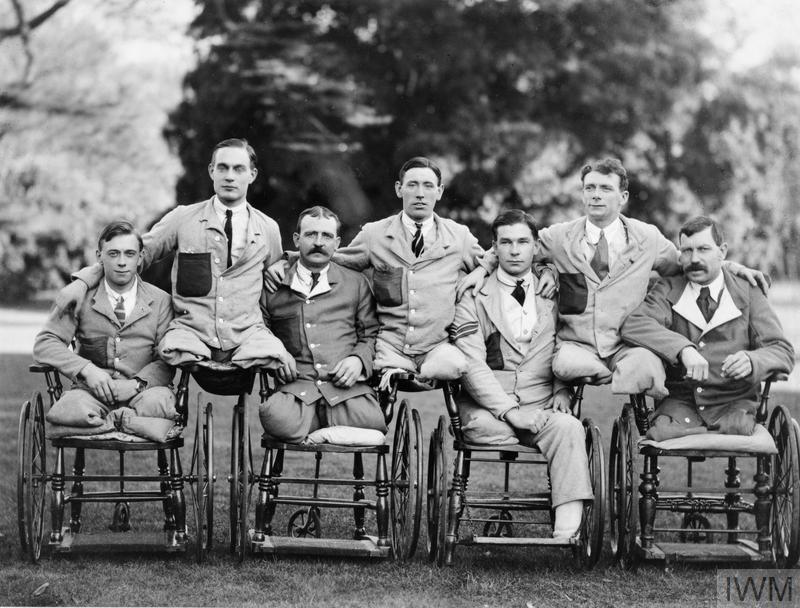 Soldiers wearing "Hospital Blues". Soldiers arrived from the front in filthy lice-infested army uniforms, clean uniforms helped prevent infection and disease and identify a wounded as soldier a hero. © IWM (Q 108161)
Florence was engaged with the Voluntary Aid Detachment (VAD) as a cook from March 1915 to April, 1919. She was 54 years old when she started.
She worked part-time for 1000 hours and her duties included keeping soldiers' hospital uniforms and linen in repair and organising patients' concerts and Red Cross Days, etc.
Florence's daughter Daisy Florence Dawes was also engaged with VAD during WW1 and served as a Nurse in hospitals in Teignmouth, London and Salonika, Greece.
The 1939 Register shows that Charles had died and Florence was living at 6 Brimley Villas, Teignmouth.
Florence Elizabeth Dawes died on 22 July 1943 at Dryll-y-Car Llanaber, Merionethshire, Wales. Her home address was recorded as 19 Hampton Road Oswestry, Shropshire.
Teignmouth Hospitals in WW1
At the start of the Great War the Teignmouth Hospital was located at what had been Alberta Mansions on Myrtle Hill, Dawlish Road.
The Hospital was run on a charitable basis, with the upkeep made possible by donations.
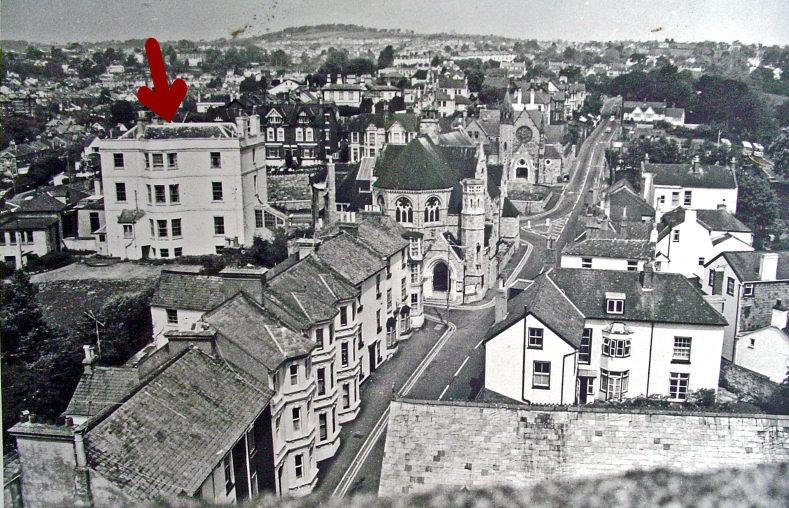 The building that was Teignmouth Hospital during WW1. (Previously called Sion House, Later known as Alberta Mansions) Photo source unknown
There was also an 'Isolation' Hospital in the grounds of Bitton House on Bitton Park Road.
In 1914 There was a mass meeting in the town hall to make arrangements for sick and wounded.
Teignmouth hospital was placed at the disposal of the Red Cross (15 beds) as well as Bitton House.
The local Suffrage Society suspended their political agenda in order to help with the war effort. Appeals were made for nurses with hospital experience, voluntary or paid; cooks, ward maids and any ladies who have a first aid certificate.
In August 1915 the Teignmouth Post mentioned that Teignmouth Hospital had a full complement of wounded soldiers who had come from the European theatre of war.
 Wounded soldiers at Teignmouth Hospital. April 1915. Source unknown
The services of a masseur/masseuse were requested to treat some of the severely injured soldiers.
House to house collections were carried out by many volunteers and people were asked to send food or any useful objects to the hospital.
 Inverteign house, home of Dr & Mrs Whiteway-Wilkinsons. They opened their home to wounded officers. From the Teign Heritage collection
Several Teignmouth residents offered up their homes as convalescent hospitals.
These included Dr & Mrs Whiteway-Wilkinson who opened up Inverteign House and set aside 8 beds to be used as a home for injured officers.
Lord and Lady Cable gave up the whole of the ground floor of Shute Hill House in Teignmouth for use as a sick bay.
Lord and Lady Cable also purchased the Treverven Estate (on Exeter Road, Teignmouth, (now part of Teignmouth Community School) and opened it as the Everest Hospital for convalescing officers (whilst the Everest Hospital was being built a hut for wounded soldiers was erected in the grounds of the original Teignmouth Hospital). Lady Cable contributed most liberally to its upkeep, their daughter, then Lady Weston Alexander, was matron of the institution.
 Everest Officer's Hospital, part of the Treverven Estate (now part of Teignmouth Community School). From the Teign Heritage Collection
 Bitton House, Teignmouth. Used by the Army in WW1. Also held a hospital. Now Teignmouth Town Council offices. (CC BY-SA 2.0) © Copyright Stephen Richards. (Modified, changed to black and white)
During WW1 the Army were in possession of Bitton House and soldiers were billeted in the town and market place.
In October 1915 the Teignmouth Urban District Council granted permission for parts of Bitton House to be used as a hospital, canteen and recreation rooms and for the Den to be used for Drill.
The Ordnance Survey, 1913 - 1914 map shows 'Isolation Hospital (Teignmouth U.D.C.)' as a long rectangular building with glass covered verandas on north of east side and south of west side of Bitton House (the Isolation Hospital was later demolished).
Voluntary Aid Detachment (VAD) Records
Date of engagement: March 1915 to April, 1919.
Rank: Cook
Duties: Services included:
- keeping soldiers' blue in repair and Hospital linen
- organised patients' concerts, Red Cross Days, etc.
Number of hours served: 1000 (part-time).
Paid: £0.
Voluntary Aid Detachment (VAD) Cards
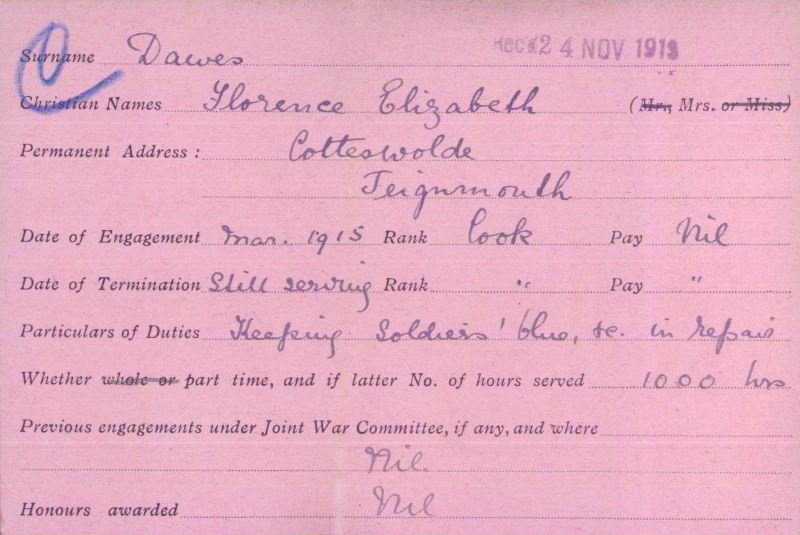 Voluntary Aid Detachment (VAD) Card. ©2018 British Red Cross (CC BY-NC 2.0 UK)
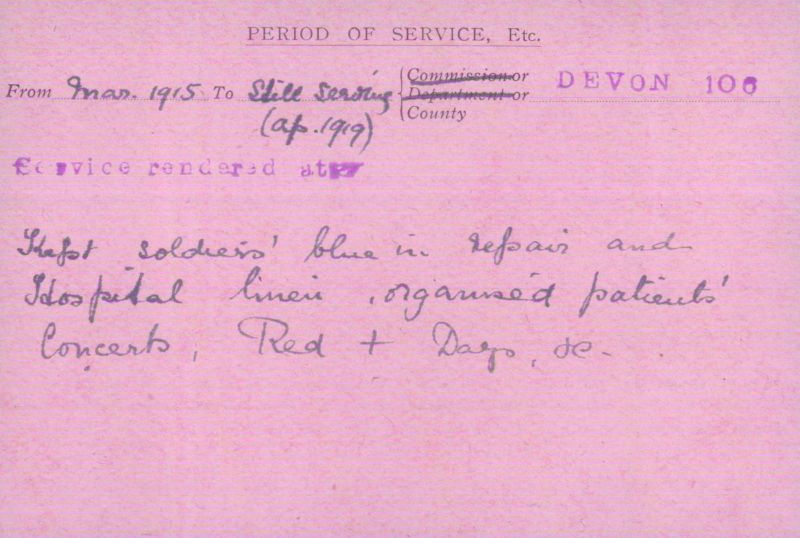 Voluntary Aid Detachment (VAD) Card. ©2018 British Red Cross (CC BY-NC 2.0 UK)
