
Miss Florence Bostock
Nurse, Voluntary Aid Detachment (VAD), British Red Cross
Date of Birth: 1889
Place of Birth: Loughborough, Leicestershire
Date of Death: February 21st 1927
Buried: Teignmouth Old Cemetery HH165
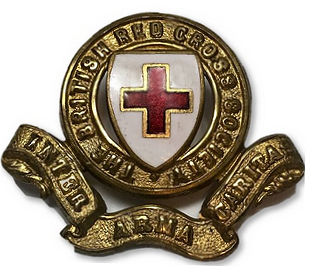 VAD hat badge
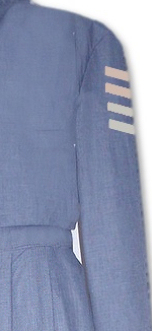
Florence Bostock was born in 1889 in Loughborough, Leicestershire.
She was the daughter of William Bostock who was born in Birmingham (1852-1928) and Alice Mary Bostock née Jones who was born in Wolverhampton (1861-1945).
In 1891, Florence was 2 years old and living at 26 Court E Baxter Gate, Loughborough, Leicestershire with her mother Alice M, her father William who was 'Postmaster' of Loughborough, her younger brother William and older sister Alice. They had one servant, General Domestic.
In 1901, Florence's family had moved to 48 Holyhead Road, Coventry and Florence's father was 'Postmaster' of Coventry Post Office. Florence had two sisters, Kate and Alice, and a brother, William.
By 1911, the family had moved to 6 Marlborough Grove, York, where Florence's father had become 'Postmaster' of York, they had general servant living with them.
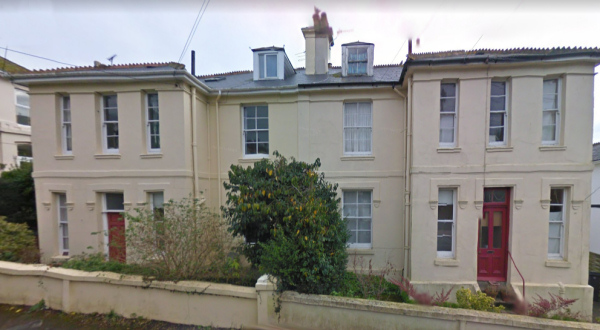 Florence's family's homes at 7 and 9 Ferndale Road, Teignmouth.
Image Capture 2018 © 2019 Google
Florence was engaged with the Voluntary Aid Detachment (VAD) in January 1915 and was still serving in January 1919. During that time she had served at the Teignmouth V.A. Hospital part-time as a nurse for 6720 hours.
When she engaged with VAD Florence gave 7 Ferndale, Teignmouth, Devon as her permanent address.
Florence's sister Kate Bostock was also engaged with VAD as a nurse, she served at the Newton Abbot VA Hospital.
Florence Bostock died on the February 21st 1927, she was living at Ebor, Ferndale Road at the time. She is buried in Teignmouth cemetery with her family.
In 1939 the register shows Kate living with her sister Alice at 9 Ferndale Road, Teignmouth. Their brother William survived the war and later became a bank manager.
Teignmouth Hospitals in WW1
At the start of the Great War the Teignmouth Hospital was located at what had been Alberta Mansions on Myrtle Hill, Dawlish Road.
The Hospital was run on a charitable basis, with the upkeep made possible by donations.
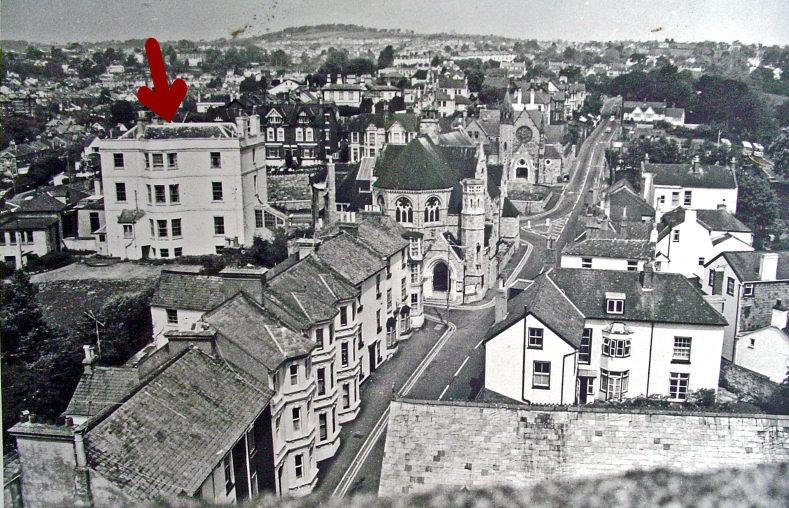 The building that was Teignmouth Hospital during WW1. (Previously called Sion House, Later known as Alberta Mansions) Photo source unknown
There was also an 'Isolation' Hospital in the grounds of Bitton House on Bitton Park Road.
In 1914 There was a mass meeting in the town hall to make arrangements for sick and wounded.
Teignmouth hospital was placed at the disposal of the Red Cross (15 beds) as well as Bitton House.
The local Suffrage Society suspended their political agenda in order to help with the war effort. Appeals were made for nurses with hospital experience, voluntary or paid; cooks, ward maids and any ladies who have a first aid certificate.
In August 1915 the Teignmouth Post mentioned that Teignmouth Hospital had a full complement of wounded soldiers who had come from the European theatre of war.
 Wounded soldiers at Teignmouth Hospital. April 1915. Source unknown
The services of a masseur/masseuse were requested to treat some of the severely injured soldiers.
House to house collections were carried out by many volunteers and people were asked to send food or any useful objects to the hospital.
 Inverteign house, home of Dr & Mrs Whiteway-Wilkinsons. They opened their home to wounded officers. From the Teign Heritage collection
Several Teignmouth residents offered up their homes as convalescent hospitals.
These included Dr & Mrs Whiteway-Wilkinson who opened up Inverteign House and set aside 8 beds to be used as a home for injured officers.
Lord and Lady Cable gave up the whole of the ground floor of Shute Hill House in Teignmouth for use as a sick bay.
Lord and Lady Cable also purchased the Treverven Estate (on Exeter Road, Teignmouth, (now part of Teignmouth Community School) and opened it as the Everest Hospital for convalescing officers (whilst the Everest Hospital was being built a hut for wounded soldiers was erected in the grounds of the original Teignmouth Hospital). Lady Cable contributed most liberally to its upkeep, their daughter, then Lady Weston Alexander, was matron of the institution.
 Everest Officer's Hospital, part of the Treverven Estate (now part of Teignmouth Community School). From the Teign Heritage Collection
 Bitton House, Teignmouth. Used by the Army in WW1. Also held a hospital. Now Teignmouth Town Council offices. (CC BY-SA 2.0) © Copyright Stephen Richards. (Modified, changed to black and white)
During WW1 the Army were in possession of Bitton House and soldiers were billeted in the town and market place.
In October 1915 the Teignmouth Urban District Council granted permission for parts of Bitton House to be used as a hospital, canteen and recreation rooms and for the Den to be used for Drill.
The Ordnance Survey, 1913 - 1914 map shows 'Isolation Hospital (Teignmouth U.D.C.)' as a long rectangular building with glass covered verandas on north of east side and south of west side of Bitton House (the Isolation Hospital was later demolished).
Voluntary Aid Detachment (VAD) Records
Date of engagement with VAD: January 1915, still serving January 1919.
Rank: Nurse.
Service rendered at:
Voluntary Aid Hospital Teignmouth, Devon.
Hours worked: 6720 (worked part-time).
Paid: £0.
Voluntary Aid Detachment (VAD) Cards
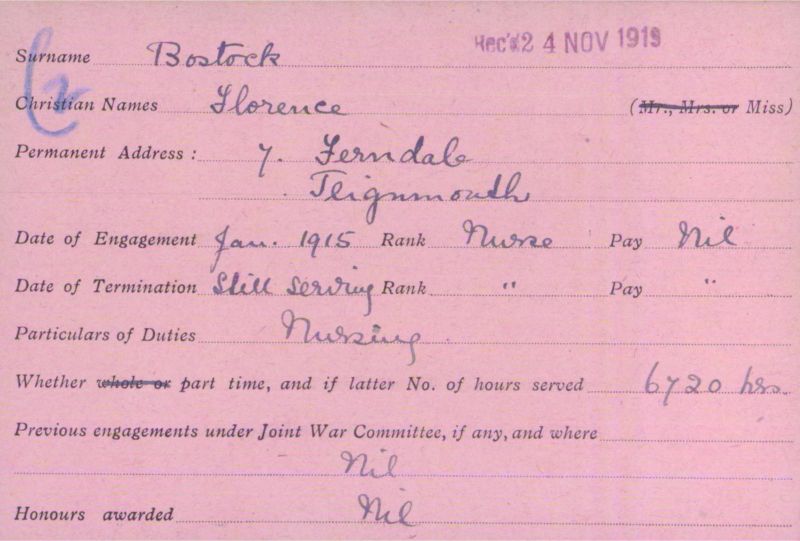 Voluntary Aid Detachment (VAD) Card. ©2018 British Red Cross (CC BY-NC 2.0 UK)
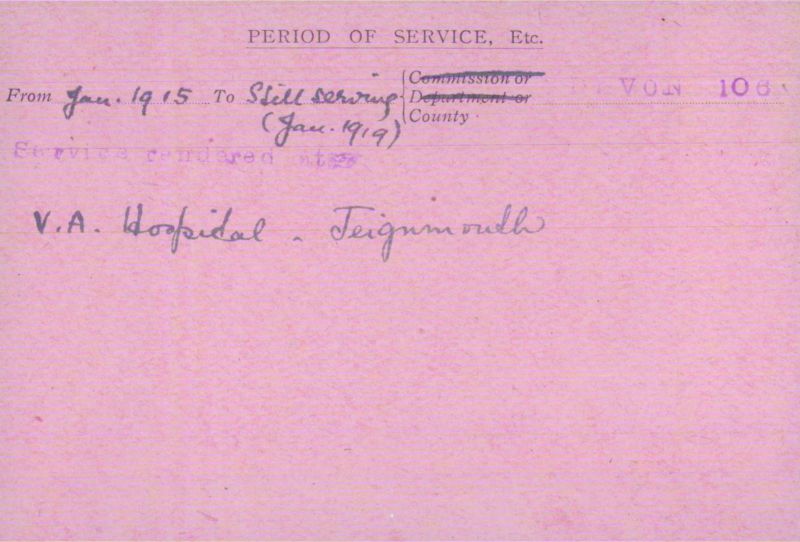 Voluntary Aid Detachment (VAD) Card. ©2018 British Red Cross (CC BY-NC 2.0 UK)
