
Miss Constance Eliza Thomas
Secretary, Voluntary Aid Detachment (VAD), British Red Cross
Date of Birth: 21st August 1895
Place of Birth: Bengal, India
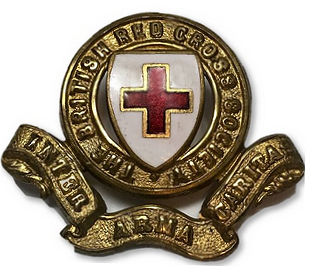 VAD hat badge
Miss Constance Eliza Thomas of Higher Woodway, Teignmouth, Devon.
Constance Eliza Thomas was the daughter of General Charles Frederick Thomas (1843–1922) who was born in Bengal, India and his third wife Edith Eliza Thomas née Sparkes (1859-1917).
Constance is shown on the India Birth and Baptisms record as having been born in Bengal India on the 21st August 1895.
Constance had a sister (Edith Powell Houghton Thomas) and a brother (George Statford Powell Thomas) records show that she also had fourteen half-siblings through her father's other three marriages.
The 1911 census shows Constance, living with her parents and her half siblings (Annie Wilson and Edith Priscilla and George Statford Powell) at Execliffe, in Exmouth, Devon with five live-in servants (a cook, a parlour-maid, a kitchen-maid, a house-maid and a butler).
Constance's mother Edith Eliza Sparkes died on 9 October 1917, the death was registered in Newton Abbot, Devon.Her father died 2 March 1922 at Higher Woodway in Teignmouth.
Constance was engaged as a secretary with VAD from May 5th, 1918 to 11th November, 1919, she worked at the Everest Officer's Hospital in Teignmouth, Devon. It was a place of convalescence.
The Everest Officer's Hospital
Lord and Lady Cable purchased the Treverven Estate (on Exeter Road, Teignmouth, now part of Teignmouth Community School) and opened it as the Everest Hospital. (whilst the Everest Hospital was being built a hut for wounded soldiers was erected in the grounds of the original Teignmouth Hospital). Lady Cable contributed most liberally to its upkeep.
Their daughter, Lady Weston Alexander (née Cable), became Matron / Commandant of the instutuition. It was used by convalescing officers.
 Everest Officer's Hospital, part of the Treverven Estate (now part of Teignmouth Community School). From the Teign Heritage Collection
Lieutenant Bertram William Brown Blight (a bank clerk in Ashburton before the war) was one of the officers who stayed at Everest. He was also one of the first men to receive extensive and plastic surgery at the end of the First World War.
 A German machine gun crew, probably of the 18th Infantry Regiment, manning their Maxim machine gun. © IWM (Q 87923)
Bertram was serving with the 9th Battalion, Devonshire Regiment near Ypres, when he was hit by machine gun bullets. His nose, teeth and part of his face were shot away. He was thought to be dead and left on a pile of bodies.
A German soldier noticed he was wearing a gold masonic ring and looked closer and realised that Bertram was alive.
Bertram was taken prisoner and was later returned to England where his injuries were then treated.
His face was rebuilt with 12 surgeries using techniques pioneered by Dr Harold Gillies.
Bertram attended several hospitals then was sent to the Everest Officer's hospital where he was nearer to family, he was deemed unfit for active service abroad but could serve at home.
Voluntary Aid Detachment (VAD) Records
Date of engagement with VAD: May 5th, 1918 to 11th November, 1919.
Rank: Secretary
Service rendered at:
Everest Officer's Hospital, Teignmouth, Devon.
Paid: £0 (worked full-time).
Voluntary Aid Detachment (VAD) Cards
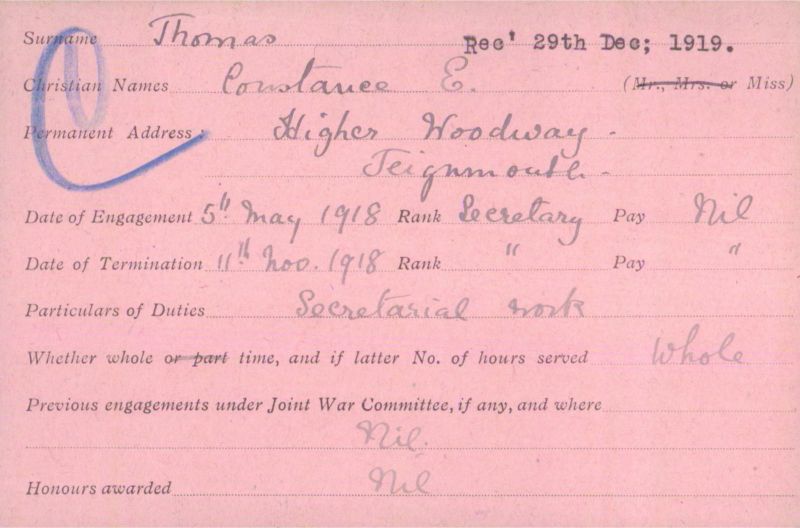 Voluntary Aid Detachment (VAD) Card. ©2018 British Red Cross (CC BY-NC 2.0 UK)
 Voluntary Aid Detachment (VAD) Card. ©2018 British Red Cross (CC BY-NC 2.0 UK)
