
Private Robert William Collins
46th Battalion, South Saskatchewan Regiment, the Canadian Infantry, CEF
Killed in Action
Date of Birth: 30 December 1889
Place of Birth: Teignmouth, Devon
Date of Death: 12 April 1917 aged 27 in France
Buried: Canadian Cemetery No. 2, Neuville St. Vaast. Remembered on Seafront Memorial and St. James’ Church Memorial Window, Teignmouth, Devon
Private Robert William Collins age 27. Born 30 December 1889 the son of Daniel, a tailor and Ellen Collins of Parson Street; Robert was shown living at this address with his parents in 1901. In 1911 he was shown as a boarder in Horsham and working as a grocery assistant; in May of that year he sailed from Liverpool to Montreal arriving on 4 May. His sailing document records his religion as Wesleyan Methodist and he had been a member of Teignmouth Methodist School. He is remembered on the Wesleyan Roll of Heroes.
Attesting on 17 September 1915 at Regina, Saskatchewan, for service with the Canadian Overseas Expeditionary Force his next of kin is listed as Edith Mary Collins, his wife. Edith is listed at living in Saskatchewan, but a note on his military record suggests that she moved to his home address following his death.
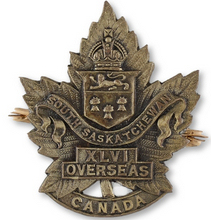 46th Canadian Infantry cap badge
Robert was a Canadian citizen serving with 46th Battalion, Canadian Infantry, service number 427647 when he was killed alongside many other men from his regiment on 12 April 1917, at the Battle of Vimy Ridge.
Reburied on 5 September 1919 in Canadian Cemetery No. 2, Neuville St. Vaast. Remembered on Seafront Memorial and St. James’ Church Memorial Window, Teignmouth, Devon.
The Battle of Vimy Ridge
From October 1914, the British and the French ad made several unsuccessful attempts to take Vimy, which had resulted in over 100,000 casualties.
On March 20, 1917, the Artillery began 3 weeks of increasingly heavy artillery bombardment.
 17th Battery, Canadian Field Artillery, firing a German 4.2 gun on the retreating Germans. April 1917. Canada. Department of National Defence. Library and Archives Canada, PA-001018 / (CC BY 2.0)
Then on April 9, 1917, four Canadian Divisions attacked Vimy Ridge.
They were able to overtake many German trenches before enemy soldiers could emerge from the shelter of their dugouts.
It took three more days for the Canadians to capture the last objective and there were heavy casualties.
The Battle of Vimy Ridge was a great tactical success for the Canadian army.
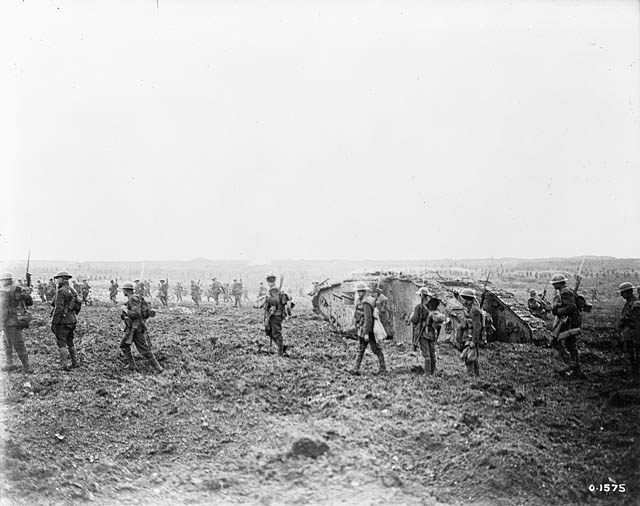 Canadians advancing with a tank over “No Man’s Land” at Vimy Ridge, April 1917. Canada. Department of National Defence. Library and Archives Canada, PA-001496 / (CC BY 2.0)
