
Private Edwin Louis Radford
1st/6th Field Ambulance, Royal Army Medical Corps (RAMC)
Killed in Action
Date of Birth: 1892
Place of Birth: Awliscombe, Devon
Date of Death: 1 December 1917 aged 25
Buried: Orival Wood Cemetery, Flesquieres, France. Remembered on Seafront Memorial and St. James’ Church Memorial Window, Teignmouth, Devon.

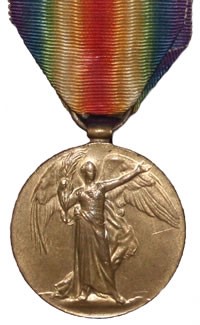
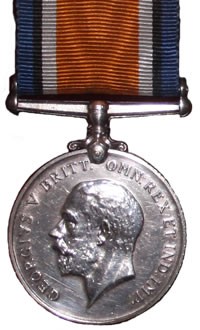
Awarded the 1914 Star with clasp, the British War Medal and the Victory Medal
Private Edwin (Ted) Louis Radford age 25. Born at Awliscombe in 1892 and baptised on 18 September 1892, the youngest son of Eli and Emma Jane Radford.
In 1901 he was living with parents and siblings at Silver Street, Honiton.
A resident of Teignmouth according to Army Records, but other army records show his home address as New Street, Honiton which was his parents’ address.
Edwin enlisted at Exeter on 13 August 1914 with 1st Wessex Regiment, RAMC; and went to France on 5 November 1914 with 24th Field Ambulance, service number 1899. On 14 October 1916 he was posted to 1st/6th Field Ambulance, service number 457162.
In April 1917 he was transferred to the Cycle Battalion Base in Rouen and was working with them in the field when he was killed on 1 December 1917. His body was identified in 1930 by the number on his boots and Edwin was reburied in Orival Wood Cemetery, Flesquieres, France. Remembered on Seafront Memorial and St. James’ Church Memorial Window, Teignmouth, Devon.
Grave Inscription Reads: “God keep our loved one until we meet again”.
Edwin’s mother wrote to the War Office in November 1919 requesting her son’s 1914 Star medal; the medal and clasp were sent to her in 1920 as well as his Victory and British War Medals.
A Royal Army Medical Corps Field Ambulance
A Field Ambulance was not a single vehicle, but an entire mobile hospital that served in the combat zone.
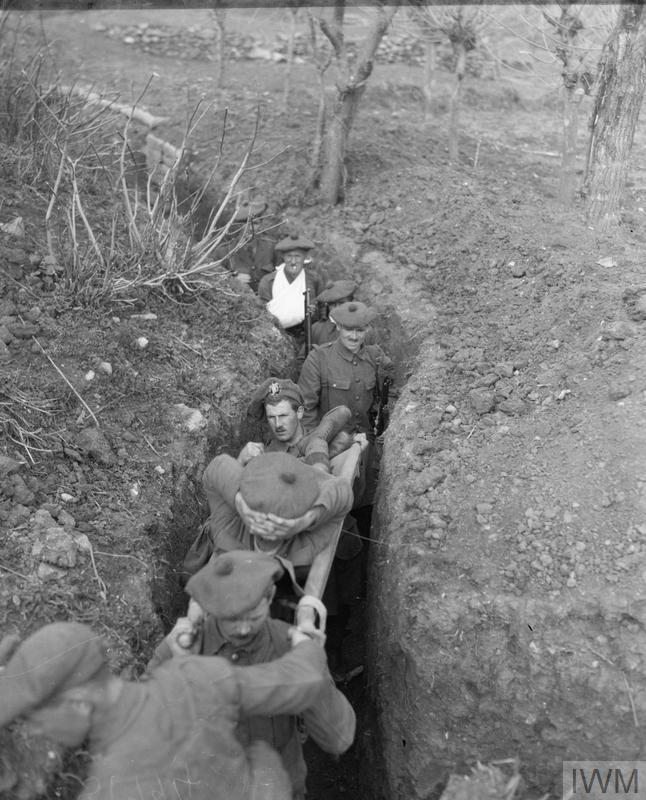 Casualties from a Scottish infantry battalion of 77th Brigade being evacuated along a communication trench outside Salonika, February 1916.© IWM (Q 31794)In the First World War, at the Front Line in battle there were often vast numbers of casualties requiring immediate treatment.
The Royal Army Medical Corps (RAMC) operated a system that immediately addressed a patient's critical injuries near the Front, then evacuated him to a medical unit in a safer area.
To achieve this goal the RAMC had units consisting of 10 officers and 224 men. The entire company was called a Field Ambulance.
 Motor ambulances and horse-drawn ambulance wagons of the RAMC collecting wounded on the Western Front © IWM (Q 9177)
The men were detailed as stretcher bearers, nursing orderlies, ambulance drivers, cooks, sanitation crew and to manage and distribute stores and water etc. The unit was divided into three equal sections, each of which could be self-sustainable, with its own tented areas, men and equipment.
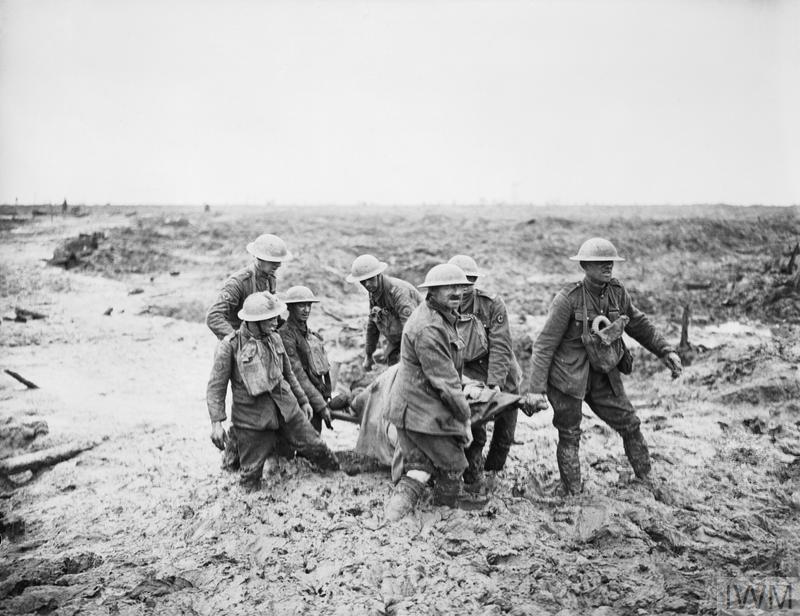 Stetcher Bearers in WW1 © IWM (Q 5935)
Each Field Ambulance had to be moved to where the combat was most intense and set up there.
Men of the Army Supply Company (ASC) were attached to assist with transport.
A Field Ambulance had 66 horses and 23 wagons. After the first year of the war transport included 7 motor vehicles and a maintenance wagon.
A full strength Field Ambulance unit in the First World War had a "capacity" for 150 casualties. In times of intense battle the unit would often treat a great many more.
RAMC officers and men were unarmed, they did not carry weapons (or ammunition). Over 6,873 RAMC personnel were either killed in action or died of wounds in WW1.
Through the work of the RAMC 1.6 million wounded men were returned to the firing line to fight again.
 RAMC personnel giving a wounded man water from a petrol tin in an abandoned trench. © IWM (Q 9177)
