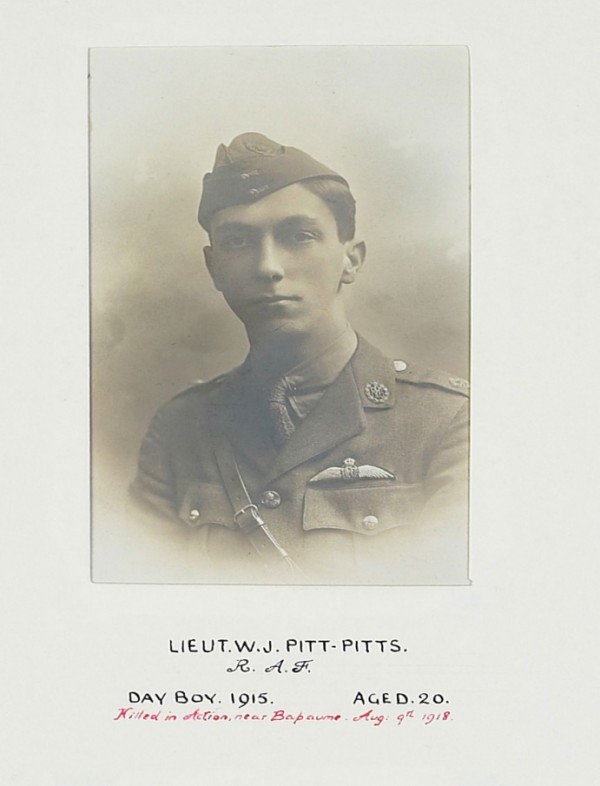
Lieutenant Walter James Pitt Pitts
57th Squadron, the Royal Flying Corps
Killed in Action
Date of Birth: 20 October 1898
Place of Birth: Mitcham, London
Date of Death: 9 August 1918 in France, aged 19
Buried: Bancourt British Cemetery. Remembered on Seafront Memorial and St. Michael’s Church, Teignmouth, Devon.
Lieutenant Walter John Pitt Pitts age 19.
Born 20 October 1898 at Mitcham, the youngest son of William, a music publisher, and Mary Pitt Pitts. In 1901 the family were living at Ticehurst, Sussex. From 1905-1909 he attended Tonbridge School. The 1911 census showed the family living in Tunbridge Wells. On 1918 absent voter’s list he was registered at Lyncroft, Ferndale Road, Teignmouth, which was his parents’ home.
On 15 January 1917 Walter enlisted in the Inns of Court Officers Training Corps and was gazetted temporary Lieutenant, General List, attached Royal Flying Corps on 20 April 1917. He was posted to 39th Reserve Squadron for training where he received his wings and was gazetted Flying Officer on 18 October 1917. Walter was later gazetted Lieutenant in the RAF in April 1918 and went to France in May where he was posted to 57th Squadron.
For the next three months he was engaged in bombing expeditions over German lines and was due to go home on leave when he was killed on 9 August 1918. Walter and his observer were sent on a photographing mission over Bapaume; they were posted missing when they did not return and the Germans later sent a message to say that they were both dead. In October the Red Cross were able to trace his burial and his grave was later found in the Bancourt British Cemetery. Remembered on Seafront Memorial and St. Michael’s Church, Teignmouth.
Grave Inscription reads: I will give a crown of life.
Walter had an older brother Edward Crewdson Pitt Pitts who died in October 1918 aged 26.
“LIEUT. WALTER JOHN PITT-PITTS 57TH SQUADRON R.A.F. PRESUMED KILLED IN AERIAL ACTION NEAR BAPAUME, AUGUST 9TH, 1918. AGED 19.
At the School 1913—15 (Day Boy). Lieut. W. J. Pitt-Pitts was the third son of Mr. and Mrs. William Edward Pitt-Pitts, of Lyncroft, Teignmouth, South Devon, and the younger brother of 2nd Lieut. E. C, Pitt-Pitts, 4thBattn. The Buffs (T.F.), who was killed in action near Brancourt, on October 17th, 1918.
Like his elder brother, he was previously at Rose Hill School, Tunbridge Wells. Joining the School in September, 1913, he had the misfortune to injure his thigh in 1915, and left that summer to continue his education under private tuition, as it was for long feared by the doctors that he had hip disease.
On January 15th, 1917, he joined the Inns of Court O.T.C. and was gazetted Temporary Lieutenant, General List, attd. R.F.C., April 20th, 1917, and posted to the 39th Reserve Squadron for training. He received his wings and was gazetted a Flying Officer, October 18th, 1917, and became a full Lieutenant in the R.A.F. in April, 1918. On going out to France in May, 1918, he was posted to the 57th Squadron, and for the next three months, flying a D.H. 4, was actively engaged, often twice daily, in bombing expeditions over the German lines and into Germany.
He had just written to announce his return on leave when he was killed on August 9th, 1918. On that day he was despatched with his observer, Lieut. H. S. Musgrove, to take photographs behind the German lines in the neighbourhood of Bapaume. They did not return, and were posted as " missing."
What happened may never be known, as no other machine accompanied them on this expedition. The Germans sent a message stating that they were both dead, and though subsequently Lieut. Musgrove was officially reported " wounded and a prisoner," all attempts to trace him have failed.
News was received in October, 1918, through the Red Cross, that Lieut. Pitt-Pitts had been buried at Bapaume, and his grave has since been found in the British Cemetery at Bancourt.
A brother Pilot, who had served with him in England and in the 57th Squadron at the front, wrote :— " Every one in the Squadron misses him, for his tall figure led every game, and his skill as a pilot was equal to his skill in games. . . . He was very popular with all the boys." The Recording Officer of the Squadron wrote:— " He is one of the fellows we can least afford to lose. He was thoroughly stout hearted and a good pilot."”
Biography written by Tonbridge School.
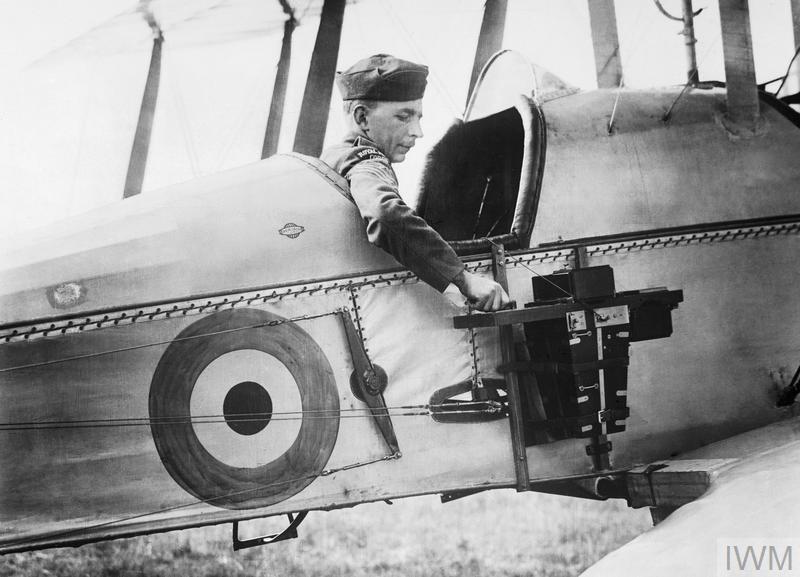 A sergeant of the Royal Flying Corps demonstrates an aerial reconnaissance camera 1916. © IWM (Q 33850)
