Private Harold Frederick Dommett
1st Royal Marine Battalion, Royal Marine Light Infantry
Killed in Action
Date of Birth: 8 March 1899
Place of Birth: Exeter, Devon
Date of Death: 25 August 1918 aged 19
Buried: Remembered on the Vis-en-Artois Memorial (MR 16) and the Stokeinteignhead War Memorial and St. Andrew's Church War Memorial
Awarded the General Service and Victory Medals
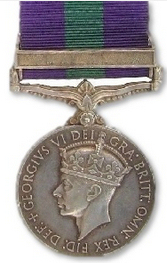 General Service Medal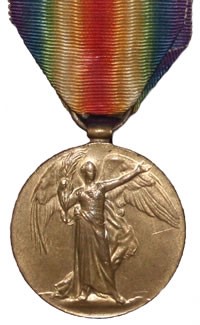
Private Harold Frederick Dommett was born in Exeter, Devon on the 8 March 1899.
Harold's father was Abraham Golesworthy Dommett who was born in Sidbury Devon, 6 October 1864. Abraham was the son of Mary Ann (a Lace Maker) and William (a Farm Labourer).
Harold's mother was Emily E.Dommett née Clark who was born in Lupitt, Devon (near Honiton), 11 December 1863. Emily was the daughter of Martha and William (an Agricultural Labourer).
In the 1901 census, Harold and his family are living at Shillingford, Exminster, St Thomas, Devon. His parents are both present and the census shows his father as 'Ordinary Agricultural Labourer' On Farm.
| Harold and his siblings | |
| Eva Jane Dommett 1887– |
Albert John Dommett 1889–1966 |
| Laura Dommett 1891– |
Gertrude Maud Dommett 1893– |
| Private Charles Abraham Dommett 1894–1971 Labour Corps attached Devonshire Regiment |
Ethel Emily Bathelor née Dommett 1896– |
| Private Harold Frederick Dommett 1899–1918 1st Royal Marine Battalion, RMLI |
Private John Albert Dommett 1899 -1917 8th Battalion, Devonshire Regiment |
| Florence Isabel Dommett 1902–1991 |
|
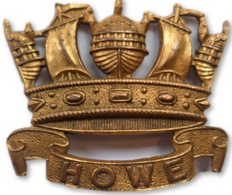 Drake Battalion cap badge
By 1911, the family have moved to Combeinteignhead, Teignmouth, Haccombe with Combe, Devon. Harold's younger brother Charles Dommett has become a Gamekeepers Assistant'.
Harold's older brother John Albert Dommett joined the 3rd Devonshire Reserves Regiment in 1909, at the outbreak of war in 1914 he was called up and served in France. He was killed in action at the Battle of Polygon Wood on 2 Ocotober 1917. He left a wife and three children.
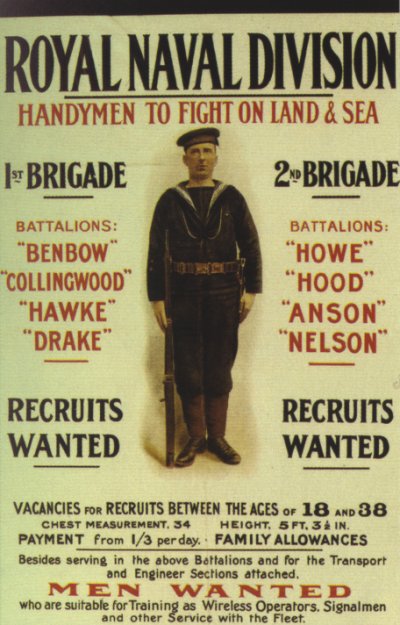 Royal Naval Division recruiting poster. Public domain
Harold joined the 1st Royal Marine Battalion, Royal Marine Light Infantry (service number PLY/2042/S) in March 1916. When he joined his trade was noted as 'Horseman'.
After a course of training Harold was drafted to the Western Front. He took part in numerous engagements of importance, including those of Beaumont Hamel, Arras, Ypres and the Retreat and Advance of 1918. He was killed in action on 25 August 1918 aged 19.
He is remembered on the Vis-en-Artois Memorial (MR 16), the Stokeinteignhead War Memorial and St. Andrew's Church War Memorial.
On the 10th December 1916 Harold's brother Charles Abraham Dommett enlisted as a Private with the 40th Labour Company attached to the Devonshire Regiment, his trade was also noted as 'Horseman' when he enlisted. Charles survived the war.
The Royal Marines
In WW1 there were two branches of marines in the Royal Navy, the Royal Marine Artillery and Royal Marine Light Infantry. Units of these forces manned some of the guns on large warships and at the shore-based batteries.
They also took part in other operations on land such as seeking out the enemy and securing ground in advance of the main force.
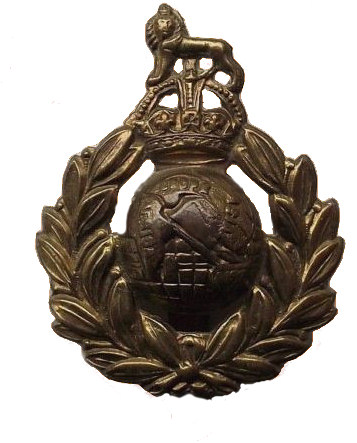 Royal Marines cap badge
Marine Battalions fought at Antwerp in 1914 and at Gallipoli in 1915.
So few men of the Royal Naval Division remained alive by the end of the Gallipoli campaign that it was transferred to the British Army. The Division then fought on the Western Front for the remainder of the war.
Some of the marines continued to serve afloat.
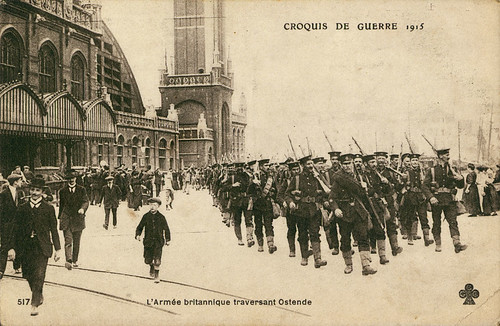 Royal Marine Light Infantry passing through Ostend, Belgium, 1915 (TWAM ref. 5770).
Many of the men had so far experienced the war as infantrymen, fighting with rifles and bayonents.
By 1916 the development of Artillery by both sides meant that few infantry reached the lines of the enemy. Infantry raids had become the exception rather than the rule.
Some of the marines' duties changed and they were intensively trained in new skills with new weapons.
The Royal Marine Light Infantry formed the 190th Machine Gun Company on May 31st 1916.
On the same day 593 of the marines afloat died in the Battle of Jutland.
By the end of the Battle of Gallipoli in 1916, there were few men left experience of serving at sea. The division was transferred to the British Army as the 63rd (Royal Naval) Division.
It then fought on the Western Front as an Army formation until the end of the war.
